

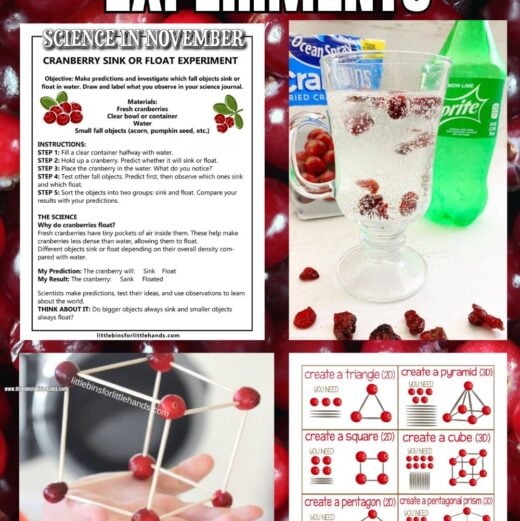
Grab a bag of fresh cranberries and try these easy cranberry science experiments for kids! From testing whether cranberries sink or float to exploring how heat changes their texture, you can investigate science in plenty of ways with this seasonal fruit.
These hands-on cranberry activities are perfect for fall science, Thanksgiving STEM, or a simple kitchen science lesson. Most use inexpensive materials and take just 10–20 minutes.
Easy Cranberry Science Activities
Best for: Preschool through grade 3, with extensions for grades 3–5. What kids explore: Buoyancy, physical changes, chemical reactions, observation, and engineering.
One bag of cranberries can provide several different science investigations! Start with a quick sink-or-float experiment, then choose another activity based on the science concept you want to explore.
Here are seven easy ways to use cranberries for science and STEM.
1. Cranberry Sink or Float Experiment
Will a cranberry sink or float in water? This simple experiment is a great introduction to making predictions, testing ideas, and recording observations.
You will need:
- Fresh cranberries
- A clear container of water
- A few other small objects to compare
- Paper and pencil
Try it: Ask kids to predict whether a cranberry will sink or float. Place it in the water and observe what happens.
Next, compare the cranberry with a grape, small stone, or another object. Do all fruits float?
The science: Fresh cranberries contain small pockets of air. These air pockets help make the whole cranberry less dense than water, allowing it to float.
Want to see the air pockets? Have an adult cut a cranberry in half and examine the inside.
Try this: Use our free printable recording sheet to predict, test, and record your results.
👉 Explore the cranberry sink or float experiment
2. Fresh vs. Cooked Cranberries Science Experiment
What happens to cranberries when you heat them? This is a simple way to explore how heat changes food properties.
You will need:
- Fresh cranberries
- Saucepan and water
- Two small bowls
- Spoon or other safe tools for pressing
Try it:
- Examine a fresh cranberry. What does it look and feel like?
- Gently press the cranberry with a spoon. How easily does it squash?
- Have an adult simmer several cranberries in water for a few minutes until they soften.
- Allow the cooked cranberries to cool completely.
- Compare the fresh and cooked cranberries. Which ones are easier to squash?
🔎 The science: Heating softens the cranberry as its plant tissues change. The firm fresh berry becomes softer and easier to break apart. Cooking creates changes that cooling can’t simply undo.
💡 Ask kids: How did the color, texture, shape, and firmness change? Can you make the cooked cranberry firm again just by cooling it?
3. Dancing Cranberry Experiment
Can you make dried cranberries rise and fall in a glass?
This fun Thanksgiving science experiment uses bubbles to make dried cranberries move through a liquid.
The science: Gas bubbles attach to the dried cranberries, helping lift them upward. When bubbles escape at the surface, the cranberries can sink again.
Kids can observe the movement and investigate how gases affect whether objects float or sink.
👉 Try the Dancing Cranberry Experiment

4. Cranberry Secret Messages
Did you know cranberry juice can help you explore acids and bases?
Use cranberry juice as a natural color indicator in this fun secret-message activity.
The science: Cranberries contain pigments called anthocyanins that can change color in response to pH. This makes cranberry juice useful for exploring acid-base chemistry.
👉 Make Cranberry Secret Messages

5. Fizzing Cranberry Experiment
Combine cranberry ingredients with a classic baking soda reaction for a fizzy Thanksgiving science activity.
The science: When baking soda reacts with an acid, carbon dioxide gas is produced. The escaping gas creates visible bubbles and fizz.
Kids can observe the reaction and discuss the difference between a chemical reaction and simply mixing materials.
👉 Try the Fizzing Cranberry Experiment

6. Cranberry Oobleck
Make a cranberry-themed version of our favorite oobleck sensory science activity!
Oobleck is a mixture of cornstarch and liquid that behaves differently depending on how much force is applied.
The science: Oobleck is a non-Newtonian fluid. It can feel firm when squeezed or pressed quickly but flow when handled slowly.
This activity combines sensory exploration with an introduction to material properties.

7. Cranberry STEM Structures
Turn fresh cranberries into an easy engineering challenge!
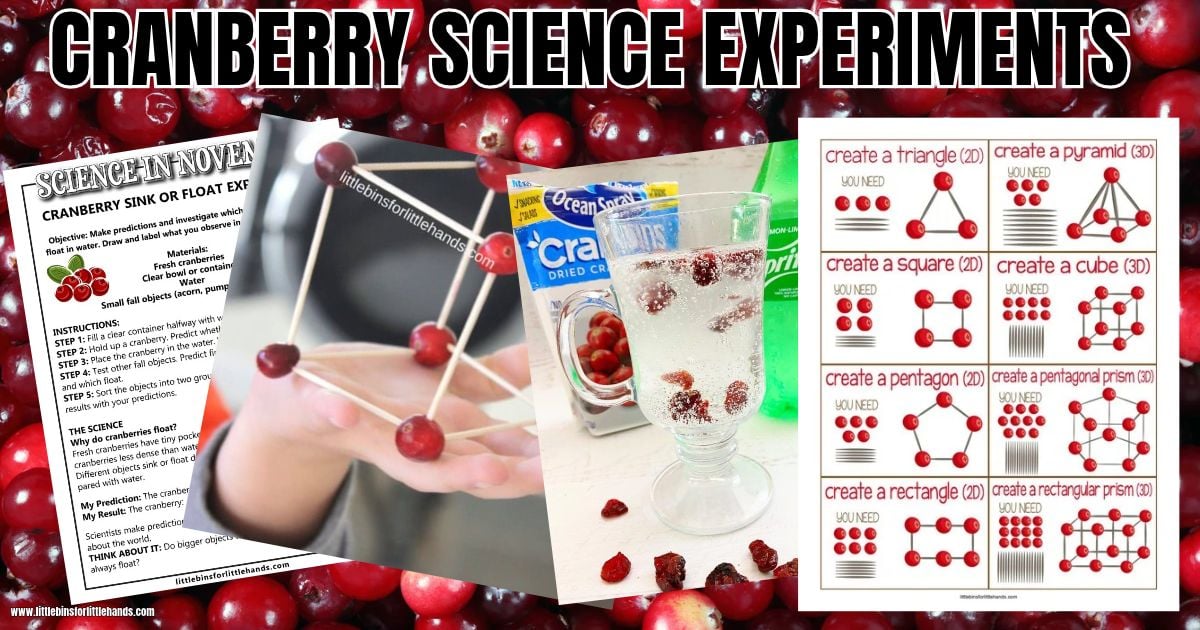
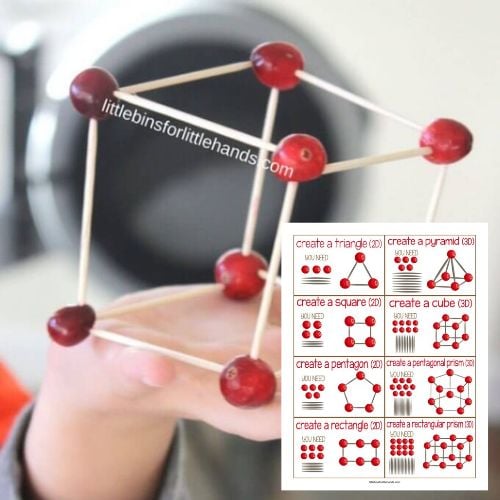
Use cranberries and toothpicks to build simple shapes, tall towers, or small structures.
The STEM challenge: Can you build a structure that stands on its own? What happens when you change the shape of the base?
Kids can investigate stability, balance, and three-dimensional shapes as they plan, build, test, and improve their designs.
👉 Build Cranberry STEM Structures
Cranberry Sensory Science for Preschoolers
For younger kids, a cranberry water bin is an easy way to encourage observation and hands-on exploration.
You will need:
- Fresh cranberries
- Shallow plastic bin
- Water
- Scoops, tongs, strainers, and basters
Add the cranberries and a small amount of water to the bin. Invite kids to scoop, transfer, sort, and investigate the floating berries.
Try asking a few simple questions:
- What happens when you push a cranberry under the water?
- Can you pick up a cranberry with tongs?
- How many cranberries fit in a scoop?
- Do all the cranberries look the same?
These simple observations encourage early science skills while children practice coordination and fine motor control.
Safety: Supervise young children closely. Whole cranberries can be a choking hazard, so this activity is not suitable for children who may put them in their mouths.

5-Day Cranberry Science Plan
Want to turn these activities into a short science unit? Try one investigation each day.
| Day | Activity | Science Focus |
|---|---|---|
| 1 | Cranberry Sink or Float | Buoyancy and predictions |
| 2 | Fresh vs. Cooked Cranberries | Changes caused by heating |
| 3 | Dancing Cranberries | Gas bubbles and floating |
| 4 | Cranberry Secret Messages | Acids, bases, and indicators |
| 5 | Cranberry Structures | Engineering and design |
💡 For younger students, substitute cranberry sensory play for one of the chemistry activities.
🔎 Encourage kids to make predictions, draw observations, and share what they discovered at the end of each investigation.
Cranberry Science Questions for Kids
Why do cranberries float? Fresh cranberries have pockets of air inside them that help the berries float in water.
Do cranberries grow underwater? No. Cranberries grow on low-growing vines. Some cranberry farms flood their fields during harvest so the floating berries can be collected.
Are cranberries good for science experiments? Yes! Fresh and dried cranberries can be used to investigate floating, changes caused by heating, chemical reactions, and engineering.
What can kids learn from cranberry science? Children can practice making predictions, observing changes, testing ideas, comparing results, and recording data.
Printable Thanksgiving STEM Activities
Want more ready-to-use Thanksgiving science and engineering activities?
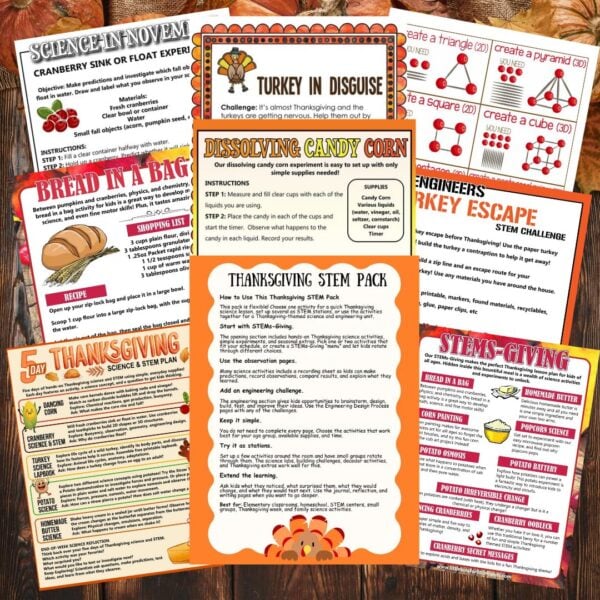
Our Thanksgiving STEM Activity Pack brings together hands-on investigations, engineering challenges, recording sheets, and seasonal STEM projects.
It’s a convenient way to add meaningful science activities to your November lesson plans without spending hours gathering ideas.
More Thanksgiving Science and STEM Activities
Looking for more fall learning ideas? Cranberries are just one of the many common foods and materials you can use for hands-on Thanksgiving activities.
Explore these collections:


Thanks, I’ll hit Costco and try again! 🙂
Cranberry-tastic!
I tried to do some sensory play with cranberries and they became smushy after about an hour. What am I doing wrong? Plus they stained the kids hands and clothing. 🙁
Hmm Maybe they weren’t fresh enough? We have had ours going for a few days now and they are fine. I left the bag in the fridge before we used them.