
Looking for fun rainbow STEM activities for kids? These printable STEM challenges encourage kids to design, build, experiment, and solve problems while exploring colorful rainbow themes.
Instead of following strict step-by-step instructions, STEM challenges invite kids to plan, build, test, and improve their ideas using the engineering design process.
These activities are perfect for:
• classroom STEM centers
• spring STEM themes
• St. Patrick’s Day activities
• homeschool science lessons
• hands-on learning at home
👉 Looking for rainbow science experiments too? Visit our Rainbow Science Experiments collection for colorful chemistry and physics activities.
Quick Pick: Rainbow STEM Activities
If you’re short on time, try one of these easy rainbow STEM activities.
• Rainbow Bridge STEM Challenge – Design and test a bridge to see how much weight it can hold.
• LEGO Rainbow Challenge – Build a colorful rainbow using LEGO bricks while exploring symmetry and structure.
• Rainbow Secret Code Activity – Decode a rainbow image while learning screen-free computer science with algorithms.
• Rainbow Binary Code Activity – Explore simple computer science with binary code.
• Rainbow Playdough Math Mat – Explore numbers, counting, and color sorting with hands-on playdough math.
What Are STEM Challenges?
STEM challenges are open-ended activities that encourage kids to use science, technology, engineering, and math to solve problems.
Kids are given a challenge and materials, then asked to design their own solution.
Most STEM challenges follow the engineering design process:
- Ask a question or identify a problem
- Plan a design
- Build the design
- Test the design
- Improve the design
This process helps kids develop critical thinking, creativity, and problem-solving skills.
👉 Learn more about the engineering design process.
Free Printable Rainbow STEM Challenge Cards
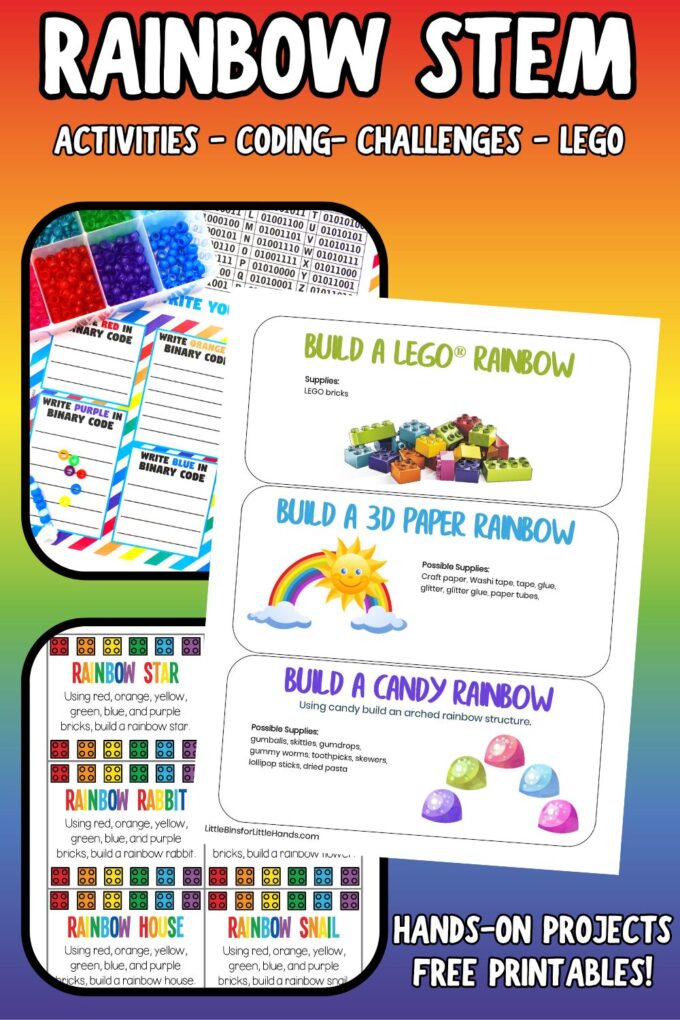
Make STEM time simple with our free printable Rainbow STEM challenge cards.
These cards provide fun prompts that encourage kids to design and build creative solutions.
Examples of the printable challenges include:
• Build a rainbow bridge
• Build a rainbow tower
• Build a rainbow boat
• Crack a secret rainbow code
These printable challenges work well for:
• classroom STEM stations
• early finishers
• small group activities
• homeschool learning
👉 Download the Rainbow STEM Guide and Challenge Cards to get started.
Featured Rainbow STEM Activities
These hands-on rainbow activities explore different parts of STEM including engineering, technology, and math.
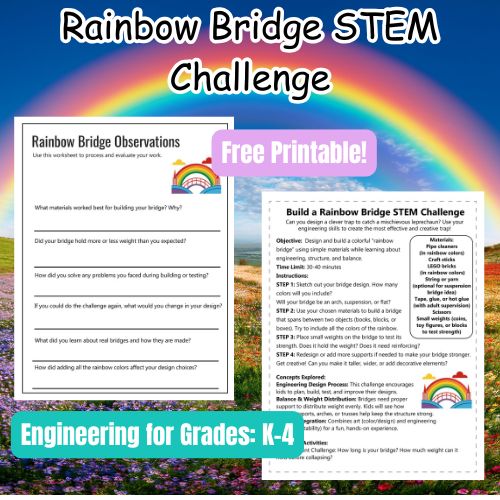
Rainbow Bridge STEM Challenge (Engineering)
Design and build a colorful bridge using materials like craft sticks, pipe cleaners, paper, or LEGO bricks. Then test how much weight the bridge can hold.
Kids explore concepts such as:
• structural engineering
• weight distribution
• bridge supports
• the engineering design process
👉 Try the Rainbow Bridge STEM Challenge.
LEGO Rainbow Challenge (Engineering)
Use LEGO bricks to design and build a rainbow structure. Kids can experiment with symmetry, patterns, and creative building techniques.
This challenge encourages:
• spatial reasoning
• design thinking
• engineering creativity
👉 Try the LEGO Rainbow Challenge.

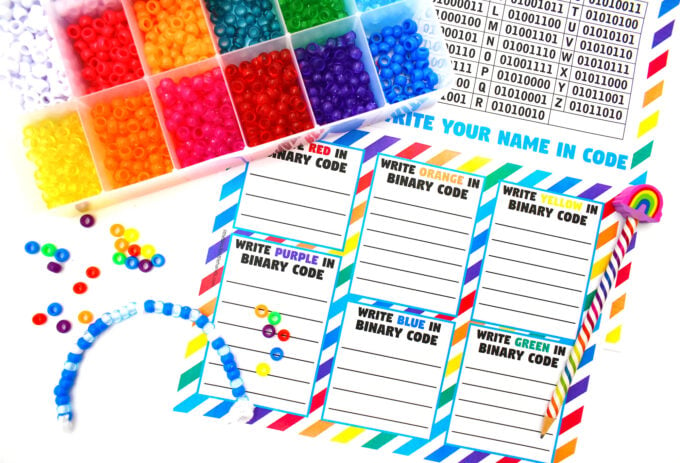
Rainbow Binary Code
Introduce kids to computer science with a rainbow binary code activity.
Binary code uses only two numbers — 0 and 1 — to represent letters and information inside computers.
Kids can use rainbow colors to represent binary digits and decode simple messages.
This activity introduces:
• basic coding concepts
• logic and sequencing
• computer science thinking
👉 Get the free Rainbow Binary Code activity pack here
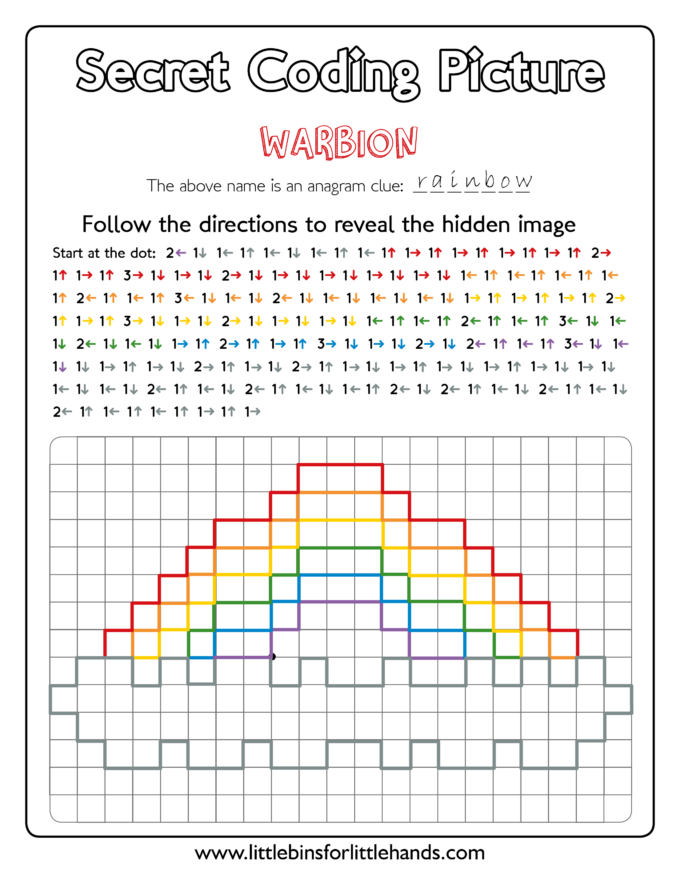
Rainbow Secret Coding Algorithm Activity (Technology)
Introduce kids to basic computer science concepts with a Rainbow Secret Coding Algorithm activity.
An algorithm is a set of instructions that tells a computer or person how to complete a task step by step. Computers rely on algorithms to solve problems, follow commands, and run programs.
In this rainbow activity, kids follow a sequence of instructions to reveal a hidden rainbow pattern or message.
This activity introduces:
• algorithms and step-by-step instructions
• coding logic
• sequencing and problem solving
Kids will learn that coding is really just giving clear instructions in the correct order.
👉 Try the Rainbow Secret Coding Algorithm Activity.
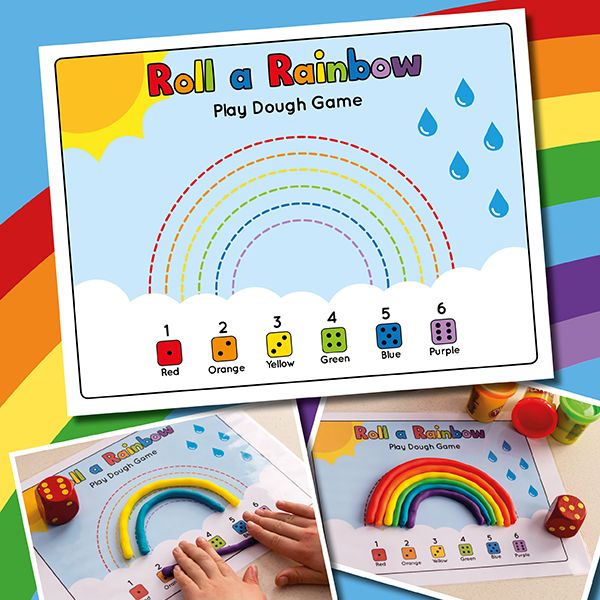
Rainbow Math Playdough Mat (Math)
Use playdough and a printable rainbow mat to explore early math skills.
Kids can practice:
• counting objects
• number recognition
• color sorting
• fine motor skills
👉 Try the Roll a Rainbow early math game with an easy foam dough recipe
How To Set Up Rainbow STEM Challenges
You don’t need expensive supplies to run STEM challenges. Many of the best materials come from everyday recycling items.
Try creating a STEM materials bin filled with building supplies.
Save items such as:
• paper towel tubes
• toilet paper tubes
• cereal boxes
• cardboard scraps
• plastic bottles
• packing materials
You can also add simple craft supplies like:
• craft sticks
• pipe cleaners
• pom poms
• colored tape
• scissors and glue
• markers and pencils
Encourage kids to experiment with different materials to see which designs work best.
Teacher Tips for Rainbow STEM Centers
Rainbow STEM activities work well as classroom STEM centers or small group challenges.
Helpful tips:
- • Give kids 20–30 minutes to complete a challenge.
- • Encourage students to draw their design first before building.
- • Ask questions like How could you make your design stronger?
- • Allow time for kids to redesign and improve their builds.
💡 STEM challenges help build creativity, collaboration, and problem-solving skills.
Extend the Activity
You can extend these rainbow STEM challenges by adding measurement or data collection.
Try:
• counting how many coins a bridge can hold
• measuring tower height
• timing how long a challenge takes
• graphing results from dice games
These extensions introduce additional math and scientific thinking.

Rainbow Printable Project Pack
If you love rainbow activities, our Rainbow Projects Pack includes a variety of printable STEM, science, and art activities designed for year-round learning.
These projects are perfect for:
• classrooms
• homeschool groups
• creative learning at home