
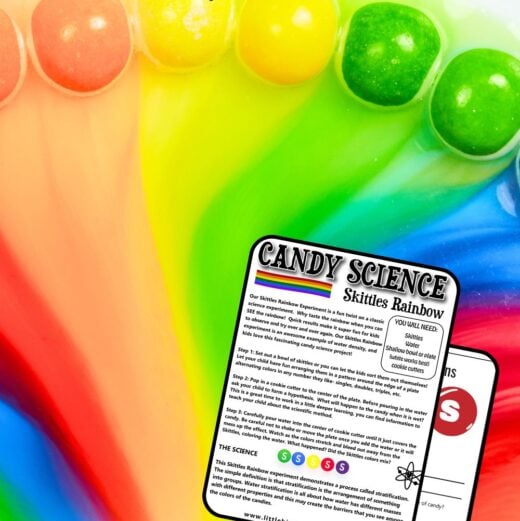
Looking for a colorful and easy science project? The Skittles science experiment is a classic, simple, and mesmerizing activity that kids love. Watch as rainbow colors swirl and blend in water while learning about solubility, diffusion, and density. This fun Skittles experiment works perfectly for classrooms, science fairs, or a quick afternoon science activity at home!

Skittles Experiment
Field of Science: Chemistry
Grade Level: Kindergarten – 5th Grade
Concepts Explored: Solubility, Diffusion, Density, Observation
When Skittles are placed in water, their outer sugar coating and food coloring begin to dissolve. This happens because the colored sugar is soluble, meaning it dissolves in water. As the color spreads, you can see how diffusion works—particles move from an area of higher concentration (around the candy) to a lower concentration (the rest of the water).
💡 Because the colored water around each Skittle has a slightly different density, the colors stay in separate bands before they mix completely. This creates the beautiful rainbow Skittles effect you see in the dish!
Supplies Needed
- A bag of Skittles candy
- Water (try cold, room temperature, and warm water)
- White plate or dish
- Optional: timer, measuring cup, notebook for observations
- Free science journal pages below
How to Do the Skittles Experiment
🎥 Watch the video:
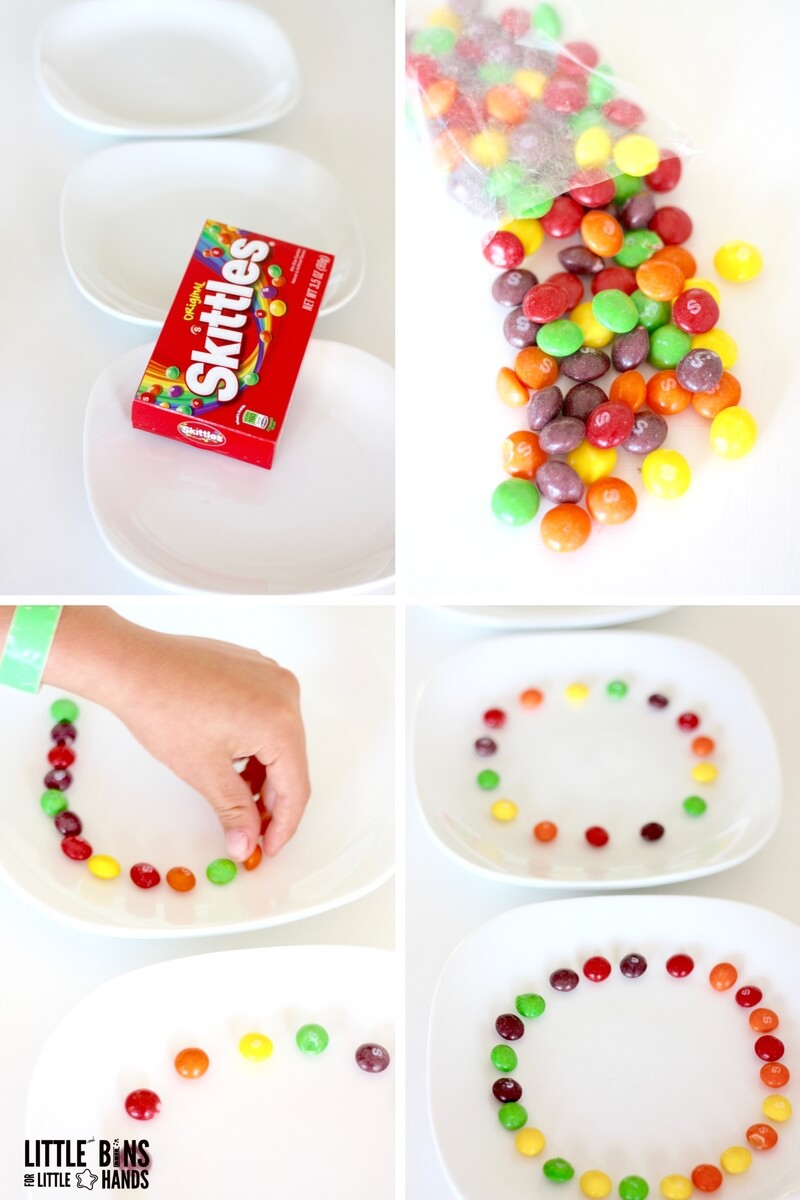
Step 1: Place your Skittles in a circle around the edge of a white plate. Try making a pattern or rainbow order.
Step 2: Slowly pour warm water into the middle of the plate—just enough to touch all the Skittles but not cover them completely.
Step 3: Watch as the Skittles colors dissolve and spread toward the center. This happens fast, so observe closely!
Step 4: Discuss what you see. What happens if you use cold water instead? Or different patterns of colors?

Make It a Science Project
Turn this simple Skittles science experiment into a science fair project by testing variables!
Here are a few ideas:
- Does water temperature change how fast the Skittles dissolve?
- How does the type of liquid (vinegar, milk, soda) affect the pattern?
- Does arranging colors differently change the results?
- Compare Skittles vs. M&Ms in the same setup.
Encourage kids to form a hypothesis, record their results, and share their conclusions
🔎 Add the scientific method (explained here)! Encourage students to make predictions, collect observations, and record results using a data sheet or printable worksheet.
Skittles Experiment Science Information
The Skittles water experiment is a great way to visualize the process of diffusion—the natural spreading of particles through a liquid.
Here’s what’s happening:
- The sugar and dye coating dissolve first, forming concentrated colored water around each Skittle.
- Because the water near each Skittle is slightly denser, the colors don’t mix immediately.
- Over time, diffusion and gentle currents (called convection) blend the colors together.
💡 Fun Fact: You can even use Skittles to show stratification, or how different densities of liquids create layers!
| NGSS Question | Concept Focus |
|---|---|
| What happens when Skittles are placed in water? | The sugar and food coloring coating dissolves, showing that solids can dissolve in liquids. |
| Why do the colors spread out in the water? | As the dyes dissolve, they move from areas of high concentration to low concentration, demonstrating diffusion. |
| Why don’t the colors mix right away? | Differences in density around each Skittle create boundaries that slow down color mixing. |
| How does water temperature affect the Skittles experiment? | Warm water speeds up dissolving because heat increases molecular motion and reaction rate. |
| What happens if you try different liquids like milk or vinegar? | Different liquids dissolve sugar at different rates, showing how material properties affect solubility. |
| Could this experiment work with other candies like M&Ms? | Yes, but results vary since different coatings and dyes dissolve differently, highlighting material differences. |
| How does this experiment teach the scientific method? | Students make predictions, test variables, record results, and observe changes—core science process skills. |
Fun Skittles Science Variations
Try these themed versions of the Skittles rainbow experiment throughout the year!
- Valentine’s Heart Skittles – Use heart-shaped cookie cutters.
- St. Patrick’s Day Rainbow Skittles – Arrange in a rainbow arch.
- 4th of July Skittles – Red, white, and blue pattern.
- Pumpkin Skittles Experiment – Use orange and green candies.
- Christmas Skittles Project – Red and green circle pattern.
- Skittles Color Wheel – Create a full rainbow for art and science!
Printable Science Packs for Kids
Visit our SHOP for easy-to-print STEM and science lesson plans for the whole year. Or join us in the Little Bins Club.
More Fun Science Experiments


This was a very cool experament
Great ideas! Thanks!