
Our pumpkin Skittles science project is a fun twist on the classic experiment. You will love how easy it is to set up and try with kids of all ages! Quick results make it super fun for kids to observe, and then try over and over again. Hands on science experiments make everyday learning and lesson planning easy!

Pumpkin Skittles Experiment
You will want to set this up someplace where it won’t be bumped into but where you can easily watch the process unfold. Add this to your STEAM lessons for quick pumpkin science.
💡 Also, we made our own Skittles paint for a fun pumpkin art activity! Mix science and art!
Supplies:
- Orange and Green Skittles Candy
- Water
- Plastic Plates or other dish (flat bottom is best)
Instructions:
👉 View the classic Skittles experiment here with a rainbow of colors.
STEP 1. Set out a bowl of Skittles or let the kids sort them out themselves.
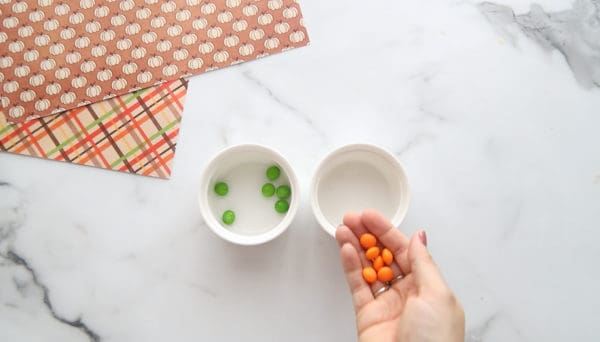
STEP 2. Arrange the orange skittles around the plate in the shape of a pumpkin. Add green Skittles on top for a stem.


STEP 3. Before pouring in the water, ask your child to form a prediction. What will happen to the candy when it is wet? This is a great time to work in a little deeper learning. You can find information to teach your child about the scientific method here.
STEP 4. Carefully pour water into the plate or dish until it covers the candy. Do not shake or move the plate once you add the water, as this will mess up the effect.

STEP 5. Watch as the colors stretch and bleed out away from the Skittles, coloring the water. What happened? Did they mix? What if you used clear soda instead would that change the outcome?

Why Don’t The Skittles Colors Mix?
The Skittles experiment involves placing Skittles in a shallow dish of water and observing how the colors from the candy dissolve and spread in the water.
When Skittles are placed in water, the outer sugar coating and food coloring begin to dissolve due to the water’s solubility. This process is driven by diffusion, where the dissolved dye molecules move from an area of higher concentration around the Skittle to an area of lower concentration in the surrounding water.
Water molecules are cohesive, meaning they tend to stick together, which contributes to surface tension. The initial dissolving creates a high concentration of sugar and color immediately around the candy, which can cause slight differences in the density of the water in that area.
These differences in density can create a barrier that slows down the mixing process. As a result, the colors remain separate for a short period until diffusion and convection currents eventually cause them to mix.
Free Printable Pumpkin STEM Activities Guide!
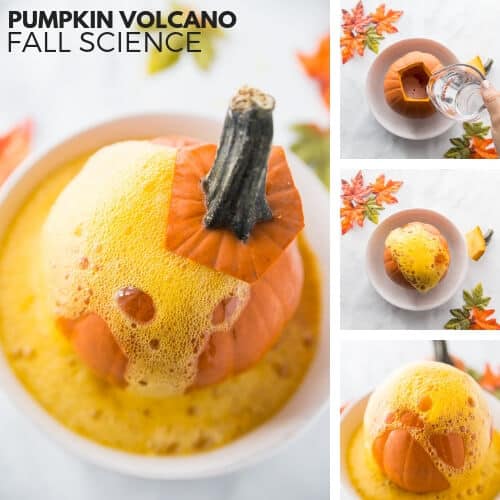
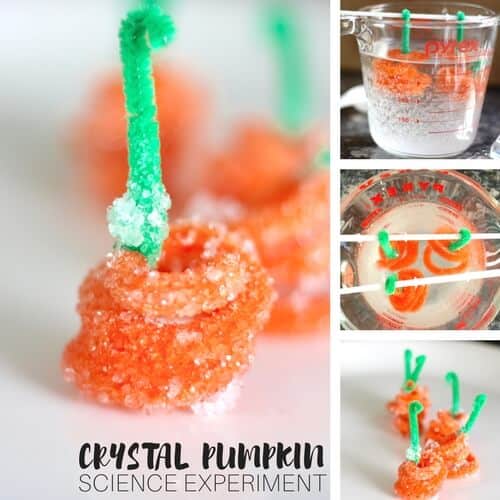
More Fun Pumpkin Science Experiments To Try

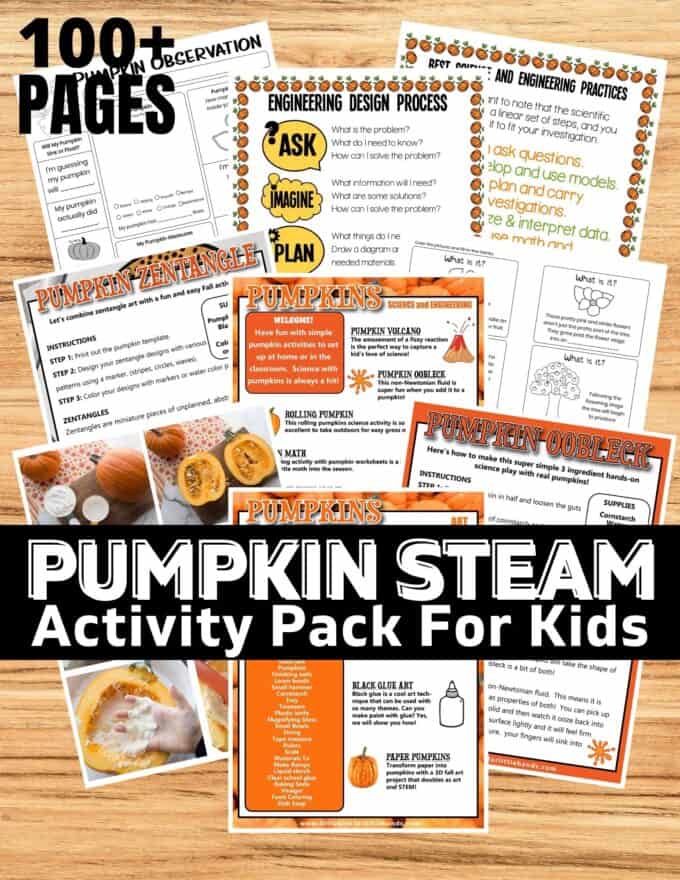
Printable Pumpkin STEM Pack
Perfect for K-2/3rd Grade and homeschool! Many activities can be modified for preschool and older kiddos as well.
Pumpkin is a festive and classic theme for fall, and this pack is perfect for exploring pumpkins with a non-Halloween theme! It includes science, STEM, engineering, early math, and art projects.
The kids will have a blast trying 100+ pages of “totally doable” projects! Read more here.