
Science and candy all in one perfectly simple science activity for kiddos to try this season. Our M&Ms Experiment is a fun twist on a classic science experiment. Taste and see this yummy rainbow! Quick results make it super fun for kids to observe and try over and over again.
M&M Science Experiment
Of course, you need to try out an M&Ms science experiment for easy candy experiments! Do you remember our original Skittles Experiment? I thought it would be fun to give this a try with the candy that melts in your mouth and not in your hands!
Recommended Grade Level: 1st-4th Grades
💡TIP: Set this experiment up where it won’t be bumped but where you can easily watch the process unfold!
Supplies:
- M&Ms Candy in rainbow colors
- Water
- White Plates or Baking Dishes (flat bottom is best)
Instructions:
STEP 1: Set out a bowl of M&Ms and you can let the kids sort them out themselves into the colors you want!
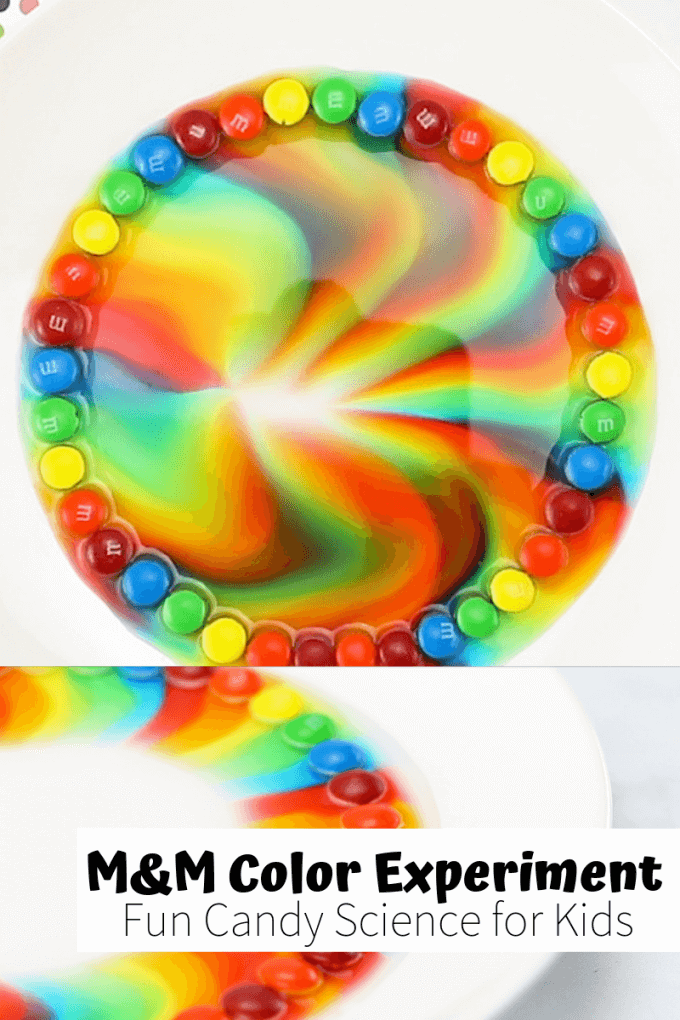
Let your child have fun arranging them in a pattern around the edge of a plate alternating colors in any number they like- singles, doubles, triples, etc…
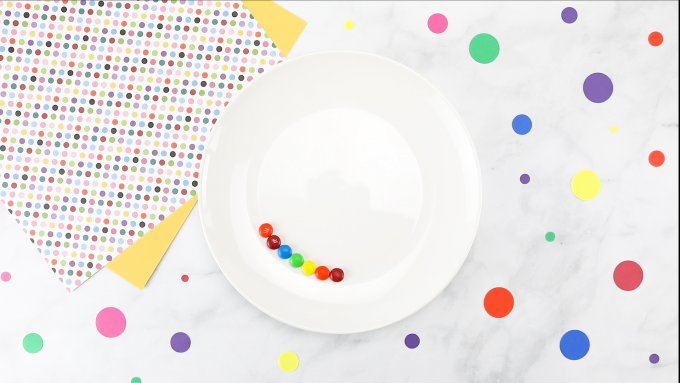
Before pouring in the water ask your child to form a hypothesis. What do you think will happen to the candy after it gets wet?
This is a great time to work in a little deeper learning, you can find more information to teach your child about the scientific method here.
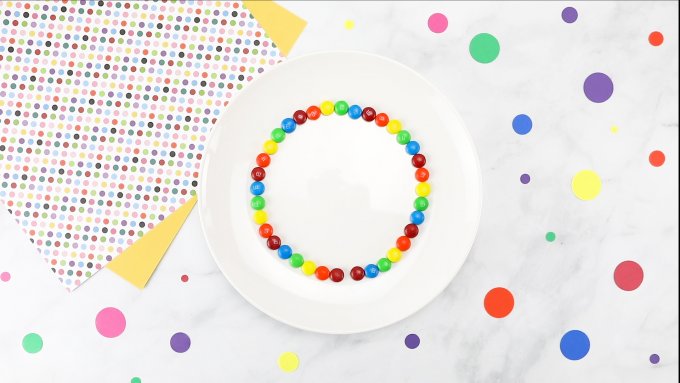
STEP 2: Carefully pour water into the center of the plate until it just covers the candy. Be careful not to shake or move the plate once you add the water or it will mess up the effect.
Watch as the colors stretch and bleed out away from the M&Ms, coloring the water. What happened? Did the M&M colors mix?
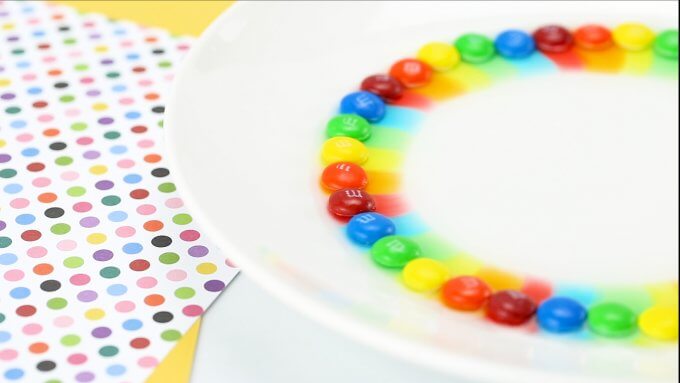
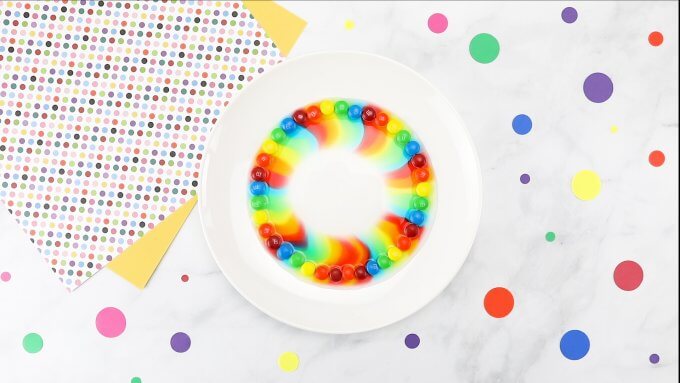
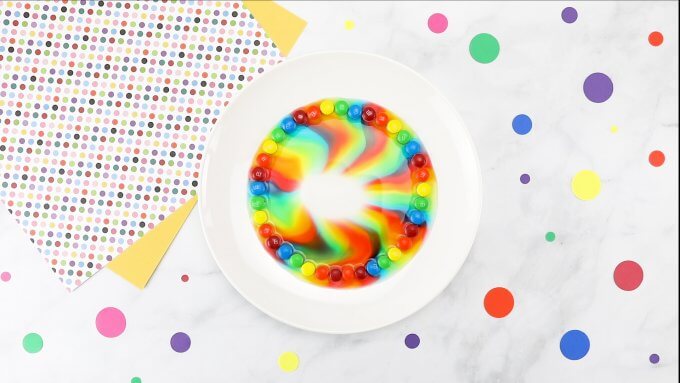
Note: After a while, the colors will begin to bleed together.
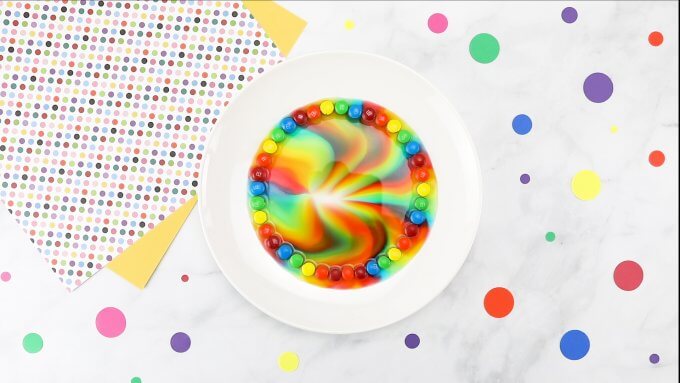
Why Don’t The Colors Mix?
When you place M&Ms in water, you might notice that the colors don’t mix immediately and instead create distinct, separate regions of color around each candy. This is because of a combination of factors involving the properties of the candy coating, the diffusion process, and the behavior of water molecules.
1. Solubility of the Coating
The candy coating of M&Ms is made from sugar and food coloring, both of which are water-soluble. When M&Ms are placed in water, the sugar and coloring start to dissolve.
2. Diffusion Process
Diffusion is the movement of molecules from an area of higher concentration to an area of lower concentration. Initially, the concentration of the dissolved color around each M&M is high, so the molecules will begin to spread out into the water.
However, diffusion is a gradual process. In the early stages, the food coloring hasn’t had enough time to spread far from the candy.
3. Water’s Surface Tension and Density Differences
Water molecules are cohesive, meaning they tend to stick together, which contributes to surface tension. The initial dissolving creates a high concentration of sugar and color immediately around the M&M, which can cause slight differences in the density of the water in that area.
These differences in density can create a barrier that slows down the mixing process. As a result, the colors remain separate for a short period until diffusion and convection currents eventually cause them to mix.
4. Temperature and Movement
If the water is still, the colors will take longer to mix because there is less movement to help distribute the color molecules. Warmer water and stirring can accelerate the mixing process by increasing molecular motion and breaking down any density barriers more quickly.
M&M Experiment Variations
You can easily turn this into an experiment by changing some variables and observing their effects on how the M&M colors dissolve and mix in water. Here are some potential variables you can change: Learn more about variables in science.
- Temperature of the water: cold, room temperature, warm, and hot
- Type of liquid: distilled water, tap water, saltwater, vinegar, and milk
- Agitation: Compare still water to trials where the water is gently stirred or shaken.
- Number of M&Ms
- Color of M&Ms
- Detergent: Add a few drops of dish soap or another detergent to the water.
Click here to get your FREE Science Challenge Calendar
More Fun Science Experiments To Try
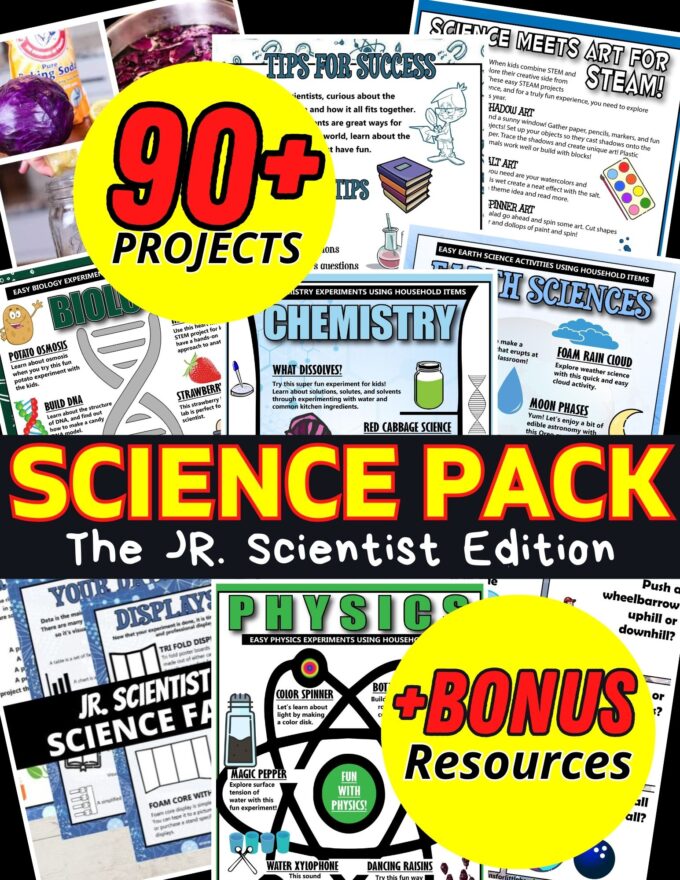
Printable Science Projects Pack For Kids
If you’re looking to grab all of our printable science projects in one convenient place, plus exclusive worksheets and bonuses like a STEAM Project pack, our Science Project Pack is what you need! Over 300+ Pages!
- 90+ classic science activities with journal pages, supply lists, set up and process, and science information. NEW! Activity-specific observation pages!
- Best science practices posters and our original science method process folders for extra alternatives!
- Be a Collector activities pack introduces kids to the world of making collections through the eyes of a scientist. What will they collect first?
- Know the Words Science vocabulary pack includes flashcards, crosswords, and word searches that illuminate keywords in the experiments!
- My science journal writing prompts explore what it means to be a scientist!!
- Bonus STEAM Project Pack: Art meets science with doable projects!
- Bonus Quick Grab Packs for Biology, Earth Science, Chemistry, and Physics