
The scientific method for kids is a simple way to explore questions and learn from real results. If you teach elementary or middle school, these steps help students practice observation, critical thinking, and problem-solving without needing fancy supplies or complicated lab setups.
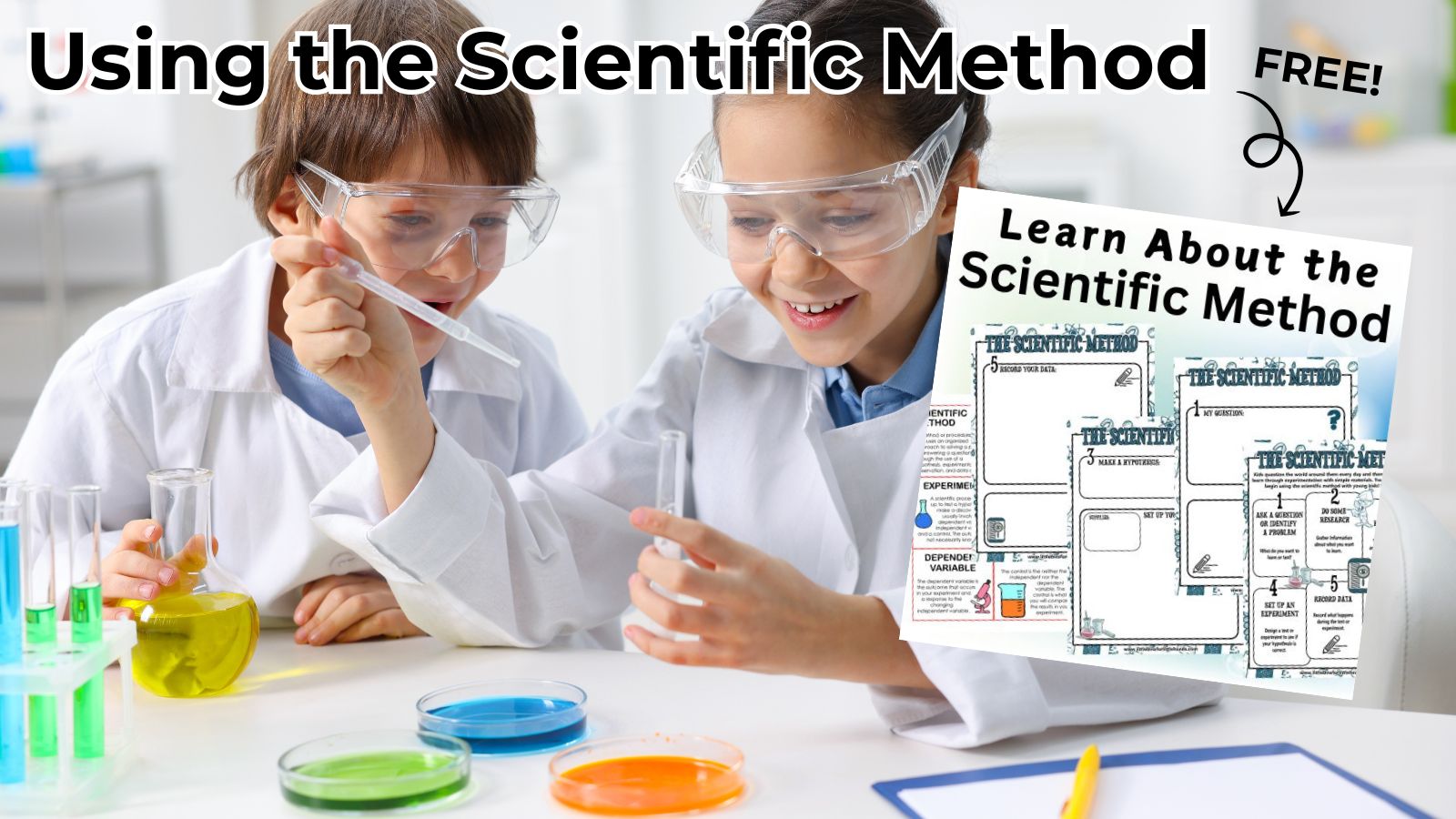
In this guide you’ll find:
- the steps of the scientific method in order
- kid-friendly examples for each step
- simple, classroom-friendly scientific method experiments students can use to practice the process
Grades: K–8 (best fit: grades 1–6)
This page teaches the process scientists use to test ideas. For hands-on activities organized by topic, visit our main science experiments hub.
What Is the Scientific Method?
The scientific method is a repeatable process students can use to ask a question, test an idea, and explain what happened using evidence. It isn’t about “getting the right answer.” It’s about learning how to think, test, and improve an idea based on results.
Teachers can use the scientific method for:
- quick investigations (10–20 minutes)
- longer experiments (over a few days)
- science fair projects
- engineering challenges that include testing and improving a design
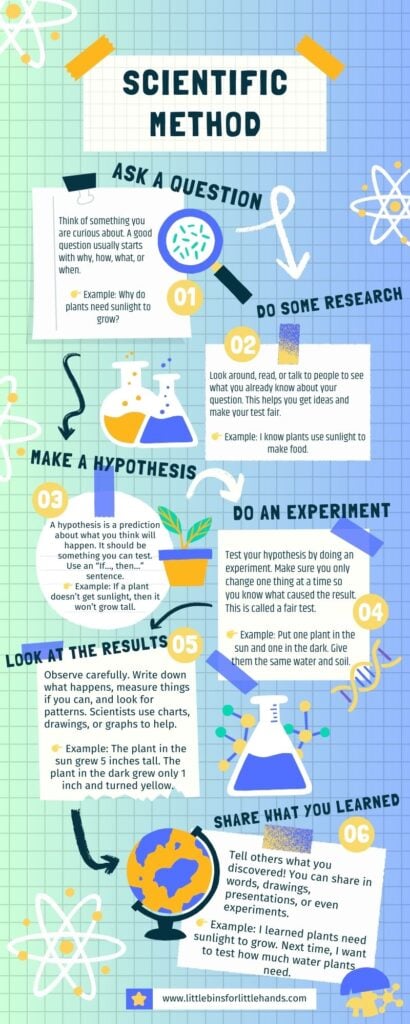
Steps of the Scientific Method (In Order)
Different classrooms use slightly different wording, but the core process is the same. Here are the 6 steps of the scientific method in a kid-friendly way.
Step 1: Make Observations
Students use their senses and simple tools to notice details.
Example observation: “This ice cube melted faster on the metal tray than on the plate.”
Teaching tip: Encourage students to add measurements when possible (time, temperature, length, number of drops, etc.).
👉 Discover more about using observations in science with kids
Step 2: Ask a Question
Turn the observation into a question students can test.
Example question: “Which surface makes ice melt the fastest?”
Teaching tip: Help students make questions specific with prompts like:
- “What would happen if…?”
- “Which one works best…?”
- “Does changing ___ change ___?”
Step 3: Form a Hypothesis
A hypothesis is a testable prediction based on what students already know or notice.
Example hypothesis: “I think ice will melt fastest on metal because metal conducts heat better.”
Teaching tip: Use a simple sentence starter:
- “I think ___ will happen because ___.”
👉 Explore writing a hypothesis with kids
Step 4: Test With an Experiment
Students run a test where they change one thing (a variable) and measure what happens.
Example experiment: Put equal-size ice cubes on different surfaces and time how long each takes to melt.
Key vocabulary (simple):
- Independent variable: the one thing you change
- Dependent variable: what you measure
- Controlled variables: what you keep the same
Teaching tip: Younger students can still do “fair tests” by using the same cup size, same amount of water, same distance, same time, etc.
👉 Learn more about variables in science
Step 5: Record Results and Draw Conclusions
Students record what happened, then explain what the results mean.
Ways to record results:
- a simple table (time / distance / number of drops)
- a bar graph
- labeled drawings
- a science notebook page
Conclusion prompt:
- “The results show…”
- “My hypothesis was supported / not supported because…”
- “Next time I would change…”
Step 6: Communicate Results
Students share what they did and what they learned.
Easy ways to communicate:
- a short oral share
- a “mini poster” (question, hypothesis, results)
- a science journal page
- a quick science fair-style board (for older kids)
Helping Kids Get Started (Without Jumping Into Big Experiments)
Knowing the steps is only half the battle. Many kids get stuck on: “What should I test?” Before launching longer experiments, start with short investigation starters that build the skills behind the scientific method:
- noticing changes
- making a prediction
- measuring results
- comparing two choices
These quick investigations work especially well for K–3, and they set students up for success with longer experiments later.
Try this: Choose one variable students can change and one thing they can measure. Keep everything else the same.
Choose a Science Topic to Investigate
Now that students understand how scientists test ideas, they need something real to investigate.
The scientific method works in every area of science — not just one experiment.
Try applying the steps to a specific topic:
Physical Science
Practice testing forces, motion, energy, and materials
👉 Explore physics experiments for kids
Chemistry
Observe reactions, mixtures, and changes in matter
👉 Try chemistry experiments for kids
Earth Science
Investigate weather, water, and the natural world
👉 Explore earth science activities
Biology
Study plants, animals, and living systems
👉 Discover biology experiments for kids
Students learn the scientific method faster when they repeat the process across different types of investigations.
Scientific Method Examples and Experiments (Classroom-Friendly)
Below are scientific method experiments that clearly match the steps above. Each one includes a testable question, what to change, and what to measure—so this section supports keywords like scientific method example, scientific method examples, and scientific experiment.


1) Sink or Float Investigation
Question: Which objects sink and which float?
Change: The object you test
Measure/Record: Sink/float + notes about shape/material
Great for: K–3 inquiry, sorting, and early data tables
2) Paper Towel Absorbency Test
Question: Which paper towel absorbs the most water?
Change: Brand/type of paper towel
Measure/Record: Amount of water absorbed (spoons, mL, or “drops”)
Tip: Keep sheet size the same for a fair test.
3) Ice Melt Test (Simple Variables Practice)
Question: What makes ice melt faster?
Change (choose one): surface type or location (sun/shade) or salt/no salt
Measure/Record: Time to melt (timer)
Why it’s great: Super clear independent/dependent variables.
4) Apple Browning Experiment
Question: What keeps apples from turning brown?
Change: What you coat the apple with (water, lemon juice, etc.)
Measure/Record: Browning level over time (photo scale or rating 1–5)
Classroom note: If you want to avoid “food,” skip this one and swap in the “rusting” version below.
No-food swap: Rusting Test
Question: Which liquid causes a nail to rust fastest?
Change: liquid type (water, saltwater, vinegar)
Measure/Record: rust level each day (rating scale)
5) Magic Milk (Best for Upper Elementary)
Question: How does soap affect the movement of food coloring in milk?
Change: soap amount (one drop vs two drops)
Measure/Record: how far colors spread / how fast movement happens
Note: This is more of a demonstration-style investigation unless you measure one variable.
6) Viscosity Race (Liquids vs Speed)
Question: Which liquid lets an object move the fastest?
Change: liquid type (water, oil, syrup—whatever fits your classroom)
Measure/Record: time for a marble to travel down a ramp or through a cup
Tip: Use the same ramp angle and same marble.
7) Color and Heat Absorption
Question: Do darker colors warm up faster than lighter colors?
Change: paper color
Measure/Record: temperature change after a set time under a lamp/sun
Tip: Keep distance from the heat source the same.
8) Balloon Rocket (Newton’s Laws in Action)
Question: What makes a balloon rocket travel farther?
Change (choose one): balloon size or straw type or string length
Measure/Record: distance traveled
Tip: Pick one variable—kids love changing everything, but that makes results messy.
9) Baking Soda + Vinegar Gas Test (Older Grades)
Question: How does the amount of baking soda affect gas production?
Change: baking soda amount
Measure/Record: balloon size (circumference with string)
Tip: Use the same bottle, vinegar amount, and balloon type.
10) Plant Growth Investigation (Longer Experiment)
Question: How does sunlight affect plant growth?
Change: light amount or location
Measure/Record: height each day + leaf count
Why it fits: Great example of a longer scientific method experiment with ongoing data.
11) Paper Airplane Test (Fast + Repeatable)
Question: Which paper airplane design flies the farthest?
Change: airplane design (choose 2–3)
Measure/Record: flight distance (best of 3 trials)
Tip: This is perfect for teaching “repeat trials.”
Free Resources for Teaching the Scientific Method
Want students to actually record observations and results (without you making a worksheet from scratch)?
Include:
- a simple scientific method worksheet
- experiment recording pages (question, hypothesis, variables, results)
- science journal pages for drawing + data
Grab your free scientific method worksheets!
Why Teach the Scientific Method?
Teaching the scientific method helps students learn how to:
- ask better questions
- test ideas fairly
- collect evidence
- explain results clearly
- build confidence with science
It also supports inquiry-based learning and fits naturally with NGSS-style skill building (planning investigations, analyzing data, and communicating explanations).
👉 When students are ready for more hands-on investigations, explore your Science Experiments & Activities hub for easy ideas by topic and age. (link your preferred hub again only if it makes sense—otherwise keep it once near the top)
FAQ Section
What are the 6 steps of the scientific method?
Observation, question, hypothesis, experiment, results, and conclusion. Students test ideas and explain evidence.
What is the first step of the scientific method?
Making observations. Students notice patterns, changes, or problems before asking a question.
What is a hypothesis in science for kids?
A hypothesis is a testable prediction based on what you think will happen and why.
What is a scientific method example?
Testing which paper towel absorbs the most water by measuring how much each brand holds.
Why do students use the scientific method?
It helps them solve problems, test ideas fairly, and explain results using evidence instead of guessing.
What grade level teaches the scientific method?
The scientific method is introduced in early elementary and becomes more detailed through middle school.
Is the scientific method only for experiments?
No. It can also be used for engineering challenges, observations, and investigations.
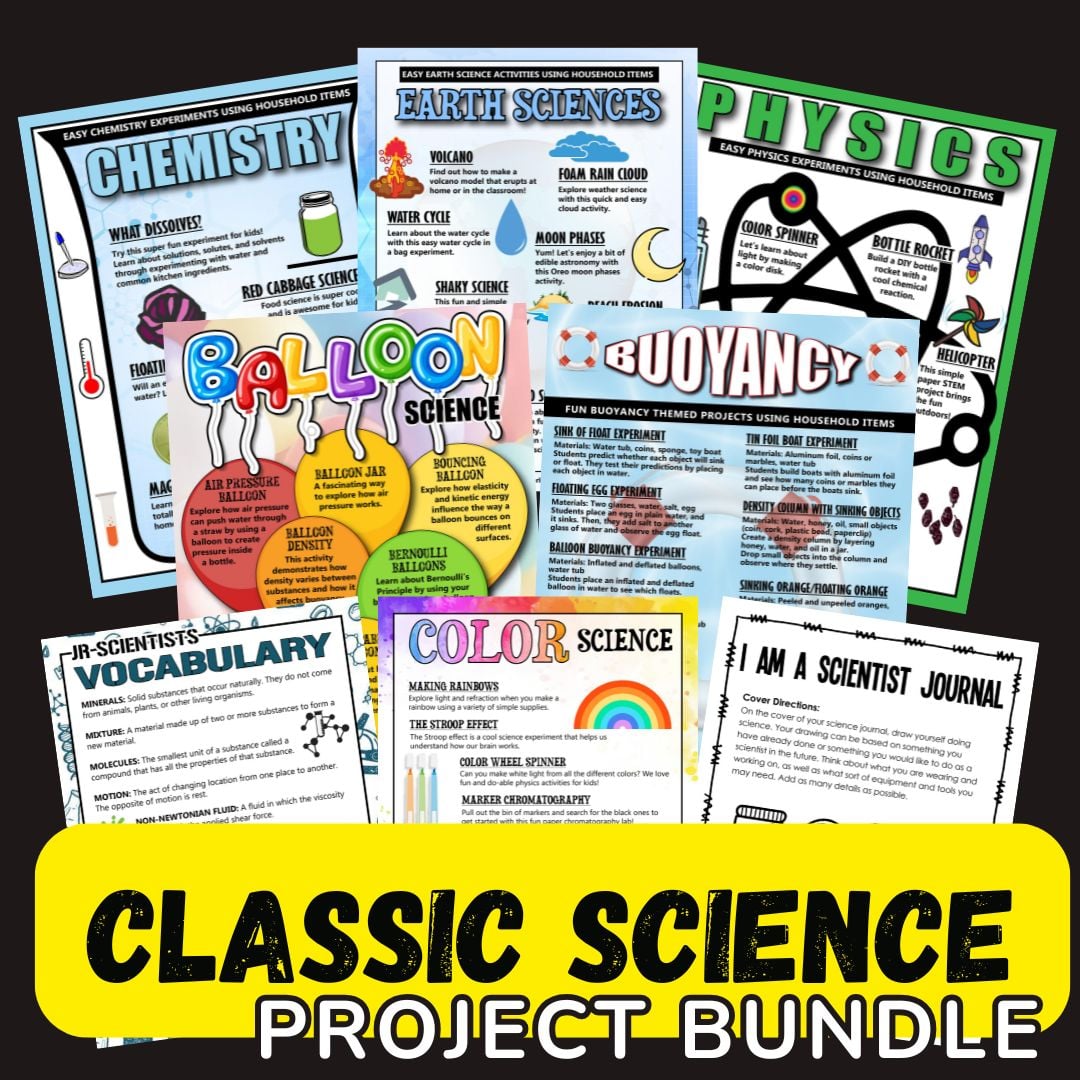
Printable Elementary Science!
Want to do meaningful science — but not start a full unit yet? This starter lab provides quick, hands-on investigations across multiple science topics, allowing students to explore how science works before diving deeper into any one subject.
Perfect for regularly trying science without extensive planning. Grades: K–5.

This helped for a science project.Thanks so much.