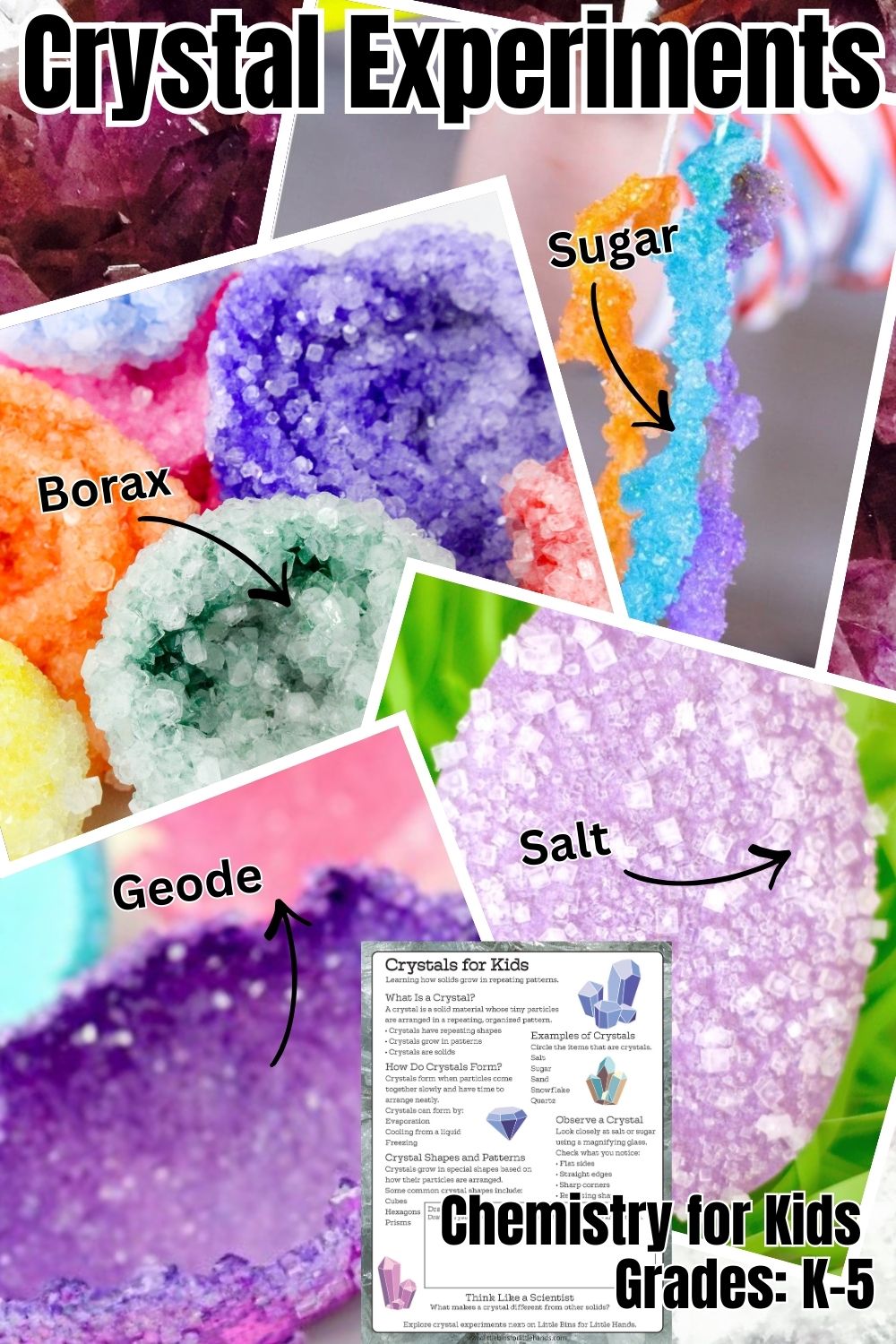

Crystals are solid materials that grow in repeating patterns. From salt and sugar to snowflakes and gemstones, crystals form when particles arrange themselves in an organized way. This post introduces what crystals are and how they form, then explores crystal-growing experiments.
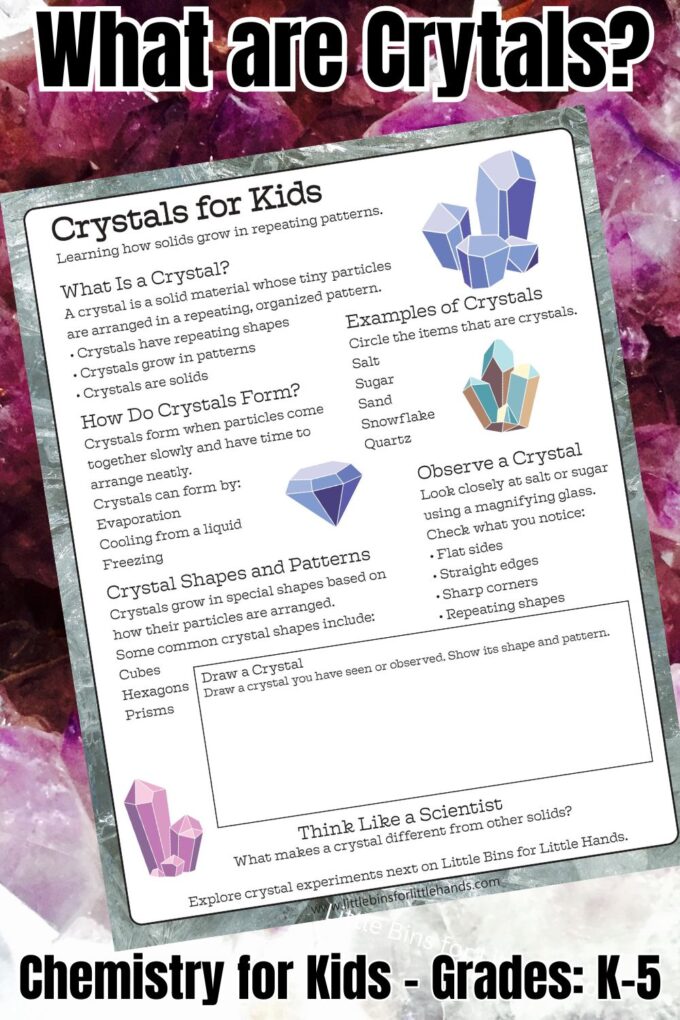
The Science Behind Crystals
Crystals form when particles join together in a repeating pattern. This pattern gives crystals their recognizable shapes.
🔎 Learning about crystals helps kids understand structure, patterns, and how solids form.
What Are Crystals? (Kid-Friendly Definition)
A crystal is a solid material whose particles are arranged in a repeating, organized pattern.
Examples of crystals:
- Salt
- Sugar
- Snowflakes
- Quartz
How Crystals Form
Crystals form when particles come together slowly and have time to arrange themselves.
Common ways crystals form:
- Evaporation
- Cooling from a liquid
- Freezing
Crystal Shapes and Patterns
Crystals grow in shapes such as:
- Cubes
- Hexagons
- Prisms
The pattern depends on the material and how it forms.
Supplies to Observe Crystals
- Salt
- Sugar
- Magnifying glass
- Clear containers
Simple Crystal Observation Activity
Use the supplies above to observe crystals closely.
Try this:
- Look at salt or sugar with a magnifying glass
- Notice the tiny shapes and straight edges
- Compare how crystals look before and after dissolving in water
Talk about:
- Do the crystals have flat sides or sharp corners?
- Do all crystals look the same?
- What happens to the crystals when they dissolve?
🔎 Tip: This activity focuses on observing crystal structure, not growing crystals. You’ll find several crystal growing experiments here.
Free Crystal Science Guide
Use this free What are Crystals science guide and explore chemistry right now.
Expanded Science Information: Crystals Made Simple
Crystals form when particles lock into a repeating pattern. The slow growth allows particles to arrange neatly, forming visible crystal shapes.
Faster growth usually leads to smaller or less defined crystals.
NGSS Guiding Questions
| NGSS Guiding Question | Student-Friendly Answer |
|---|---|
| What do you notice? | Crystals grow in shapes with straight edges and repeating patterns. |
| What is happening? | Particles are joining together in an organized, repeating arrangement. |
| Why does it matter? | Crystals help explain how solids form and why some materials have specific shapes. |
Field: Chemistry—Matter & Its Interactions
Grades: K–5
Concepts Explored: Crystals form from repeating particle patterns; crystal shape depends on structure and growth conditions; crystals form through evaporation, cooling, or freezing.
How Crystals Connect to Other Chemistry Topics
Crystals are solids. Learn more in States of Matter.
Crystals often form from solutions. Explore Solutions and Dissolving.
🔎 To see how crystals grow step by step, explore our crystal experiments for kids, including salt, sugar, and borax crystals.
Crystals FAQ
What is a crystal in simple terms?
A crystal is a solid where particles are arranged in a repeating, organized pattern. This pattern gives crystals their shape.
Are all solids crystals?
No. Some solids have particles arranged randomly. Only solids with repeating patterns are crystals.
How do crystals form?
Crystals form when particles come together slowly, often as a liquid cools or evaporates, giving the particles time to arrange neatly.
Why do crystals have shapes?
Crystals have shapes because their particles connect in specific repeating patterns that grow outward as the crystal forms.
Is a snowflake a crystal?
Yes. Snowflakes are ice crystals, and each one forms in a repeating pattern as water freezes.
Related Chemistry Activities
- Crystal Growing Experiments
- States of Matter
- Solutions and Dissolving
- Chemistry Experiments Hub


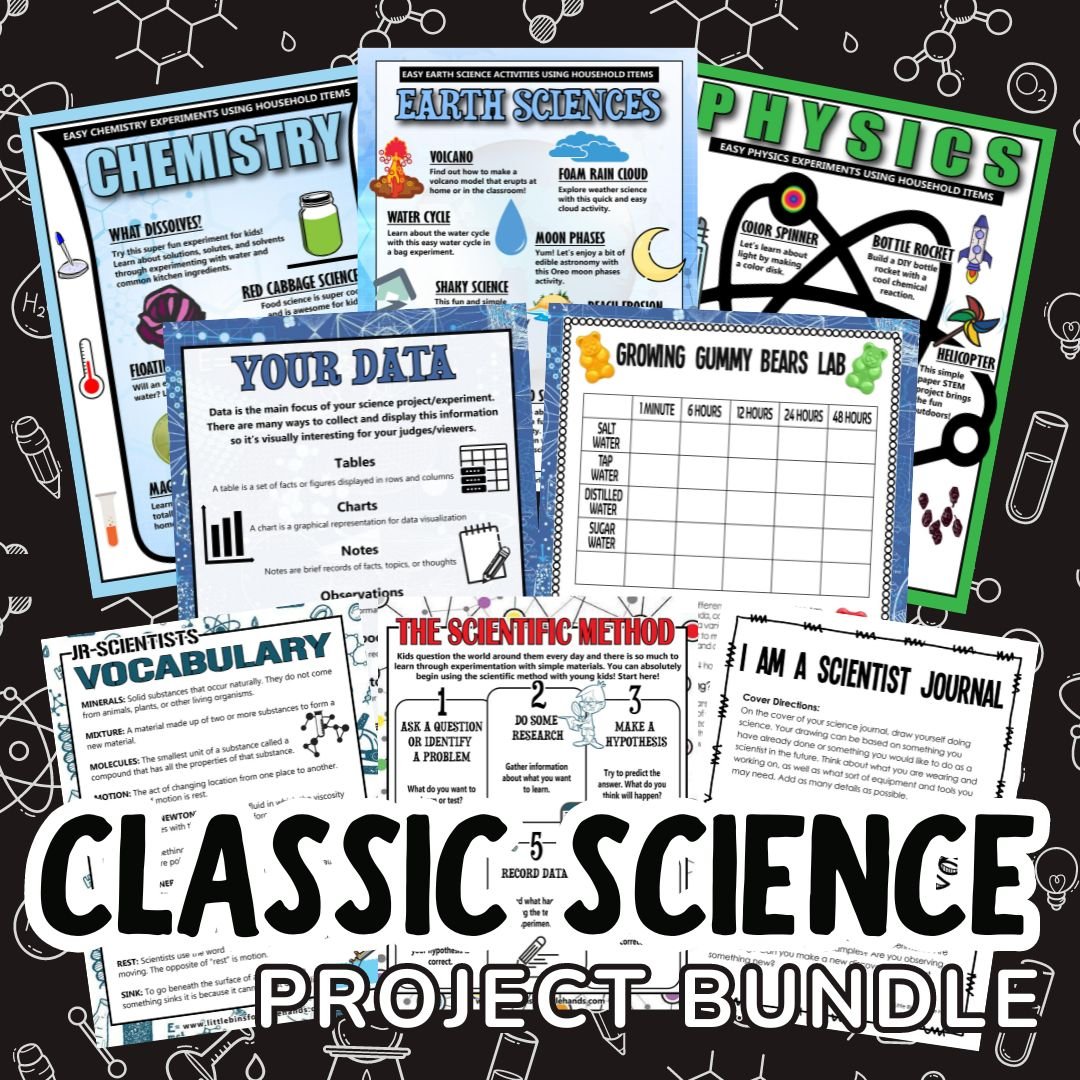
Extend Your Science Learning
If your kids enjoyed these hands-on solutions and dissolving experiments, take their science further with our Classic Science Activities Pack — 90+ easy, printable chemistry and STEM activities complete with recording pages and extension ideas. Perfect for homeschool, classroom centers, or family science nights.