
Why do cut apples turn brown, and can you slow it down? This easy apple browning experiment lets kids compare apple slices and test whether lemon juice can help keep them from browning.
It’s a simple fall science investigation for exploring oxidation, observation, variables, and cause and effect with supplies you probably already have.
Field: Chemistry, Life Science
Grades: K–5
Concepts: Apple browning, oxidation, enzymes, variables, observation
Apple Browning Experiment
When you cut an apple open, you expose the inside to oxygen in the air. Over time, the cut surface turns brown.
Supplies
- Apple
- Lemon juice
- 2 small plates or dishes
- Knife for adult use
- Timer or clock
- Apple Browning Experiment printable
- Pencil
💡 Optional: After you complete the basic experiment, try several apple varieties or additional liquids.
How to Set Up the Apple Browning Experiment
1. Prepare two apple slices.
Have an adult cut two similar-sized slices from the same apple.
Using the same apple variety and similar-sized pieces helps keep the comparison fair.
2. Leave one slice untreated.
Place one apple slice on a plate. This is your comparison or control.
3. Add lemon juice.
Coat the second slice with lemon juice and place it on a separate plate.
4. Make a prediction.
Which slice do you think will brown first?
5. Observe the slices.
Check the apples at regular intervals, such as every 5 or 10 minutes.
Look for changes in:
- Color
- Amount of browning
- Where browning begins
- How quickly the change happens
6. Record your results.
Use the printable to record what you observe and compare your results with your prediction.
Free Apple Browning Experiment Worksheet
Use the printable Apple Browning Experiment Worksheet to turn the activity into a simple science investigation.
Kids can use it to:
- Ask a question
- Make a prediction
- Record observations
- Compare results
- Draw a conclusion
Why Do Apples Turn Brown?
Apple browning happens when the inside of the apple is exposed to oxygen. Cutting or bruising the apple damages some of its cells. An enzyme called polyphenol oxidase, or PPO, can then react with compounds in the apple in the presence of oxygen.
This reaction creates brown-colored compounds on the cut surface. The process is often called enzymatic browning.
🔎 For younger kids, you can simply explain: Cut apple + air → browning
💡 The important observation is that cutting the apple exposes the inside to air and starts a change that we can see.
Why Does Lemon Juice Keep Apples From Turning Brown?
Lemon juice can slow apple browning in a couple of ways.
It is acidic, which creates conditions that make the browning enzyme work less effectively. Lemon juice also contains ascorbic acid, or vitamin C, which can help slow the reactions involved in browning.
This is why a lemon-coated apple slice usually stays lighter longer than an untreated slice. You can connect this activity to the pH Scale for Kids if you want to explore acids further.
What Are the Variables?
For the simplest version of this experiment:
Independent Variable: Whether the apple slice is treated with lemon juice.
Dependent Variable: How much the apple slice browns or how long it takes to brown.
Controlled Variables: Things you try to keep the same, such as:
- Apple variety
- Slice size
- Amount of time
- Room conditions
This setup is much cleaner than changing both the apple variety and the amount of lemon juice at the same time.
👉 Learn more about variables in science.
Test Other Ways to Keep Apples From Browning
Once you’ve tested lemon juice, extend the investigation. Try coating apple slices with:
- Plain water
- Salt water
- Lemon juice
- Vinegar
- Another citrus juice
Keep one slice untreated for comparison.
💡 Then ask: Which treatment keeps an apple from browning the longest? Older students can record the amount of browning at set time intervals and compare the results.
Do Different Apples Brown at the Same Rate?
You can also run a separate experiment using several apple varieties. Cut similar-sized pieces and leave them all untreated.
Then observe:
- Which variety browns first?
- Which becomes darkest?
- Do some varieties change very little?
- How long does each one take to show visible browning?
🔎 Keeping this as a separate investigation makes it much easier for kids to understand what variable they are testing.
👉 This pairs especially well with the Apple 5 Senses Activity if you already have several varieties available.
Adapt the Apple Browning Experiment by Grade
PreK–Kindergarten
Keep the focus on observation and comparison. Ask kids to predict which apple slice will stay lighter, then describe what they notice using words like light, dark, brown, wet, and dry.
Grades 1–2
Have students predict, compare a treated and untreated apple slice, and record simple observations. Introduce the idea that air causes changes in the cut apple, and lemon juice can slow that change.
Grades 3–5
Turn the activity into a fair test. Identify the independent and dependent variables, keep the apple slices similar in size, observe at set time intervals, and compare different treatments such as lemon juice, water, or salt water.
👉 This is a great opportunity to explore the scientific method with kids!
💡 Turn it into an Apple Browning Science Fair Project for older kids. It’s low-cost, testable, and easy for kids to do independently! Learn more about science fair projects here.
Guiding Questions
- What did the apple look like when you first cut it?
- Which slice began browning first?
- Did lemon juice slow the browning?
- What changed over time?
- What stayed the same?
- Why is it important to use similar-sized apple slices?
- What could you test next?
- Do you think every apple variety would give the same result?
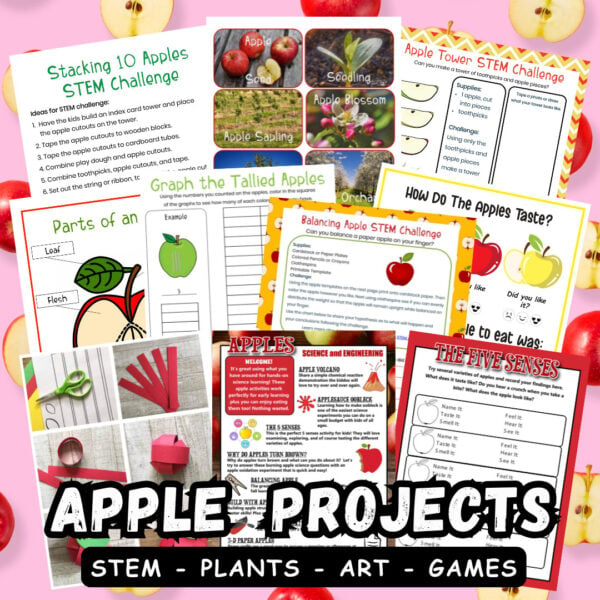
Printable Apple Science and STEM Pack
Want more apple activities in one place?
The Apple Science and STEM Pack includes more than 125 pages of apple-themed projects and printables for Kindergarten through elementary.
Inside, you’ll find apple science activities, STEM challenges, life cycle resources, observation pages, and additional printable activities for fall learning.
More to Explore
Apple Science Experiments | Apple Observation Activity | Apple 5 Senses Activity | Apple Volcano Experiment | pH Scale for Kids

4 Comments
Comments are closed.