

Looking for a fun way to explore physics with your kids? This screaming balloon experiment is a surprising but simple way to explore motion, vibration, and centripetal force—all with just a balloon and a hex nut! Get ready for science that sounds awesome (literally)!

Screaming Balloon Science
Field of Science: Physics
Grade Level: K–5
Concepts Explored:
- Motion and force
- Sound and vibration
- Circular motion and centripetal force
Simplified NGSS Alignment:
- What will students figure out? Objects can move in a circular path due to an inward force (centripetal force).
- What will students do? Test how a hex nut behaves inside a spinning balloon and observe the resulting sound.
- What will students learn? Vibration can create sound, and objects in motion are affected by shape, force, and direction.
Supplies Needed
- 1 latex balloon
- 1 small hex nut
🔎 Optional: Try other small objects (such as marbles or pennies) for comparison. See extensions below.
How to Make Screaming Balloons
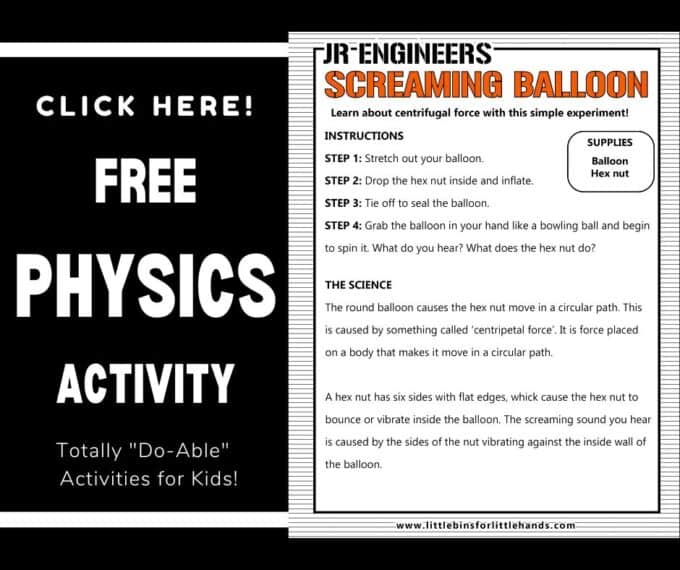
STEP 1: Stretch your balloon to loosen it up.
STEP 2: Carefully place the hex nut inside the balloon.
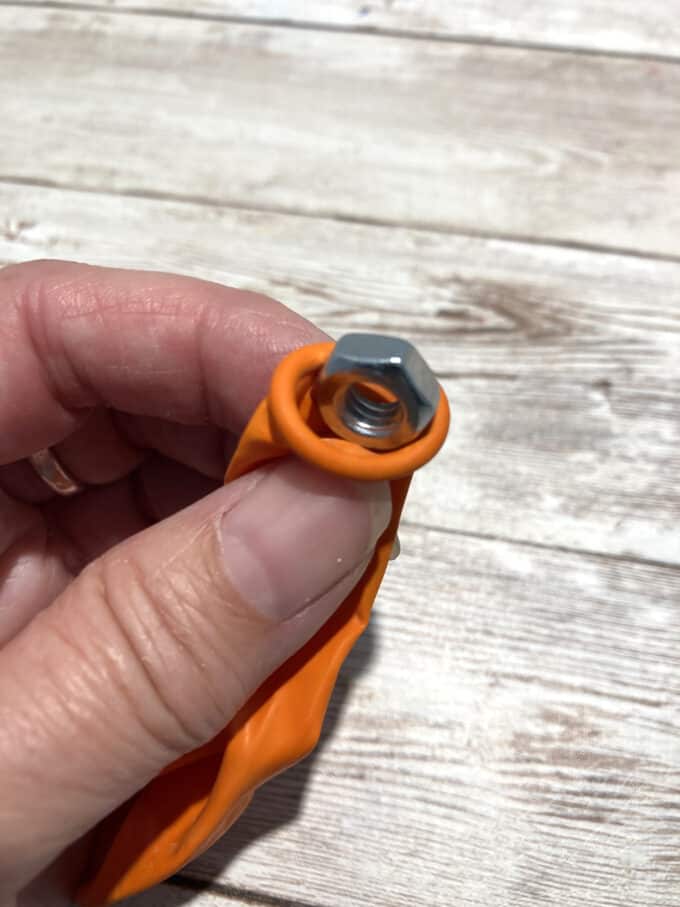
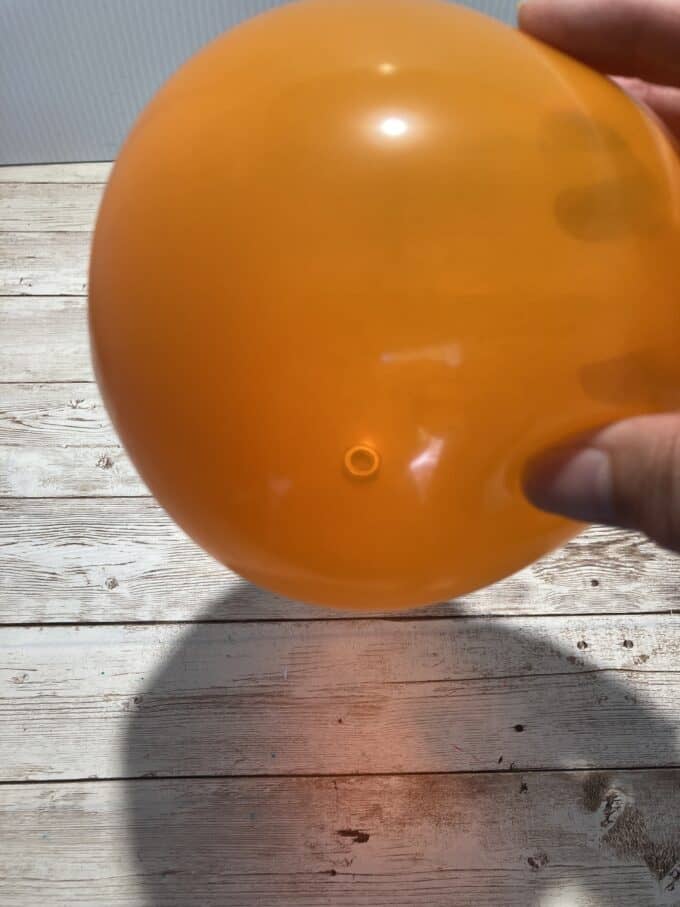
STEP 3: Inflate the balloon to about the size of a grapefruit—don’t overfill!
STEP 4: Tie off the balloon to seal it.
STEP 5: Hold the balloon by the tied end and spin it in a circular motion like a lasso.
🔎 Listen closely—what do you hear?
Screaming Balloon Science Information
When you spin the balloon, the hex nut rolls along the inside wall in a circular path. This motion occurs due to centripetal force, the inward force that keeps the hex nut moving in a circle instead of flying off in a straight line.
The “screaming” sound? That’s caused by vibration. As the hex nut moves, its flat edges rapidly bump against the inside of the balloon, causing the balloon to vibrate. Those vibrations create the loud, high-pitched sound you hear, just like how a speaker or drum makes sound through vibration.
More Science Facts for Kids
- A circle requires constant force to keep something moving along it. Without that force, the object would fly off in a straight line!
- Sound is produced when something vibrates, such as the balloon wall in this experiment.
- The hex nut’s shape is key—its flat edges help create the vibration that makes the sound. A round object wouldn’t scream the same way!
Make It a Balloon Science Project
Turn this into a complete experiment by asking a testable question:
Which object makes the loudest sound in the balloon?
- Try repeating the activity with a marble, penny, or washer.
- Record your results and observations for each object.
- Graph the volume (high, medium, low) if you don’t have a decibel meter.
🔎 This is a great opportunity to explore the scientific method, learn how to write a hypothesis, and choose variables!
Extension Activities
- Try a different-shaped balloon (long, round, small) and observe if the sound or motion changes.
- Use a sound meter app to measure volume.
- Transform this into a physics science fair demonstration and explain centripetal force and sound using posters or visuals.
More Sound Science Activities to Explore
Find more hands-on activities that investigate sound waves, volume, and how sound travels in our Sound Science for Kids hub.
Looking for more hands-on activities? Explore our collection of physics experiments for kids that investigate sound, energy, and motion.

Turn this activity into a full sound unit.
If your students loved this experiment, expand it into a complete sound science study with 8 investigations, recording pages, and guiding questions already done for you.