
These free simple machines worksheets are an easy way for kids to learn about levers, pulleys, inclined planes, wheels and axles, wedges, and screws.
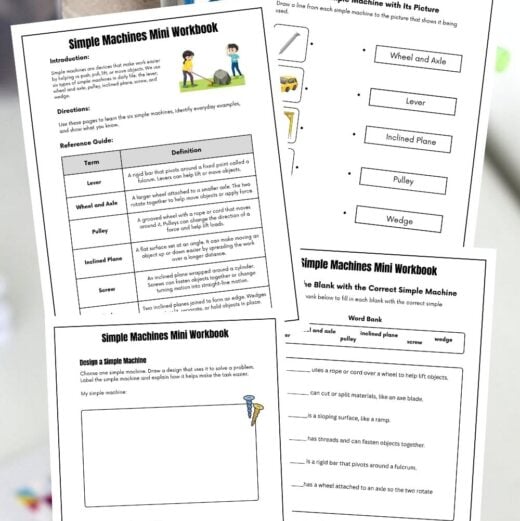
Use the printable Simple Machines Mini Workbook for a science lesson, STEM center, review activity, or at-home learning. Kids will identify the six simple machines, match them with everyday examples, and use what they know to design their own simple machine.
Field: Physical Science + Engineering
Grades: 2–5
Concepts: Simple Machines, Force, Motion, Work, Engineering Design
Free Simple Machines Mini Workbook
Want an easy way to introduce or review the six simple machines?
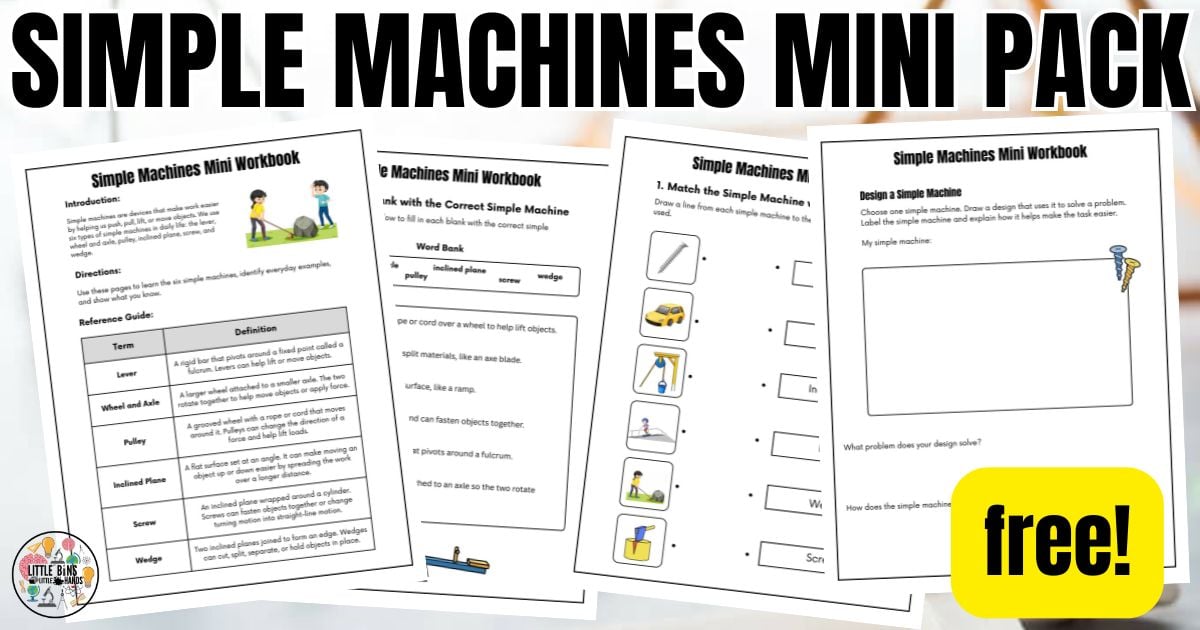
Grab our free Simple Machines Mini Workbook with four printable pages for learning and applying the concepts.
Kids can:
- Learn the six simple machines
- Match each machine to an everyday example
- Practice identifying simple machines from clues
- Design a simple machine to solve a problem
👉 Get the Free Simple Machines Mini Workbook Here
This works well for a science lesson, STEM center, review activity, or simple machines unit.
What Are the 6 Simple Machines?
Simple machines are devices that help us do work by changing the size or direction of a force.
There are six classic types of simple machines:
Lever
A lever is a rigid bar that pivots around a fixed point called a fulcrum. Levers can help lift or move objects.
Examples include a seesaw, crowbar, bottle opener, and wheelbarrow.
Wheel and Axle
A wheel and axle consists of a larger wheel attached to a smaller axle. The two rotate together to help move objects or apply force.
Examples include bicycle wheels, car wheels, and doorknobs.
Pulley
A pulley is a grooved wheel with a rope or cord that moves around it. Pulleys can change the direction of a force and help lift loads.
Examples include flagpoles, cranes, and some window blinds.
Inclined Plane
An inclined plane is a flat surface set at an angle. It can make moving an object up or down easier by spreading the work over a longer distance.
Examples include ramps, stairs, and sloping roads.
Screw
A screw is an inclined plane wrapped around a cylinder. Screws can fasten objects together or change turning motion into straight-line motion.
Examples include hardware screws, bolts, jar lids, and bottle caps.
Wedge
A wedge is made from two inclined planes joined to form an edge. Wedges can cut, split, separate, or hold objects in place.
Examples include axes, knives, nails, chisels, and doorstops.
What’s Included in the Simple Machines Mini Workbook?
The printable workbook gives kids several different ways to practice the same concepts without simply repeating definitions.
Simple Machines Reference Guide
Start with an easy reference page that introduces all six simple machines and explains how each one works.
Kids can use this page while completing the remaining activities or keep it as a quick science reference.
Match the Simple Machine
Kids match the names of the six simple machines with pictures showing them in everyday use.
This helps connect science vocabulary with objects and machines kids may already recognize.
Fill in the Blank
Use the word bank to identify each simple machine from a short description.
This works well as review after introducing the six machines.
Design a Simple Machine
Finish with a simple engineering activity.
Kids choose one simple machine and draw a design that uses it to solve a problem. Then they explain:
- What problem their design solves
- Which simple machine it uses
- How the machine helps make the task easier
💡 This is an easy way to move from identifying simple machines to applying the concept.
Ways to Use These Simple Machines Worksheets
These printable pages can work in several different ways depending on your lesson.
- Introduce simple machines. Use the reference page before beginning a hands-on simple machines unit.
- Science center. Add the matching and fill-in-the-blank pages to a physical science center.
- Review activity. Use the workbook after exploring simple machines with classroom objects or demonstrations.
- Engineering extension. Use the design page after kids understand how the six machines work.
- Early finisher activity. Keep a few copies available for independent science work.
Simple Machines in Everyday Life
Once kids understand the six simple machines, challenge them to find examples around the classroom, school, playground, or home.
They might spot:
- A doorstop as a wedge
- A doorknob as a wheel and axle
- A ramp as an inclined plane
- A flagpole using a pulley
- A seesaw as a lever
- A jar lid using screw threads
Ask kids to explain which part of the object acts as the simple machine, especially when looking at more complicated objects that may contain several different mechanisms.
Add Hands-On Simple Machine Projects
Ready to move from worksheets to building?
Try our collection of simple machine projects for kids with hands-on activities for levers, pulleys, wheels and axles, ramps, screws, and more.
You can build:
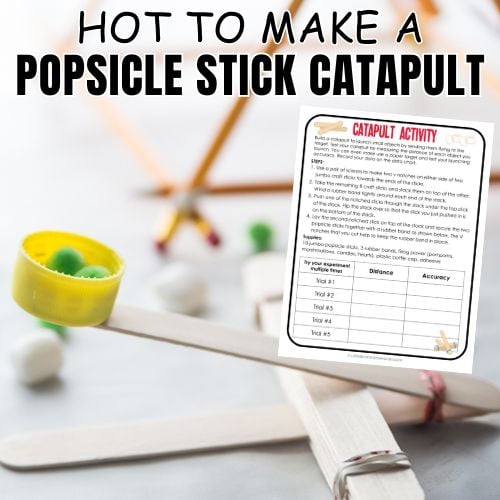
- A popsicle stick catapult
- A rubber band car
- A mini pulley
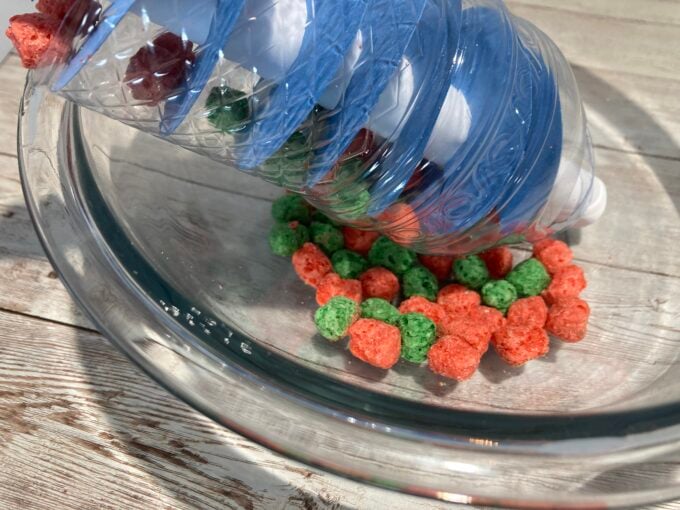
- An Archimedes screw
- A ramp investigation
- A hand crank winch
👉 Explore Simple Machine Projects for Kids
Guiding Questions
Use these questions with the worksheets or a hands-on activity:
- Which simple machine is being used?
- What job does the machine help accomplish?
- Where is force being applied?
- Does the machine change the direction of a force?
- Where could you find this simple machine in everyday life?
- Can one object contain more than one simple machine?
- How could you use a simple machine to solve a problem?
Printable Simple Machines Project Pack
Want to take the learning further?
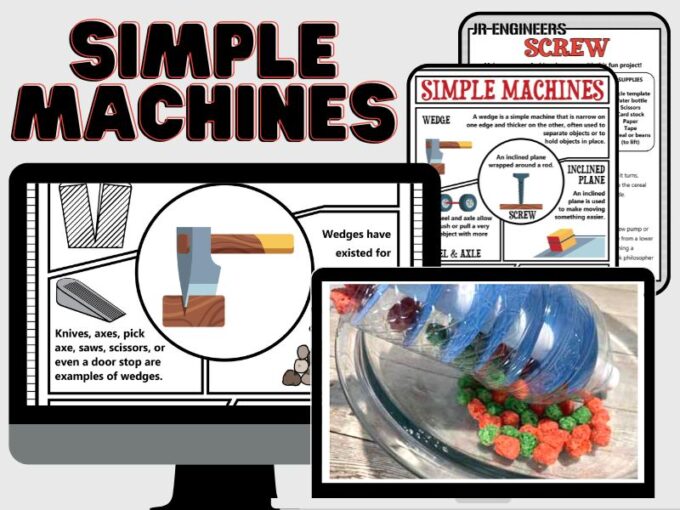
Our Simple Machines Project Pack includes one hands-on project for each of the six simple machines, plus information pages and supporting activities.
Kids explore:
- Wheel and axle
- Lever
- Wedge
- Screw
- Pulley
- Inclined plane
The pack includes instructions, project pictures, templates where needed, and easy-to-read information pages.
👉 Explore the Simple Machines Project Pack
More to Explore
Simple Machine Projects | Free Science Worksheets | Engineering Activities | Force and Motion | STEM Projects for Kids