

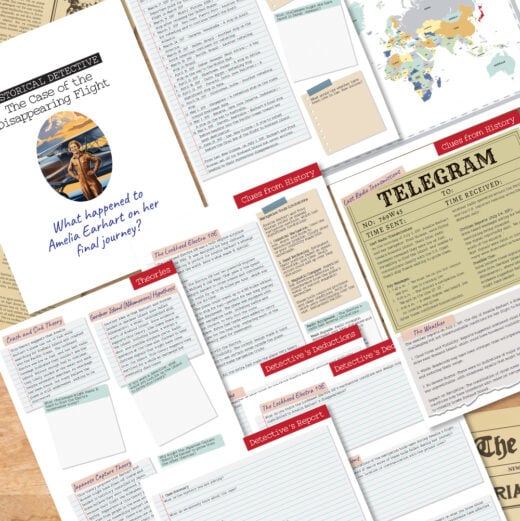
Amelia Earhart was one of the most famous aviators in history. She broke flight records, inspired women around the world, and helped advance the science of aviation. But her final flight in 1937 ended in one of the greatest unsolved mysteries in aviation history.
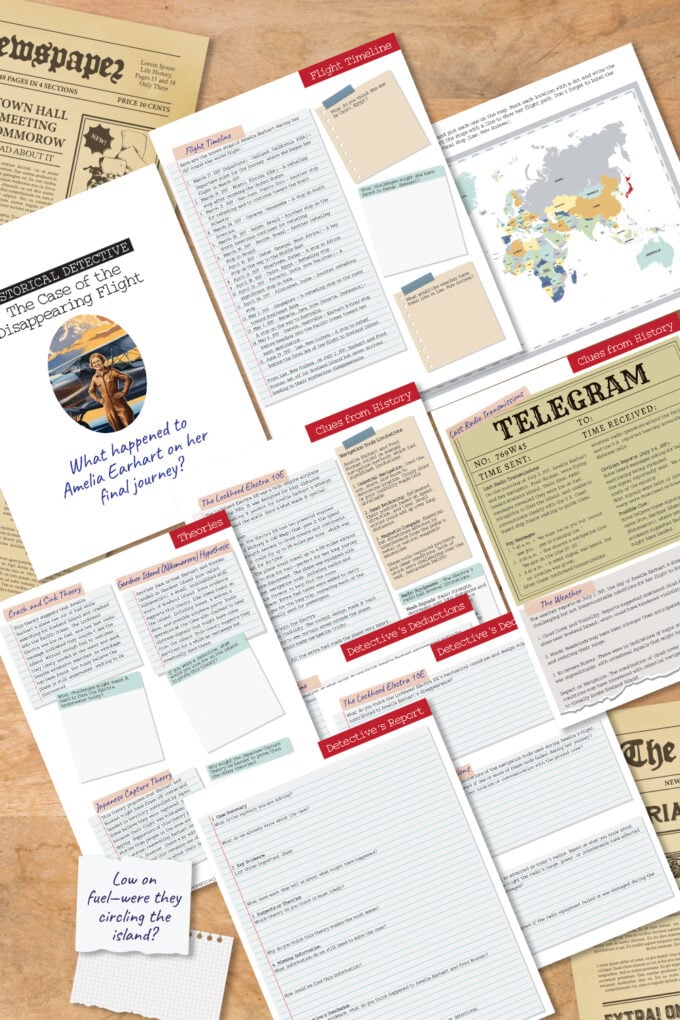
What happened to Amelia Earhart during her attempt to fly around the world?
In this activity, students become historical detectives. They will examine clues from Earhart’s final flight, study evidence, and evaluate the different theories about her disappearance.
💡 This investigation combines history, science, and critical thinking, making it a great addition to STEM lessons, Women’s History Month, or aviation science units.
Recommended grade level: 3–6
Who Was Amelia Earhart?
Amelia Earhart was an American aviation pioneer and author. She became famous for her bravery, skill as a pilot, and determination to break barriers in aviation.
In 1932, Earhart became the first woman to fly solo across the Atlantic Ocean, a journey that made her internationally famous.
Throughout her career she:
- set multiple aviation records
- wrote books about flying
- promoted opportunities for women in aviation
- helped form The Ninety-Nines, an international organization for women pilots
Earhart believed aviation could open new possibilities for exploration and travel. Her passion for flight helped inspire future engineers, pilots, and scientists.
You can explore more famous pioneers in our women in STEM scientists collection.
Amelia Earhart’s Around-the-World Flight
In 1937, Earhart attempted something incredibly ambitious: flying around the world near the equator, a journey of about 29,000 miles.
She flew with navigator Fred Noonan in a twin-engine aircraft called the Lockheed Electra 10E.
Their route included stops across:
- North America
- South America
- Africa
- the Middle East
- Asia
- Australia
By June 1937 they had successfully completed most of the journey. Only one difficult section remained: crossing the vast Pacific Ocean.
The Final Flight
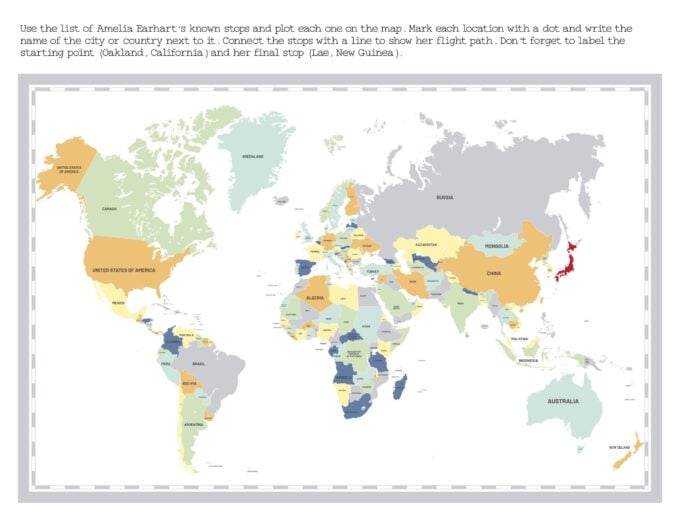
On July 2, 1937, Earhart and Noonan took off from Lae, New Guinea.
Their destination was Howland Island, a tiny island in the Pacific Ocean that would serve as a refueling stop.
Finding Howland Island was extremely difficult. The island was only about 1.5 miles long and half a mile wide, surrounded by thousands of miles of open ocean.
The U.S. Coast Guard ship Itasca waited near the island to guide the plane using radio signals. But communication problems soon began.

The Last Radio Messages
During the flight, Earhart sent several radio messages describing their situation.
One of her last messages reported:
“We must be on you but cannot see you… gas is running low.”
Another message suggested they were flying along a navigation line known as 157–337, trying to locate the island.
After that, the radio signals stopped. Earhart and Noonan were never heard from again. Despite a massive search effort by the U.S. Navy and Coast Guard, no confirmed wreckage was found.

The Science of Navigation in the 1930s
Today, airplanes use GPS and satellite technology to find their exact location. But in the 1930s pilots relied on much simpler tools.
Earhart and Noonan used several navigation methods:
Celestial navigation
Using the sun and stars to determine position.
Dead reckoning
Estimating location based on speed, direction, and travel time.
Magnetic compass
Used to maintain direction during flight. 👉 See how to make your own magnetic compass here.
These methods required clear skies and precise measurements. Clouds, strong winds, or small calculation errors could make navigation very difficult.
These challenges show how early aviation relied heavily on both science and engineering to solve problems in flight.
The Lockheed Electra Airplane
Amelia Earhart’s aircraft was a Lockheed Electra 10E, a twin-engine airplane designed for long-distance travel.
Important features of the Electra included:
Two powerful engines
These allowed the plane to travel long distances over oceans.
Extra fuel tanks
Many passenger seats were removed to make space for additional fuel.
Navigation equipment
The aircraft included radio equipment and navigation tools used during long flights.
Even with these features, flying across large areas of ocean was still very risky.

Theories About Amelia Earhart’s Disappearance
Because no confirmed wreckage has been found, historians and scientists have proposed several theories about what may have happened.
Crash and Sink Theory
The most widely accepted explanation is that Earhart’s plane ran out of fuel while searching for Howland Island.
If this happened, the aircraft may have crashed into the Pacific Ocean and sunk.
Because the ocean in this region is extremely deep, the wreckage may still be undiscovered.
Nikumaroro Island Hypothesis
Another theory suggests Earhart may have landed on Nikumaroro Island, an uninhabited island south of Howland Island.
Some researchers believe artifacts found on the island could be connected to Earhart’s flight.
If this theory is correct, Earhart and Noonan may have survived for some time as castaways.
Japanese Capture Theory
A less widely accepted theory claims that Earhart’s plane may have landed in territory controlled by Japan during that time period.
Some stories suggested she may have been captured.
However, there is no strong historical evidence supporting this idea, so most historians consider it unlikely.

Become a Historical Detective
Now it’s time for students to investigate the mystery themselves.
Using the printable investigation sheets, students can:
- map Earhart’s flight path
- analyze clues from radio transmissions
- study the challenges of navigation
- examine different disappearance theories
- write their own detective conclusion
Encourage students to ask questions such as:
- What challenges would pilots face when flying over open ocean?
- What clues from the radio messages might explain what happened?
- Which theory seems most likely based on the evidence?
💡 This type of investigation helps students practice observation, reasoning, and evidence-based thinking.

Aviation Inspiration
Amelia Earhart’s story continues to inspire scientists, engineers, and explorers today.
Her determination helped break barriers in aviation and encouraged more women to pursue careers in science and engineering.
Students interested in flight can also explore how airplanes move through the air by studying lift, thrust, drag, and gravity in our paper airplane aerodynamics science project.
👉 You can even try building your own launcher in this paper airplane launcher STEM project.
Free Amelia Earhart Mystery Investigation
Download the Amelia Earhart historical detective activity printable to explore the mystery through maps, clues, and investigation questions.
This printable is perfect for STEM lessons, Women’s History Month activities, or aviation science units.
Amelia Earhart FAQ
Who was Amelia Earhart?
Amelia Earhart was an American aviation pioneer and the first woman to fly solo across the Atlantic Ocean. She set many flight records and became one of the most famous pilots in history.
What happened to Amelia Earhart?
Amelia Earhart disappeared in 1937 while attempting to fly around the world. Her airplane was last heard from near Howland Island in the Pacific Ocean, and her disappearance remains one of aviation’s greatest mysteries.
Why was Amelia Earhart famous?
Earhart became famous for breaking aviation records, promoting women in aviation, and attempting one of the longest flights ever attempted at the time.
Why is Amelia Earhart important in STEM?
Amelia Earhart helped advance aviation science and inspired future engineers, pilots, and explorers. Her work contributed to the growing field of aerospace and aviation technology.

Explore More Women in STEM
This activity is part of our larger Women in STEM collection, featuring inspiring scientists, engineers, and mathematicians.
✔ Kid-friendly biographies
✔ Hands-on STEM investigations
✔ Easy-to-use printables
I
👉 See everything included in the Women in STEM Project Pack here. Included with the All-Access Pass