
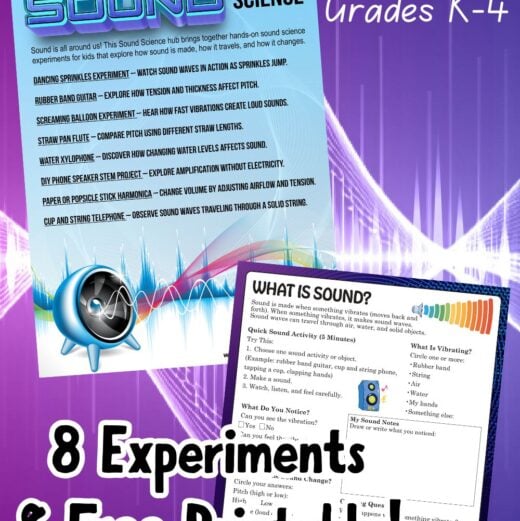
Sound is all around us! From music and voices to echoes and animal calls, sound helps us communicate and understand the world. This Sound Science hub brings together hands-on sound science experiments for kids that explore how sound is made, how it travels, and how it changes.
These activities help kids see, hear, and feel sound energy in action using simple materials—perfect for classrooms, homeschool, and science centers.
Sound Science at a Glance
Field: Physics—Sound Energy
Grades: K–4
Concepts Explored: Sound is energy produced by vibrations; vibrations move through solids, liquids, and gases; pitch changes with vibration speed, length, or tension; volume depends on vibration strength; sound waves transfer energy through different materials.
What Is Sound?
Sound is a type of energy made by vibrations. When something vibrates—like a rubber band, speaker, or vocal cords—it causes nearby particles to move. These movements travel as sound waves through air, water, or solid materials.
When sound waves reach our ears, they make the eardrum vibrate. Our brains then interpret those vibrations as sound we can hear.
Sound travels at different speeds depending on the material. It moves fastest through solids, slower through liquids, and slowest through gases like air.
Sound and Vibration Experiments
Each activity below focuses on one or more sound concepts and works well as a quick investigation, science center activity, or full lesson.
Sound Made by Vibrations
These activities show how vibrations create sound.
- Dancing Sprinkles Experiment – Watch sound waves in action as vibrations make sprinkles jump.
- Rubber Band Guitar – Explore how tension and thickness affect pitch.
- Screaming Balloon Experiment – Hear how fast vibrations create loud sounds.

Pitch and Frequency
Explore how high and low sounds are created.
- Straw Pan Flute – Compare pitch using different straw lengths.
- Water Xylophone – Discover how changing water levels affects sound.

Volume and Amplification
Investigate loud and soft sounds.
- DIY Phone Speaker STEM Project – Explore amplification without electricity.
- Paper or Popsicle Stick Harmonica – Change volume by adjusting airflow and tension.

Sound Traveling Through Materials
Explore how sound moves through solids, liquids, and gases.
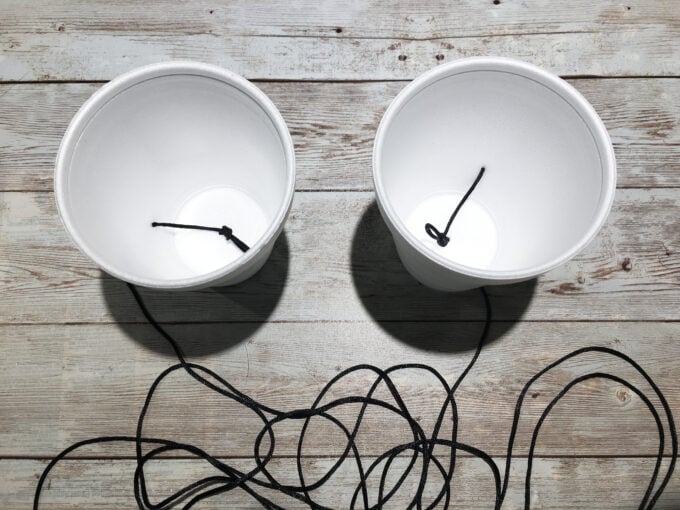
- Cup and String Telephone – Observe sound waves traveling through a solid string.
NGSS Guiding Questions for Sound Science
Grades: K–4
- What happens when something vibrates?
- How does sound travel through air, water, and solid materials?
- How can changing vibration speed, length, or tension change the sound we hear?
- Why do some sounds sound louder or quieter than others?
- How does sound show that energy can move from one place to another?
Free Sound science Guide
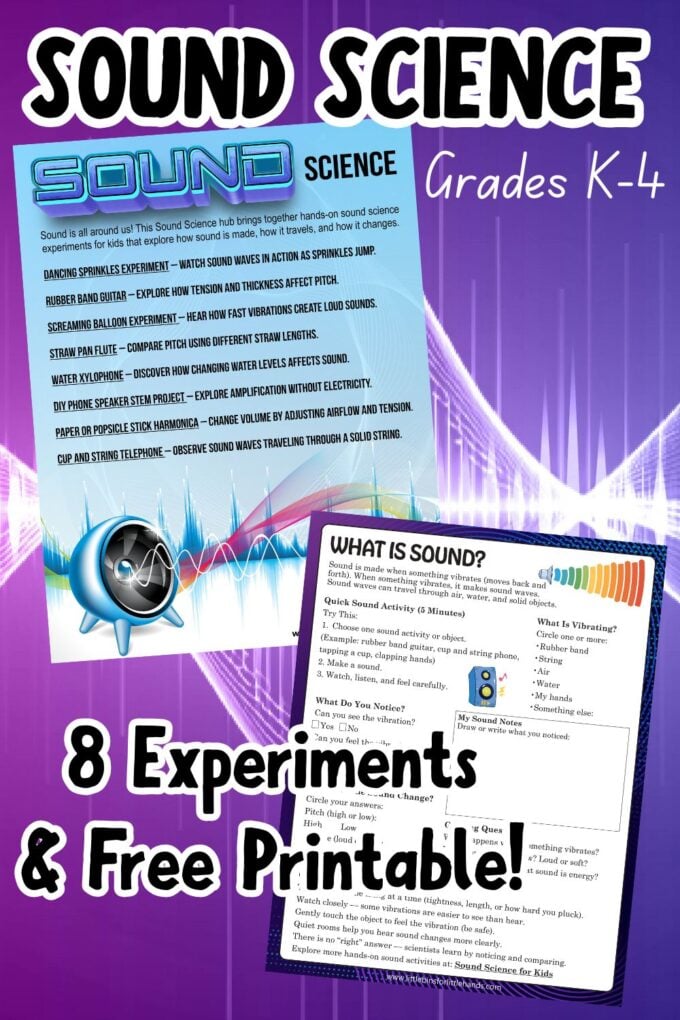
Add this free sound science guide and worksheet to your physics unit on sound and vibrations.
Sound Vocabulary for Kids
Vibration – Back-and-forth movement that produces sound.
Pitch – How high or low a sound is.
Volume – How loud or soft a sound is.
Frequency – How fast something vibrates.
Sound Wave – The movement of sound energy through materials.
More Sound Facts for Kids
- Sound reflects off surfaces, creating echoes.
- Whales and dolphins use sound to communicate underwater.
- Ultrasound uses high-frequency sound waves to visualize internal structures.
- Sound travels faster in solids and liquids than in air.
Extension Activities for Sound Science
- Build a sound museum where students demonstrate different sound projects.
- Use a sound meter app to compare volume changes.
- Explore animal communication using sound.
- Design and test a musical instrument using recycled materials.
Sound Science FAQ
What is sound?
Sound is a type of energy made by vibrations. When something vibrates, it creates sound waves that travel through air, water, or solid materials.
How does sound travel?
Sound travels in waves through particles. It can move through solids, liquids, and gases, but it travels fastest through solids and slowest through air.
What is the difference between pitch and volume?
Pitch is how high or low a sound is and depends on how fast something vibrates. Volume is how loud or soft a sound is and depends on how strong the vibrations are.
What grade levels are these sound experiments for?
These sound science activities work best for grades K–4. Younger students can explore cause and effect, while older students can investigate pitch, frequency, and energy transfer.
Do I need special materials to do these experiments?
No. Most sound experiments use simple materials like cups, rubber bands, straws, paper, water, or recycled items commonly found at home or in the classroom.
Is sound a form of energy?
Yes. Sound is energy created by vibrations and transferred through waves as those vibrations move through materials.
Explore More Physics for Kids

Make sound science actually click for kids.
Skip the guesswork and use a ready-to-teach investigation unit where students build instruments, test vibrations, and see sound waves in action — using simple materials you already have.