
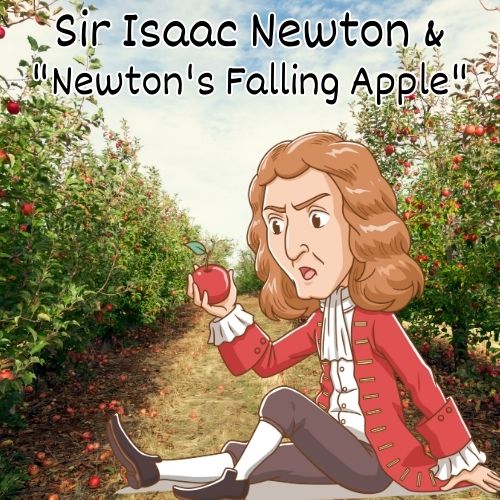
Have you ever wondered why a ball keeps rolling until something stops it or why you feel a pushback when you jump? Get ready to explore the wonders of motion with Sir Isaac Newton’s groundbreaking work with Newton’s Laws Experiments!

Newton’s Laws of Motions
Newton’s Laws of Motion are fundamental principles in physics that explain how and why things move. Each law describes a different aspect of motion, showing us the effects of forces on objects, including concepts like velocity, constant speed, and collisions.
💡Explore more physics experiments here.
Newton’s three laws—Inertia (First Law), Force and Acceleration (Second Law), and Action and Reaction (Third Law)—apply to everything from a rolling ball to rockets launching into space. Through these fantastic Newton’s Laws experiments, kids will experience science in action! Read more about each law below!
Newton’s Laws Experiments
Explore these hands-on experiments that bring science to life. They’re perfect for budding scientists eager to understand how things move and interact with forces like gravity.
💡Investigate more gravity experiments [here].
Grade Level Recommendation: These activities are perfect for elementary and middle school students, especially grades 3-6. They make understanding force and motion in physics fun!
💡Look for free printables with most projects! Plus, grab free science journal notebook pages here.👇

Basketball Bounce Experiment
- What to Do: Drop a basketball with a tennis ball stacked on top of it. Watch the tennis ball bounce higher than usual.
- Science Explanation: The tennis ball bounces higher because it gains energy from the basketball, demonstrating Newton’s Third Law. The action of the basketball’s bounce results in the reaction of the tennis ball moving upward with extra velocity.
Bottle Rocket
- What to Do: Use baking soda and vinegar in a bottle to create pressure, then watch as the rocket launches when the cork or cap releases.
- Science Explanation: The gas produced pushes down, forcing the rocket upward. This action and reaction demonstrate Newton’s Third Law, showing how gas expansion can propel an object in the opposite direction.
Alternatively, use just water and air pressure to launch a bottle rocket.
Egg Drop Challenge
- What to Do: Create a container to protect an egg from breaking when dropped. Test the container from a height and observe how it cushions the egg.
- Science Explanation: This experiment tests Newton’s First Law, as the egg wants to stay in motion when it falls. Using materials to absorb the impact force helps prevent the egg from breaking, demonstrating how force and inertia affect motion. This is similar to how seatbelts protect us during car collisions by absorbing and distributing the force.
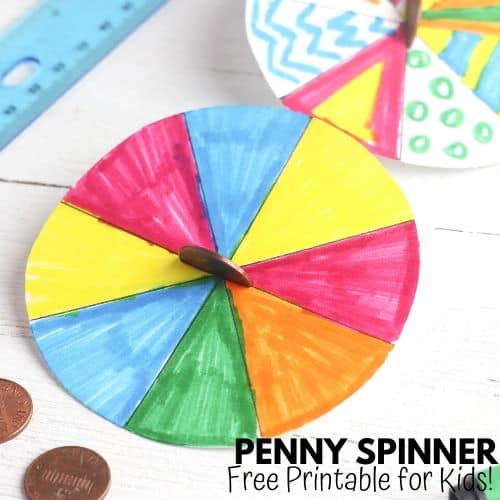
Penny Spinner
- What to Do: Spin a penny on a flat surface and observe how long it stays in motion.
- Science Explanation: This demonstrates Newton’s First Law. The penny will keep spinning until friction (an external force) slows it down. It’s a simple way to see how objects at rest or in motion behave until acted upon.
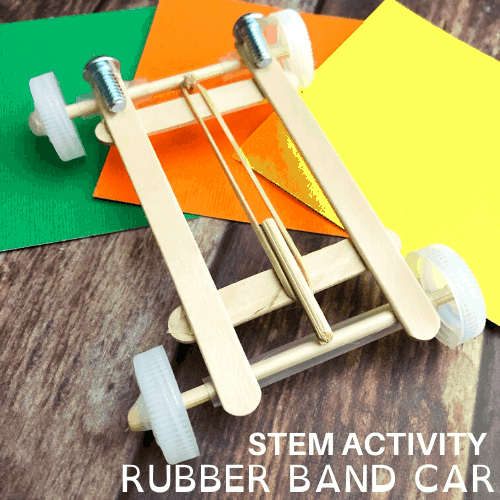
Rubber Band Car
- What to Do: Build a car powered by a stretched rubber band. Release the car and watch it zoom forward.
- Science Explanation: When stretched, the rubber band stores potential energy. When released, it propels the car forward, demonstrating Newton’s First and Third Laws. The car moves due to the release of energy (First Law), and the pushback of the rubber band creates forward motion (Third Law).
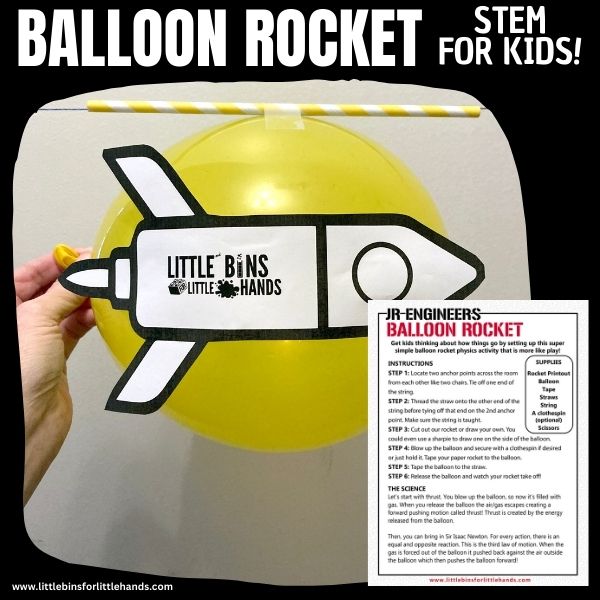
Balloon Rocket
- What to Do: Attach a balloon to a piece of string and release the air. Watch the balloon zip along the string.
- Science Explanation: As air escapes the balloon, it pushes backward, causing the balloon to move forward. This action and reaction illustrate Newton’s Third Law.
Domino Chain Reaction
- What to Do: Arrange the dominoes upright in a series of dominoes on a flat surface. Give the first domino a gentle push and watch them fall over one by one.
- Science Explanation: Inertia keeps the dominos stationary until the force from the preceding domino starts the chain reaction. When one domino pushes another, the second domino exerts an equal and opposite force back on the first. This interaction ensures that each domino transmits enough energy to topple the next one.
“Snowball” Launcher
- What to Do: Make a sturdy base for your launcher, attach a plastic spoon and launch mini snowballs (cotton balls).
- Science Explanation: A snowball at rest stays at rest until a force (the spoon) propels it. The acceleration of an object depends on the force applied. For every action (pulling the spoon), there is an equal and opposite reaction (snowball launch).
Stack of Coins (Inertia Tower)
- What to Do: Stack several coins, then flick the bottom one. Watch the coins on top remain stacked.
- Science Explanation: This hands-on activity demonstrates inertia, showing that an object at rest tends to stay at rest unless acted upon by an external force.
Film Canister Rocket
- What to Do: Add a little water and an effervescent tablet to a film canister, seal it, and stand back. The pressure builds, eventually popping the canister into the air.
- Science Explanation: The buildup of gas inside the canister creates pressure. When the lid pops off, the downward force pushes the canister up, demonstrating Newton’s Third Law in a fun and simple way.
💡Investigate more “things that go” experiments here.

What are Newton’s Laws of Motion?
Knowing the basics of the three laws is essential to getting the most out of our Newton’s Laws experiments!
First Law of Motion (Law of Inertia)
The Law: Objects like to keep doing what they’re doing. If they’re at rest, they stay at rest, and if they’re in motion, they keep moving in a straight line at a constant speed—unless an external force acts on them.
Example Activity: Stack of Coins (Inertia Tower)
Stack a few coins or washers on top of each other. Flick the bottom coin out quickly, and observe how the coins on top stay mostly in place. This activity demonstrates the concept of inertia, as the top coins resist the change in motion.
- Science Explanation: This is inertia in action! The stack stays still until an external force (your flick) acts on the bottom coin. The coins above want to stay at rest, so they remain stacked while the bottom coin is removed. This is a great way to illustrate how an object at rest stays at rest, and an object in motion stays in motion, unless acted on by an external force.
Second Law of Motion (Force and Acceleration)
The Law: The force needed to move an object depends on its mass and the acceleration it experiences. Heavier objects require more force to move or accelerate.
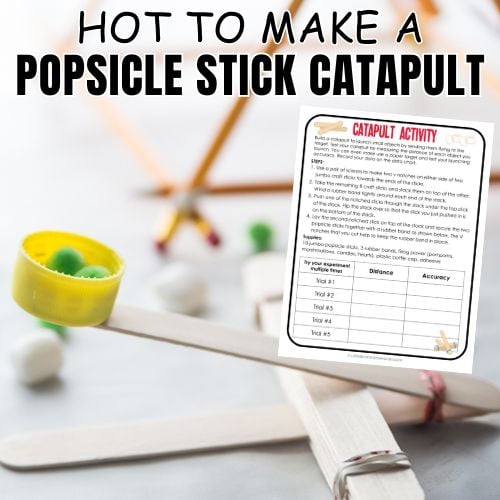
Example Activity: Popsicle Stick Catapult
Build a catapult using craft sticks and rubber bands. Launch marshmallows and see how different levels of force affect the distance traveled. Adjust the angle and magnitude of the applied force to observe changes in motion.
- Science Explanation: The harder you push, the faster and farther the marshmallow flies. This demonstrates Newton’s Second Law, as adding more force increases acceleration, especially for lighter objects like marshmallows.
Third Law of Motion (Action and Reaction)
The Law: For every action, there’s an equal and opposite reaction.
Example Activity: Film Canister Rocket
Fill a film canister with a bit of water, add an effervescent tablet, and seal it quickly. The reaction builds pressure inside, launching the canister into the air, similar to how an airplane gains lift.
- Science Explanation: The gas builds pressure inside the canister, and when it releases, the gas pushes downward, propelling the canister upward. This demonstrates Newton’s Third Law, as the action of gas pushing down results in the reaction of the canister moving up.
Why are these Newton’s Laws Experiments important for kids?
Newton’s Laws of Motion are all around us! From riding a bike to playing on a swing, these laws explain why things move the way they do. Kids can see how forces impact our daily lives by understanding and experimenting with these laws.
💡 Encourage your young experimenters to try these activities, observe the outcomes, and consider why they happen. Science is in motion, and it’s all around us every day!



Helpful Science Resources
Here are a few resources to help you introduce science more effectively to your kids or students and feel confident presenting materials. You’ll find helpful free printables throughout.
- Printable Science Project Pack 👇
- Best Science Practices (as it relates to the scientific method)
- Science Vocabulary
- All About Scientists
- Free Science Worksheets
- DIY Science Kits
- Science Tools for Kids
- Scientific Method for Kids
- Citizen Science Guide
- Join us in the Club