
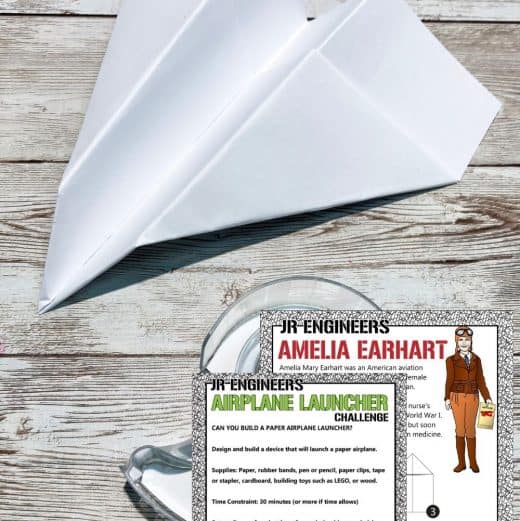
Are you ready for a fun STEM challenge? Learning how to make a paper airplane launcher is a hands-on engineering activity that helps kids explore force, motion, and energy while launching paper airplanes farther and faster.
Instead of throwing a paper airplane by hand, a launcher uses stored energy from a stretched rubber band to create extra thrust. Kids can design their own launcher, test different airplanes, and experiment with launch angles to discover what makes a plane fly the farthest.
This activity works well for classrooms, homeschool science lessons, STEM clubs, or science fair projects.
Recommended grade level: 3–6

How to Make a Paper Airplane Launcher
A paper airplane launcher works like a small catapult. Instead of launching objects across a distance, the launcher sends a lightweight paper airplane forward using elastic energy stored in a rubber band.
When the rubber band stretches, it stores potential energy. When released, that energy converts into kinetic energy, pushing the airplane forward into flight.
This simple device demonstrates the same physics principles used in real aircraft launches and engineering systems. These ideas are part of the science of force and motion. You can explore these ideas further in our guide to force and motion science activities for kids.
💡 Think of the launcher as a miniature runway that gives your plane an extra burst of speed.
Supplies
- Paper for folding airplanes
- Rubber bands (different lengths and thicknesses)
- Large paper clip
- Craft stick
- Tape or stapler
- Cardboard
- Pen or pencil
- Free printable guide below
- Optional building materials such as LEGO bricks, foam board, wood, or other craft materials to make the alternative launcher shown below.
💡 For best results, use a simple airplane design such as a classic dart paper airplane. These designs are stable and work well when launched quickly.
Engineering Design Process
An important part of this activity is following the engineering design process. Engineers rarely build a perfect design on the first try. Instead, they create prototypes, test them, and improve them.
Students can follow these steps while building their launcher.
- Ask – What type of launcher design might work best?
- Imagine – Sketch ideas for your launcher.
- Plan – Decide which materials you will use and how the launcher will work.
- Create – Build your launcher model.
- Test – Launch airplanes and observe the results.
- Improve – Adjust your design to increase flight distance or stability.
👉 Learn more about how engineers solve problems in our guide to the engineering design process for kids.
Paper Airplane Launcher Instructions
Use the materials listed above to build a simple launcher or create your own design.
Step 1: gather materials
You will need a rubber band, craft stick, paper clip, tape, and a paper airplane.
Step 2: prepare the launcher base
Loop the rubber band tightly around the craft stick. The rubber band should stretch easily but remain secure.

Step 3: fold your paper airplane
Fold a paper airplane using a simple design such as the classic dart. Strong folds and smooth wings help the airplane stay stable during launch.

Step 4: attach the paper clip
Bend a large paper clip into an L shape. Attach it to the nose of the airplane so the rubber band can hook onto it.


Step 5: set up the launcher
Hook the rubber band onto the paper clip attached to the airplane.

Step 6: launch the airplane
Hold the craft stick in one hand and pull the airplane back with the other hand to stretch the rubber band. Release the airplane and watch it fly.
Choose a large open space free of strong wind or drafts for the best results.
Alternative Airplane Launcher
With a little ingenuity and simple supplies such as wood, screws or nails, and a rubber band, you can make a fantastic airplane launcher.

Experiment With Your Paper Airplane Launcher
Once your launcher works, students can begin testing different ideas to improve performance.
Engineers test designs repeatedly to understand how changes affect results. Encourage students to change one variable at a time during testing.
Questions to explore:
- How does the launch angle affect flight distance?
- Do thicker rubber bands launch airplanes farther?
- Does stretching the rubber band farther increase speed?
- Which paper airplane design works best with the launcher?
Students can measure flight distance and record results in a data table. Comparing several launches helps identify patterns and improve the design.
Turn This Activity Into a Science Fair Project
A paper airplane launcher can easily become a science fair experiment.
Step 1: ask a research question
Examples:
- How does launch angle affect flight distance?
- How does rubber band thickness affect thrust?
- Which airplane design flies the farthest?
Step 2: form a hypothesis
Write an if–then statement predicting what might happen.
Example:
If the rubber band is thicker, then the airplane will travel farther because thicker rubber bands store more elastic potential energy.
Step 3: test the idea
Launch the airplane multiple times for each test condition and measure the distance traveled.
Step 4: analyze the results
Look for patterns in the data and determine which design worked best.
For help planning a full investigation, see our guide to a paper airplane aerodynamics science project.
Best Paper Airplanes for a Launcher
Not every airplane design works well with a launcher. Lightweight planes may flip or stall during launch, while heavier designs may travel farther but glide less smoothly.
- Students can test several designs to see which performs best.
- Classic dart: Fast and stable. Often produces the longest flights.
- Wide wing glider: Creates more lift and can stay in the air longer.
- Long nose airplane: Provides extra stability during launch.
Testing different airplane designs helps students understand aerodynamics, the science of how air moves around objects in flight.
The Science Behind Paper Airplane Launchers
Forces in Flight
Four major forces affect airplane flight.
Lift: Lift is the upward force that keeps the airplane in the air. Air moving over and under the wings creates lift.
Thrust: Thrust pushes the airplane forward. In this activity, the launcher provides thrust when the rubber band releases.
Drag: Drag is air resistance pushing against the airplane as it moves forward. Streamlined airplane shapes reduce drag.
Gravity: Gravity pulls the airplane toward the ground.
💡 These forces are part of the physics studied in force and motion science for kids.
Energy Transformation
Energy powers the launcher.
Potential energy
When the rubber band is stretched, it stores elastic potential energy.
Kinetic energy
When released, that stored energy becomes kinetic energy, which moves the airplane forward.
💡 Some energy is lost as heat, sound, and air resistance, which eventually slows the airplane. You can explore this concept further in our guide to energy science experiments for kids.
Aviation Inspiration
Early aviators relied on the same forces of flight that affect a paper airplane today.
One of the most famous aviation pioneers was Amelia Earhart, the first woman to fly solo across the Atlantic Ocean. Pilots like Earhart helped scientists and engineers better understand navigation, aircraft design, and long-distance flight. Dive into our What Happened to Amelia Earheart History Detectives project.
Students interested in aviation history can explore more about Amelia Earhart and other pioneers in our women in STEM scientists collection.
Free Paper Airplane Launcher Project
Download the paper airplane launcher project printable to get step-by-step instructions and recording sheets for this activity.
Airplane Launcher FAQ
What is a paper airplane launcher?
A paper airplane launcher is a simple device that uses stored energy—usually from a stretched rubber band—to launch a paper airplane into the air. It works like a small catapult that gives the airplane extra speed and thrust.
How far can a paper airplane launcher launch a plane?
The distance depends on the airplane design, rubber band strength, and launch angle. With a good design, a launcher can send a paper airplane significantly farther than throwing it by hand.
What grade level is a paper airplane launcher STEM project for?
This activity works well for grades 3–6, although younger students can participate with adult guidance.
What variables can you test in a paper airplane launcher experiment?
Students can test launch angle, rubber band thickness, airplane design, and stretch distance to see how each factor affects flight distance.