
Explore number patterns with these free Fibonacci sequence worksheets for kids! Practice addition, fill in missing numbers, and solve fun math puzzles with our printable Fibonacci Number Detective activities.
These simple worksheets are perfect for grades 2–4, math centers, early finishers, or a quick math lesson for Fibonacci Day on November 23. All you need is the printable worksheets and a pencil!
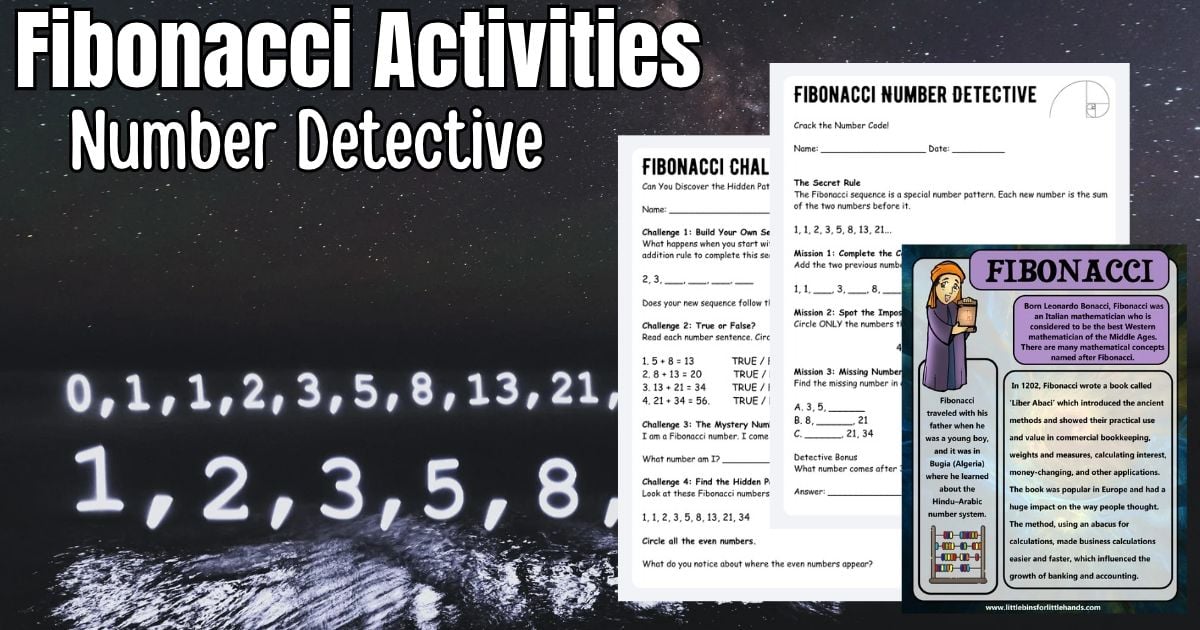
What Is the Fibonacci Sequence?
The Fibonacci sequence is a number pattern where each new number is found by adding the two numbers before it. Here’s how it works:
1, 1, 2, 3, 5, 8, 13, 21, 34, 55…
Look at the pattern:
- 1 + 1 = 2
- 1 + 2 = 3
- 2 + 3 = 5
- 3 + 5 = 8
- 5 + 8 = 13
Can you figure out which number comes next? The Fibonacci sequence is a fun way for elementary students to practice addition, recognize number patterns, and develop mathematical reasoning.
💡 You can even find Fibonacci number patterns in nature, including the spiral arrangements of some pinecones, pineapples, and sunflower seeds!
👉 Explore more Fibonacci Day activities for kids, including printable spiral art and a hands-on nature investigation.
Free Fibonacci Sequence Math Worksheets
Our printable Fibonacci Number Detective mini-pack includes two math worksheets and an answer key.
Kids work through a series of number challenges, starting with simple addition and moving on to discovering hidden patterns.
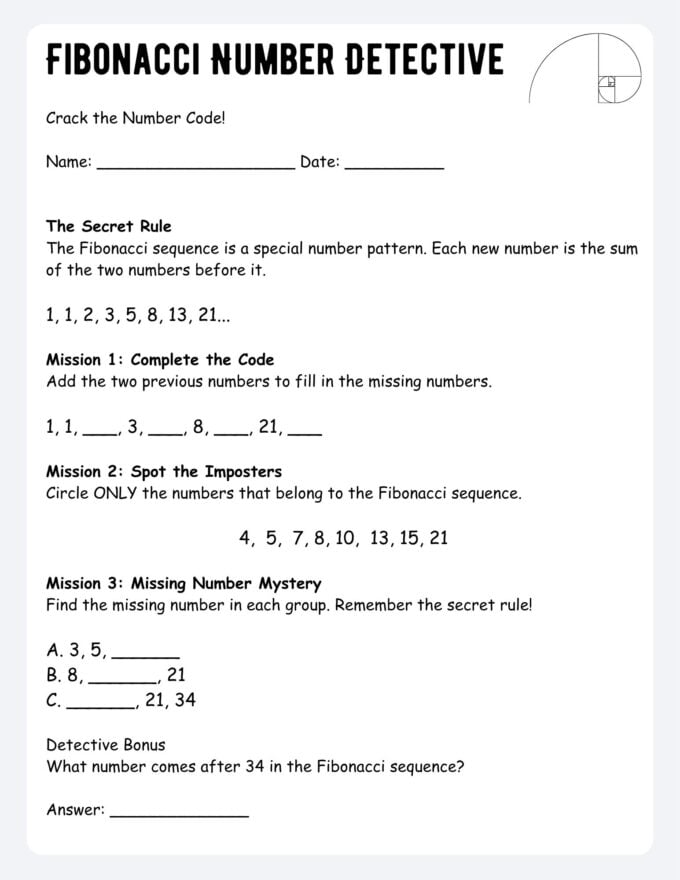
Worksheet 1: Fibonacci Number Detective
Can you crack the Fibonacci number code? This first worksheet introduces students to the Fibonacci addition rule with three short math challenges.
Kids will:
- Complete the Fibonacci sequence by filling in missing numbers.
- Identify which numbers belong to the sequence.
- Solve missing-number addition puzzles.
- Find the next number in the pattern.
Math skills: Addition, number sequences, missing numbers, and pattern recognition.
This is a great starting activity for students who are just learning how the Fibonacci sequence works.
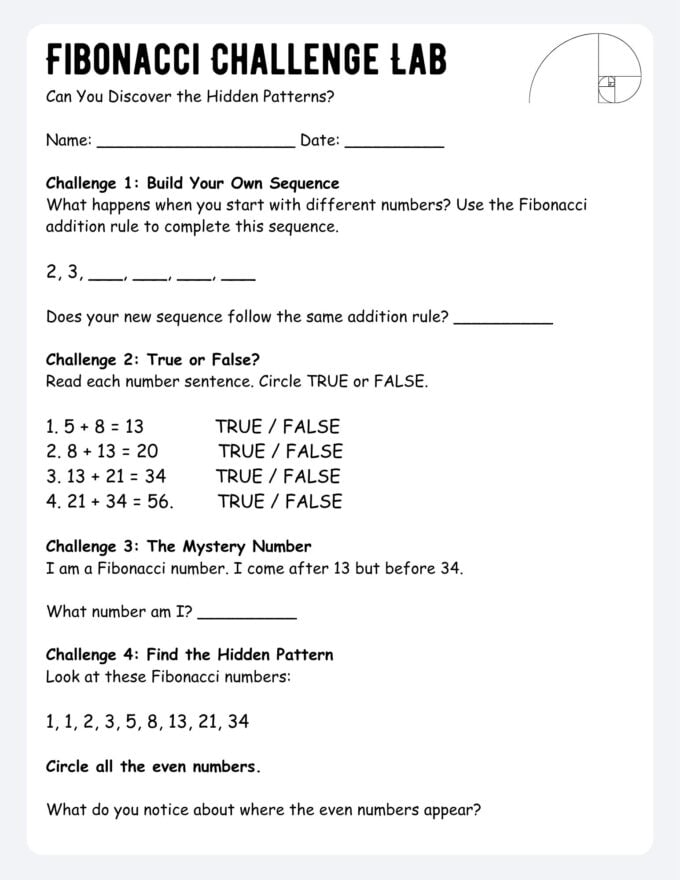
Worksheet 2: Fibonacci Challenge Lab
Ready for a little more math detective work? The second worksheet encourages students to apply the Fibonacci addition rule in new ways.
Kids will:
- Build a new sequence starting with different numbers.
- Solve true-or-false addition problems.
- Identify a mystery Fibonacci number.
- Discover a hidden pattern among the even numbers.
💡 Math skills: Addition, logical thinking, mathematical reasoning, and number patterns.
🔎 Try this: Ask students what they notice about the even numbers in the Fibonacci sequence. Can they figure out where the next even number will appear?
Get Your Free Fibonacci Sequence Worksheets
Ready to put your math detective skills to the test?
Grab our FREE Fibonacci Printable Pack, including the new Number Detective worksheets, answer key, Fibonacci spiral art, and Zentangle coloring activities.
Use these printables for a math center, classroom activity, homeschool lesson, or Fibonacci Day celebration!
👉 Grab our free Fibonacci printable pack
Tips for Using the Fibonacci Worksheets
These printable math activities are easy to adapt for different elementary grade levels.
- For younger students: Start with the first worksheet and provide counters, blocks, or a number line to help with addition.
- For older students: Challenge them to complete both worksheets independently and explain how they found their answers.
- For an extra challenge: Have students choose two different starting numbers and build their own sequence using the Fibonacci addition rule.
For example, start with 3 and 4: 3, 4, 7, 11, 18, 29…
🔎 Students can compare their new number patterns and see how the same addition rule creates different sequences.
More Fun Math Activities for Kids
Keep exploring number patterns, mathematical discoveries, and hands-on STEM activities with these fun projects!
- Fibonacci Day Activities — Explore the Fibonacci sequence through colorful spiral art, Zentangle designs, and patterns in nature.
- Pi Day Activities — Celebrate Pi Day on March 14 with creative math activities and printable projects that explore circles and the number pi.
- Make a Möbius Strip — Explore an unusual mathematical shape with just a strip of paper and a little curiosity.
- Katherine Johnson for Kids — Meet the NASA mathematician whose calculations helped make space exploration possible.
- M.C. Escher Tessellations — Explore repeating geometric shapes and create colorful patterns with a free printable.
- Evelyn Boyd Granville — Another mathematician whose calculations contributed to satellite technology.
- Margaret Hamilton Binary Code Activity — Learn about the computer scientist who helped develop software for NASA’s Apollo missions, then use binary code to turn your name into a pattern of 0s and 1s.

Explore More Famous Scientists and Inventors
Introduce kids to inspiring STEM leaders with our Famous Scientists and Inventors Printable Pack! Explore fascinating people, their discoveries, and hands-on projects that bring science and invention to life.