
Celebrate Fibonacci Day on November 23 with simple math and art activities for kids! Explore the Fibonacci sequence, discover number patterns in nature, and create colorful Fibonacci spiral art with our free printable worksheets.
These hands-on activities are perfect for elementary classrooms, homeschool lessons, or anytime you want to combine math, nature, and creativity.
What Is Fibonacci Day?
Fibonacci Day is celebrated every November 23 because the date, written as 11/23, matches the beginning of the Fibonacci sequence: 1, 1, 2, 3.
It’s a fun opportunity to introduce kids to number patterns, creative math activities, and the surprising ways mathematics connects to the natural world.
You don’t need any special materials to get started! Our printable Fibonacci activities combine simple number sequences with colorful art projects.
What Is the Fibonacci Sequence for Kids?
The Fibonacci sequence is a number pattern where each new number is found by adding the two numbers before it.
Here’s what it looks like:
1, 1, 2, 3, 5, 8, 13, 21, 34…
For example:
- 1 + 1 = 2
- 1 + 2 = 3
- 2 + 3 = 5
- 3 + 5 = 8
- 5 + 8 = 13
Can you figure out what comes next?
🔎 TRY IT: Write the first few Fibonacci numbers on a piece of paper. Have kids use counters, blocks, or drawings to work out the next number in the sequence.
💡 Younger kids can practice adding small numbers, while older students can see how far they can extend the pattern.
Who Was Fibonacci?
Leonardo of Pisa, better known as Fibonacci, was an Italian mathematician who lived during the Middle Ages. He helped introduce important mathematical ideas to Europe, including the number pattern we now call the Fibonacci sequence.
Although this pattern was known to mathematicians in India long before Fibonacci, his work helped make it widely known in Europe. Today, Fibonacci numbers are studied in mathematics, science, art, and nature.
Fibonacci Day Art Activities
Explore the connection between math and art with these two printable Fibonacci projects. Both are easy to set up with common classroom supplies.
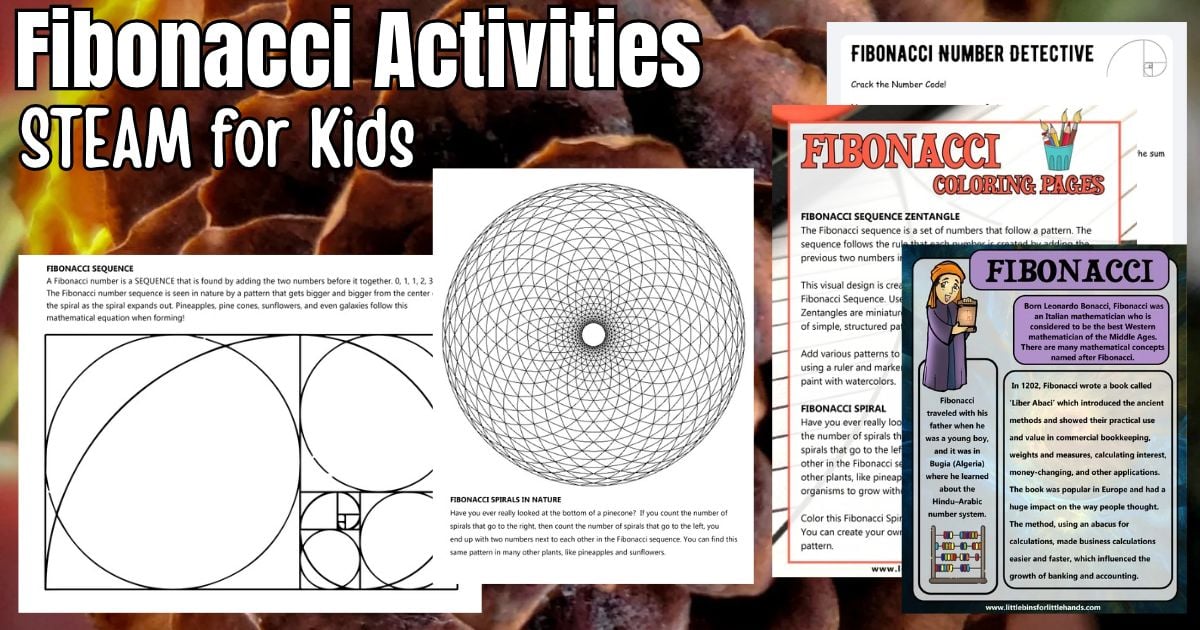
1. Fibonacci Sequence Zentangle Art
Combine number patterns and creative drawing with this colorful Fibonacci zentangle art project.
A zentangle is a design made by repeating simple lines, shapes, and patterns. Our printable provides a Fibonacci-inspired layout that kids can fill with their own creative designs.
Supplies:
- Printable Fibonacci art page
- Black marker
- Ruler
- Colored pencils, markers, or watercolors
Instructions:
- Print the Fibonacci zentangle template.
- Use a black marker to add patterns to the different sections of the design.
- Try stripes, dots, circles, waves, zigzags, or repeating shapes.
- Color each section using your favorite art materials.

Math connection: Look at how the different sections change in size. Discuss how adding the previous two numbers creates larger numbers in the Fibonacci sequence.


2. Fibonacci Spiral Art
Turn a mathematical pattern into colorful spiral art with our printable Fibonacci spiral. Create the spiral by drawing curves through squares whose side lengths follow the Fibonacci sequence.
Supplies:
- Printable Fibonacci spiral
- Markers, crayons, or colored pencils
- Watercolors (optional)
Instructions:
- Print the Fibonacci spiral coloring page.
- Look at the squares and follow how the spiral curves through the design.
- Color the sections to highlight the changing sizes.
- Add your own patterns or colors to turn the spiral into an original piece of art.

Math connection: Look for squares that follow the pattern 1, 1, 2, 3, 5, and 8. How does the spiral change as the squares get larger?


Free Printable Fibonacci Activities
Ready to explore number patterns and create your own Fibonacci art?
👉 Grab our free Fibonacci printable pack, including coloring pages and activities for exploring the Fibonacci sequence. Also includes Fibonacci number detective worksheets. Use these printables for Fibonacci Day, math centers, early finisher activities, or a simple math-and-art lesson.
Fibonacci Numbers in Nature
Did you know that Fibonacci number patterns appear in some plants?
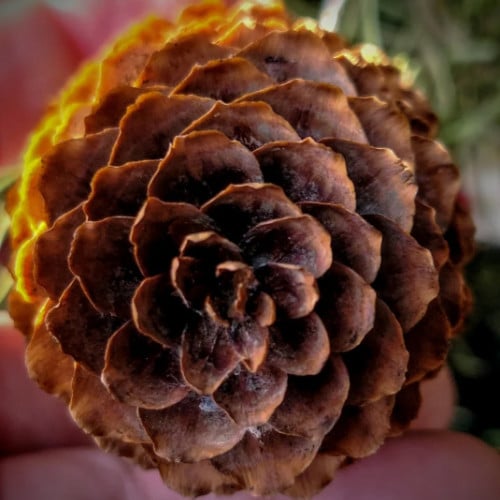
🔎 Look closely at pinecones, pineapples, and sunflower seed heads. You may notice spirals that curve in different directions.
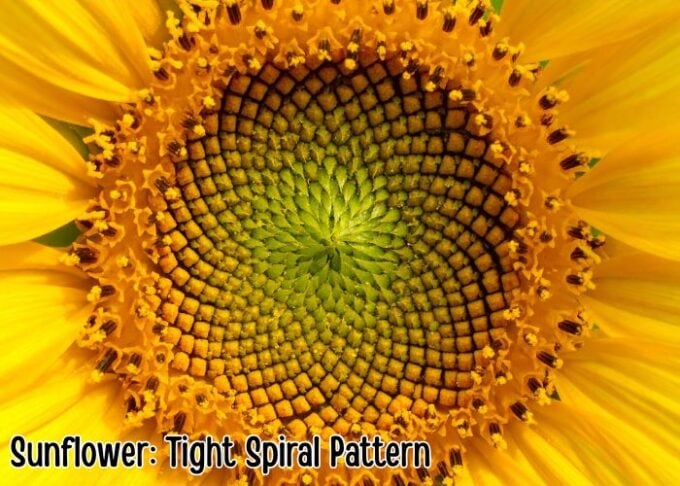
In many examples, the number of spirals in each direction matches two neighboring Fibonacci numbers, such as 5 and 8 or 8 and 13.
💡 Not every natural spiral follows the Fibonacci sequence, but looking for these patterns makes a fascinating math and nature investigation. See more about patterns in nature here.
Try a Pinecone Fibonacci Investigation
You need: A pinecone and a piece of paper.
- Look closely at the overlapping scales on your pinecone.
- Find a spiral that curves in one direction.
- Count the spirals going that way.
- Look for spirals curving in the opposite direction and count those too.
- Compare your results with the Fibonacci sequence.
Ask: Do your spiral counts match Fibonacci numbers? What other patterns can you find? This is a simple way to connect number patterns to a hands-on nature lesson.
What Is the Golden Ratio?
The golden ratio is a mathematical relationship of approximately 1.618. As Fibonacci numbers get larger, dividing one number by the previous number produces a result that gets closer to the golden ratio.
⭐️ For example, 13 ÷ 8 = 1.625.
💡 Younger kids don’t need to calculate the golden ratio to enjoy Fibonacci activities. Recognizing the number pattern and exploring spirals is a great place to start!
More Fun Math Activities for Kids
Keep exploring number patterns, mathematical discoveries, and hands-on STEM activities with these fun projects!
- Fibonacci Sequence Worksheets — Explore the Fibonacci sequence with quick but engaging math challenges.
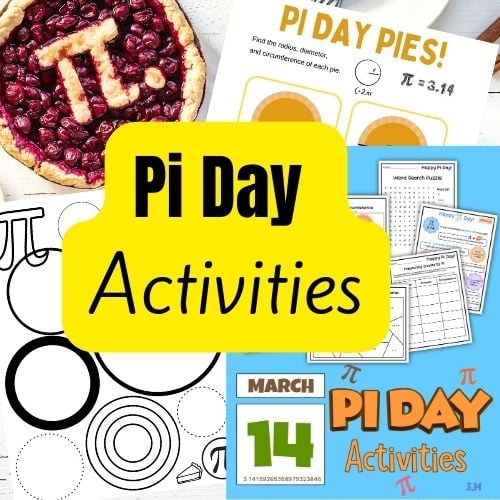
- Pi Day Activities — Celebrate Pi Day on March 14 with creative math activities and printable projects that explore circles and the number pi.
- Make a Möbius Strip — Explore an unusual mathematical shape with just a strip of paper and a little curiosity.
- Katherine Johnson for Kids — Meet the NASA mathematician whose calculations helped make space exploration possible.
- M.C. Escher Tessellations — Explore repeating geometric shapes and create colorful patterns with a free printable.
- Evelyn Boyd Granville — Another mathematician whose calculations contributed to satellite technology.
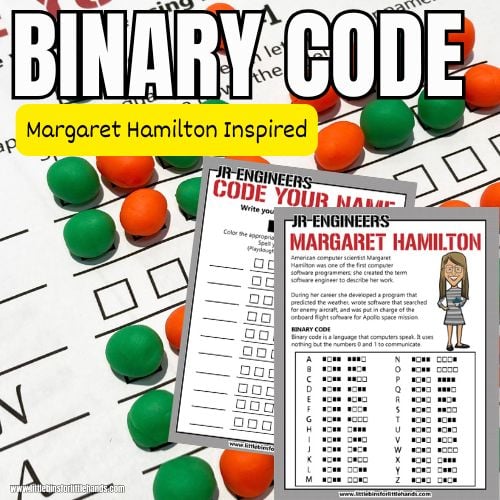
- Margaret Hamilton Binary Code Activity — Learn about the computer scientist who helped develop software for NASA’s Apollo missions, then use binary code to turn your name into a pattern of 0s and 1s.

Explore More Famous Scientists and Inventors
Introduce kids to inspiring STEM leaders with our Famous Scientists and Inventors Printable Pack! Explore fascinating people, their discoveries, and hands-on projects that bring science and invention to life.