
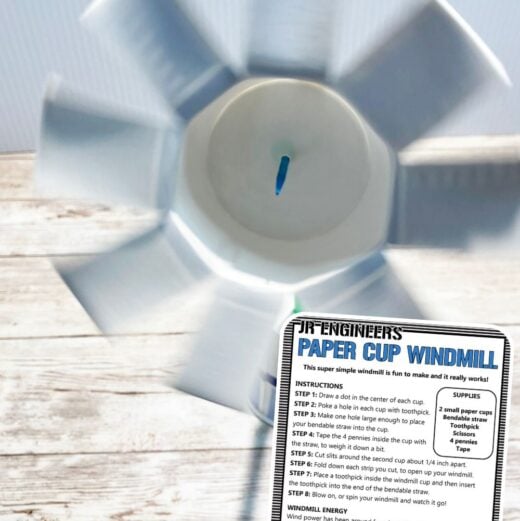
Learn how to make a simple windmill with paper cups, a straw, and a toothpick! This easy windmill project for kids is a fun way to explore wind power, force and motion, simple machines, engineering design, and renewable energy.
Whether you’re looking for a school windmill project, a STEM challenge, or a hands-on engineering activity, this DIY windmill demonstrates how moving air can create motion and transfer energy.
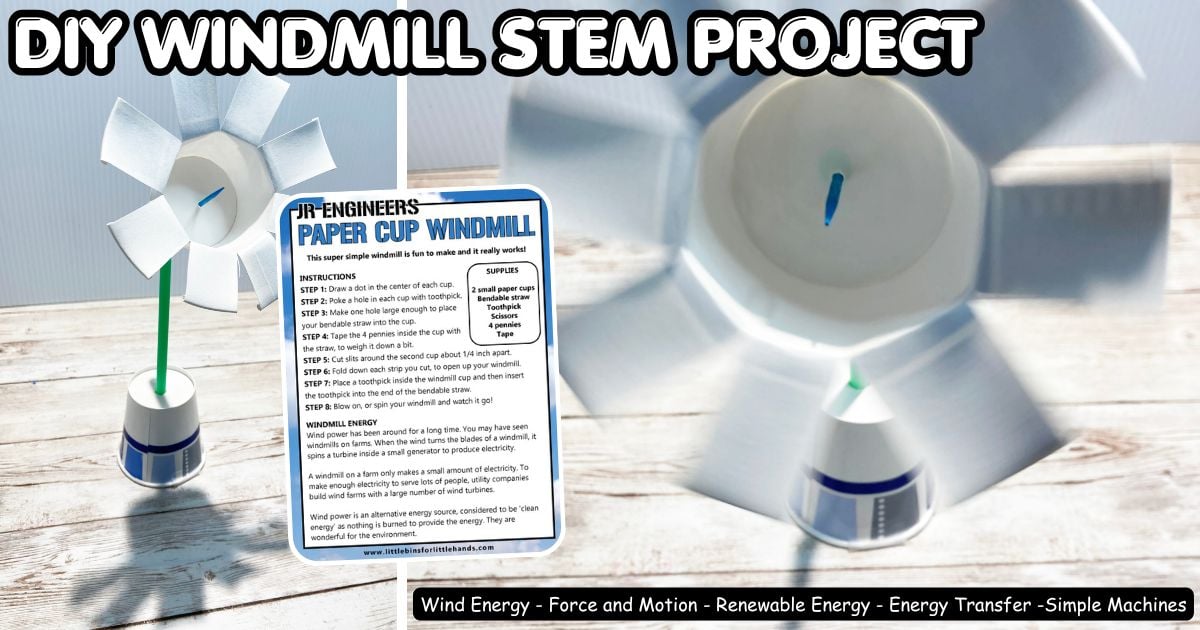
Windmill STEM Activity
- Field of Science: Engineering & Renewable Energy
- Grade Level: 2nd–5th Grade
- Concepts Explored: Wind Energy, Force and Motion, Renewable Energy, Energy Transfer, Simple Machines, Engineering Design
Pair It With a Book
Read Energy Island by Allan Drummond before building your windmill. This inspiring picture book tells the true story of the Danish island of Samsø and how its residents worked together to harness renewable energy, including wind power.
👉 After reading, challenge kids to build and test their own windmill while discussing how people use wind energy to solve real-world problems.
Talk About It
- Why do people use wind energy?
- What are some benefits of renewable energy?
- How is your windmill similar to a real wind turbine?
- How is it different?
Supplies
Teacher Tip
This project was originally designed with small 3-ounce paper cups. Through troubleshooting with a librarian preparing a STEAM Storytime, we found that larger 8-ounce and 12-ounce cups can become too heavy to spin easily. Lightweight cups, a bendable straw, and a toothpick or small skewer produce the best results.
- 2 small paper cups (3-ounce size works best)
- Bendable straw
- Toothpick
- Scissors
- 4 pennies
- Tape
How to Make a Windmill
STEP 1
Draw a dot in the center of each paper cup.
STEP 2
Use a toothpick to poke a hole through the center of each cup.
STEP 3
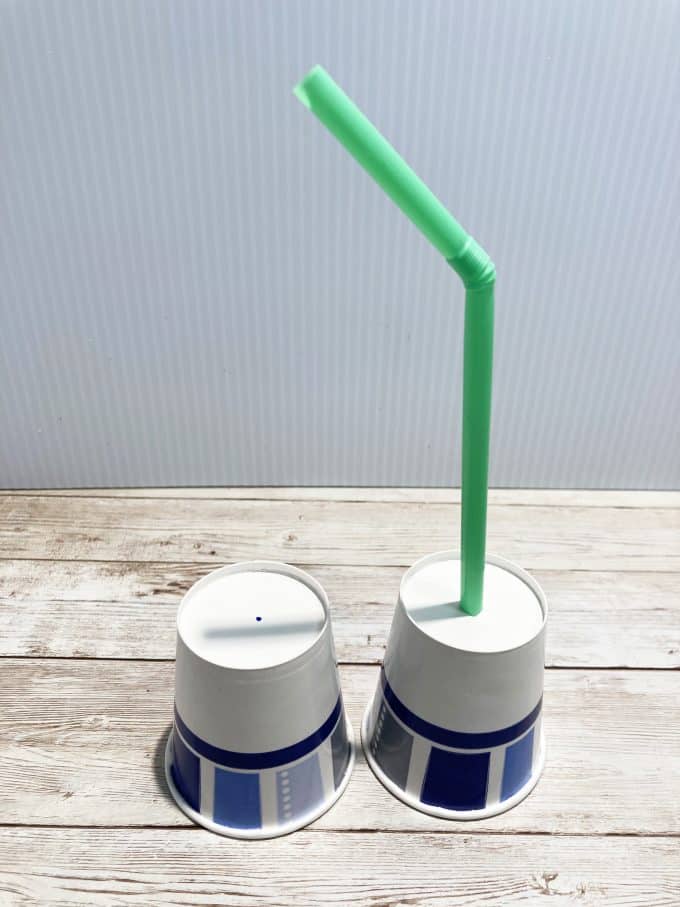
Make one hole slightly larger so the bendable straw fits snugly inside.
STEP 4
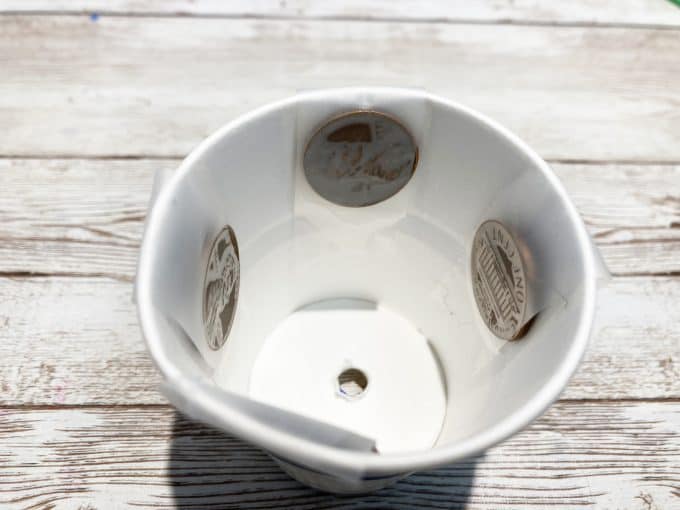
Tape four pennies inside the cup that contains the straw to help stabilize the windmill.
STEP 5
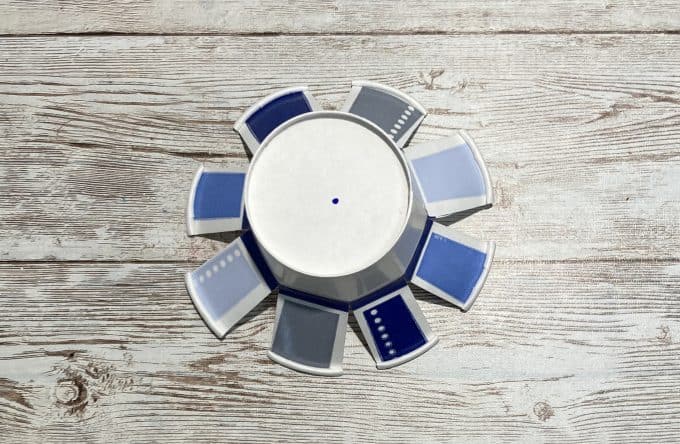
Cut narrow slits around the rim of the second cup.
STEP 6
Fold each strip outward to create blades.
STEP 7
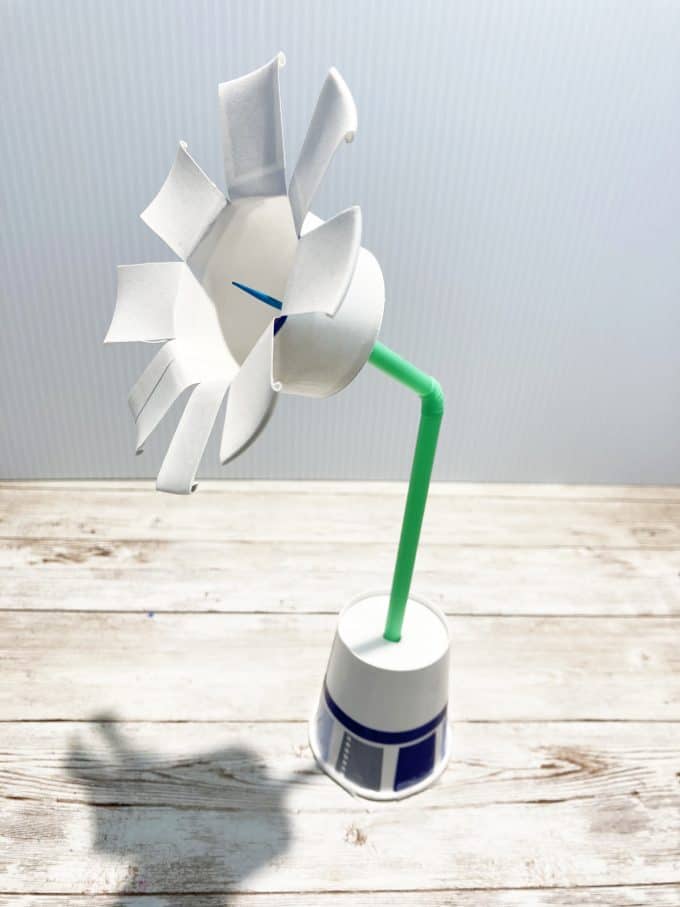
Push a toothpick through the center of the blade cup. Insert the toothpick into the bendable end of the straw.
STEP 8
Blow gently on the blades or take your windmill outside and let the wind spin it.
Watch your windmill in action!
What Makes a Windmill Spin?
Wind is moving air.
Moving air contains kinetic energy, which is the energy of motion. When air pushes against the blades, it applies a force that causes the windmill to spin.
The stronger the wind, the greater the force on the blades and the faster the windmill may rotate.
💡 This simple activity demonstrates how force creates motion and how energy transfers from one object to another.
The Science Behind This Windmill Project
Force
A force is a push or a pull. In this activity, moving air pushes against the blades and causes them to move.
👉 Explore more Force and Motion Activities for Kids.
Motion
The force of the wind creates motion as the blades rotate around the center point. Motion is all around us, from spinning windmills to rolling cars and flying paper airplanes.
Energy Transfer
The kinetic energy of moving air is transferred to the spinning blades. This is an example of energy transfer, an important concept in both physics and engineering.
👉 Continue exploring with our Energy Activities for Kids.
Simple Machines
This activity demonstrates a wheel and axle, one of the six simple machines. The blades serve as the wheel, while the center shaft serves as the axle.
👉 Learn more about Simple Machines for Kids.
Renewable Energy
Wind is a renewable energy source because it is naturally replenished and can be used repeatedly.
Wind power is one example of renewable energy. Solar and hydropower are other renewable energy sources used around the world.
👉 Discover more Renewable Energy Activities for Kids.
How Does a Windmill Work?
When wind pushes against the blades of a windmill, the blades spin around a central shaft called an axle.
Traditional windmills used this spinning motion to grind grain, pump water, and perform other types of mechanical work.
Modern wind turbines use a similar design. Instead of doing mechanical work directly, the spinning blades turn a generator that produces electricity.
Both windmills and wind turbines capture the kinetic energy of moving air and convert it into useful energy.
👉 Want to compare a traditional windmill with a modern turbine? Try our Wind Turbine Project.
Windmill Troubleshooting Tips
If your windmill isn’t spinning, check these common issues:
- Use lightweight paper cups whenever possible. Larger cups may be too heavy for the axle to rotate easily.
- Make sure the straw is not squeezing the toothpick too tightly.
- The blades should move freely without rubbing against the straw.
- Add weight to the bottom cup to help keep the windmill balanced and upright.
- A bendable plastic straw typically creates less friction than a paper straw.
- Try a stronger fan or test your windmill outdoors on a breezy day.
💡 Remember, engineers often redesign and improve their first prototype. If your windmill doesn’t work right away, make one change at a time and test again. Learn more about the engineering design process here.
Think Like an Engineer
Engineers use the Engineering Design Process to design, test, and improve solutions.
Try changing one variable at a time and observe what happens.
- Which windmill spins the fastest?
- Do larger blades spin better than smaller blades?
- What happens if you add more blades?
- Does changing the blade angle affect performance?
- Can your windmill spin outdoors using natural wind?
- Which design improvements work best?
Questions for Reflection
- What caused the windmill to move?
- How did force create motion?
- How was energy transferred in this activity?
- Which design worked best?
- What changes improved performance?
- Why is wind considered a renewable energy source?
Free Windmill STEM Project Printable
Grab your free Windmill STEM Project Guide!
This printable includes:
- Step-by-step directions
- Engineering challenge ideas
- Observation sheet
- Reflection questions
- STEM extension activities
Perfect for STEM lessons, science centers, homeschool projects, and classroom investigations.
More Wind Energy Activities for Kids
👉 Looking for more ways to build, test, and problem-solve? Explore our Engineering Projects for Kids


Frequently Asked Questions
How does a windmill work? Wind pushes against the blades, causing them to spin around an axle.
What type of energy powers a windmill? Windmills use the kinetic energy found in moving air.
Is a windmill the same as a wind turbine? No. Traditional windmills perform mechanical work, while wind turbines generate electricity.
Why won’t my windmill spin? Check that the blades can move freely, the straw is not creating too much friction, and the windmill is balanced properly. Lightweight cups often work best.
What STEM concepts does this activity teach? Kids explore force, motion, energy transfer, simple machines, renewable energy, engineering design, and problem-solving.
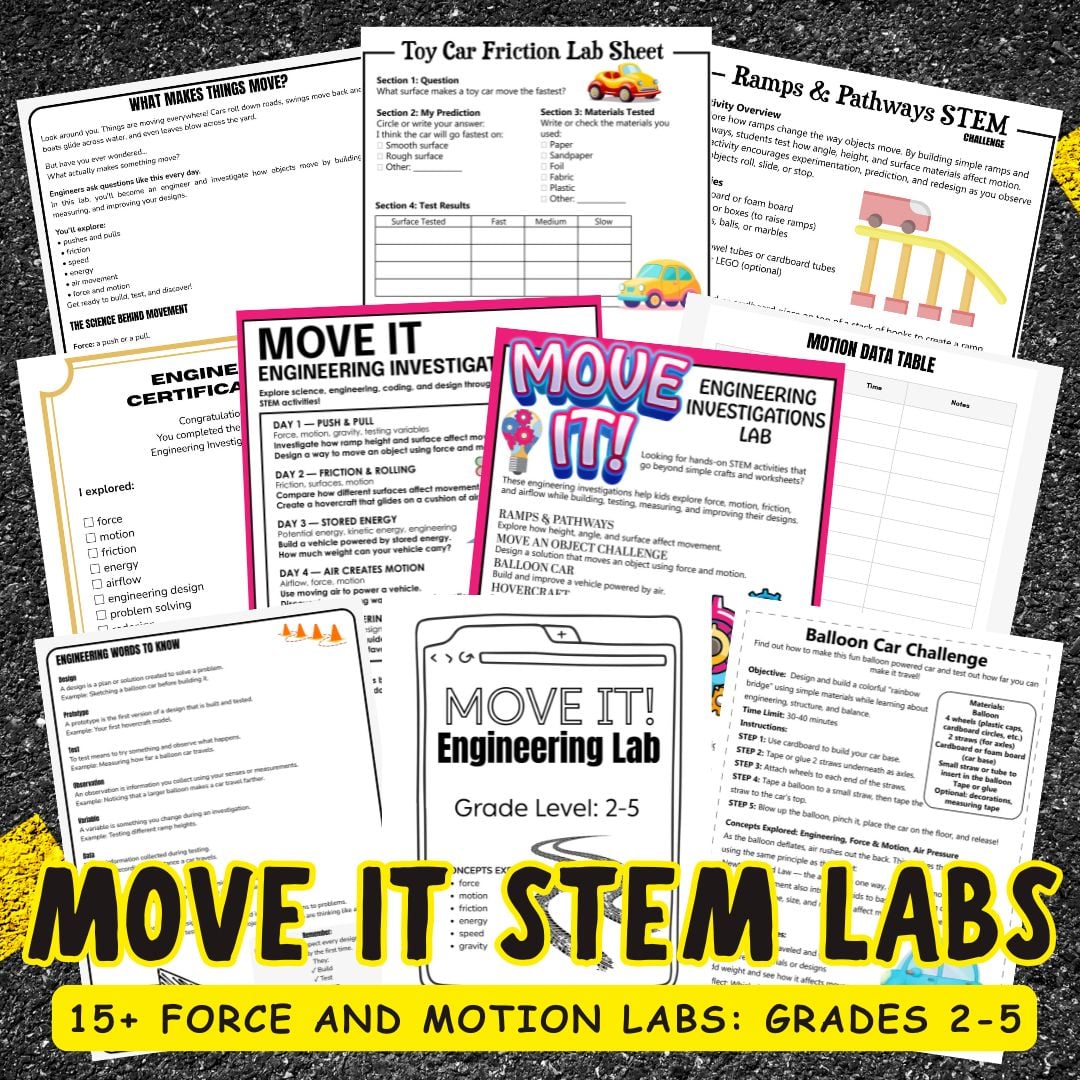
Move It! Engineering Investigations Lab
Help kids explore force, motion, friction, airflow, and energy through hands-on engineering challenges that encourage them to build, test, measure, and improve designs.
✔ Engineering investigations that go beyond worksheets
✔ 5-day STEM plan included
✔ Engineering notebook and planning pages
✔ Build, test, redesign, and improve challenges
✔ Grades 2–5
👉 Get the Complete Lab