
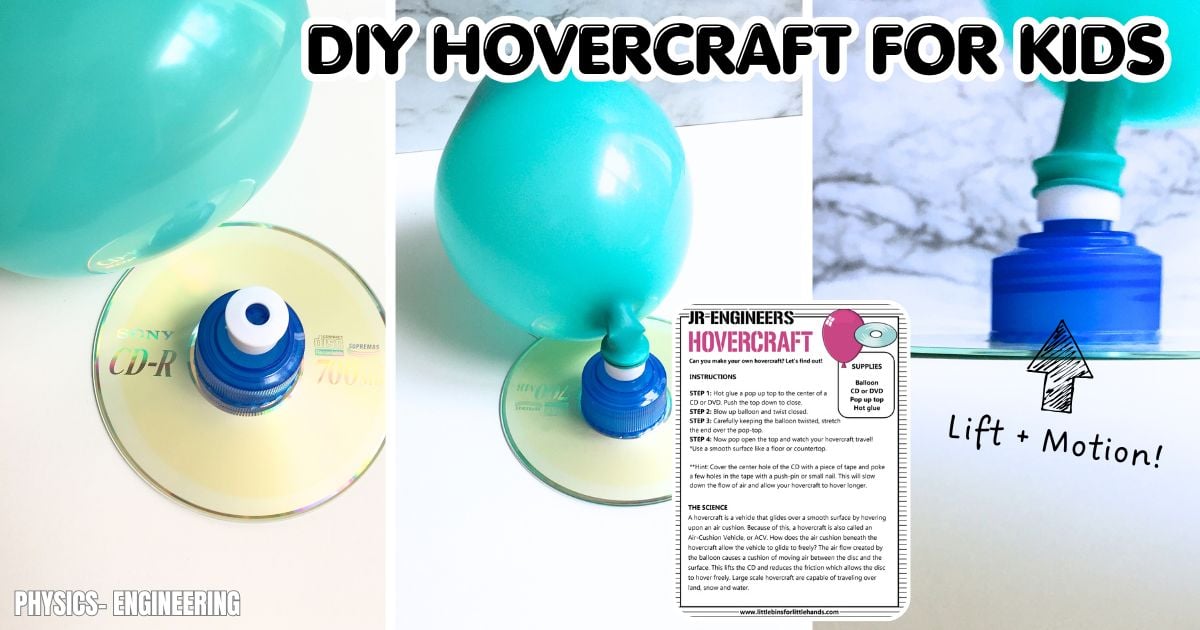
Learn how to make a DIY hovercraft for kids using a balloon, CD, and a few simple supplies. This homemade hovercraft STEM project demonstrates air pressure, friction, force, and engineering design in a hands-on way that kids love. Perfect for classrooms, homeschool activities, STEM clubs, and science fair projects, this hovercraft experiment encourages testing, problem-solving, and redesign.
If your kids enjoy building things that move, this hovercraft activity is a fantastic introduction to engineering. They’ll discover how air can reduce friction and help an object glide across a surface while exploring important physics concepts through play.
👉 Explore more force and motion engineering activities here
Science Concepts
Hovercrafts glide on a cushion of air that reduces friction between the vehicle and the surface below. In this project, kids will explore how air pressure and motion work together while building a simple homemade hovercraft.
- Field: Physics & Engineering
- Grades: 2–5
- Concepts Explored: Air pressure, friction, force, motion, lift, engineering design, testing and redesign.
Supplies Needed
- Balloon
- CD or DVD
- Pop-up bottle cap top
- Hot glue
- Tape (optional)
How To Make A Hovercraft
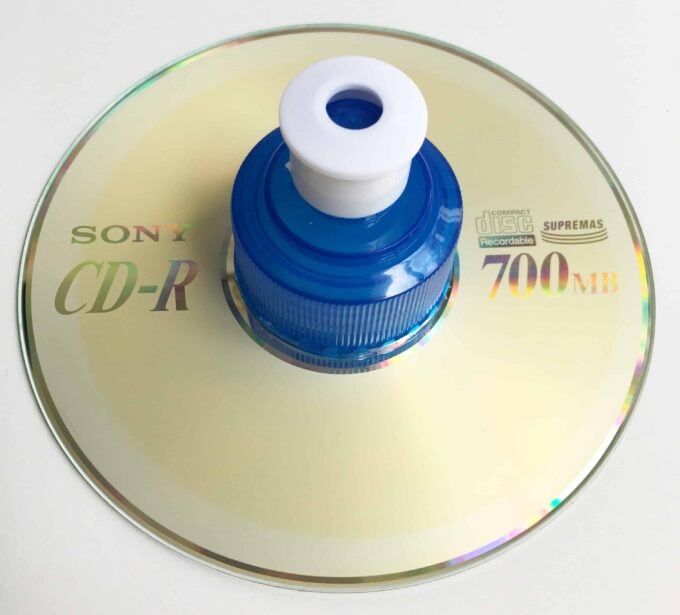
STEP 1: Hot glue a pop up top to the center of a CD or DVD. Push the top down to close.
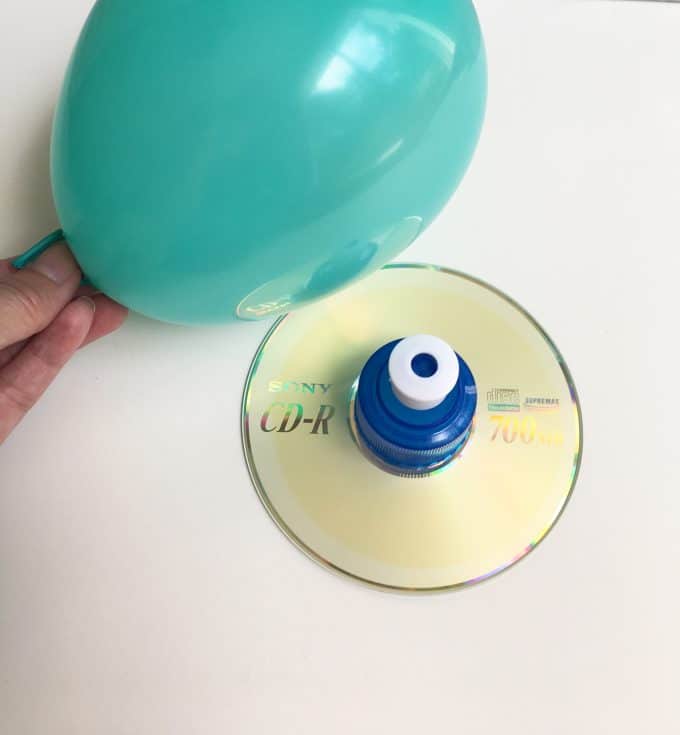
STEP 2: Blow up the balloon and twist it closed.
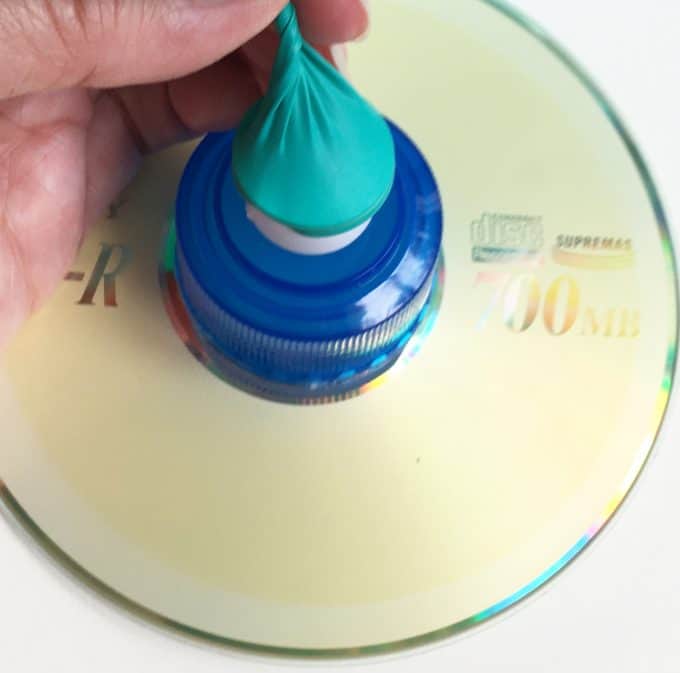
STEP 3: Carefully keeping the balloon twisted, stretch the end over the pop-top.
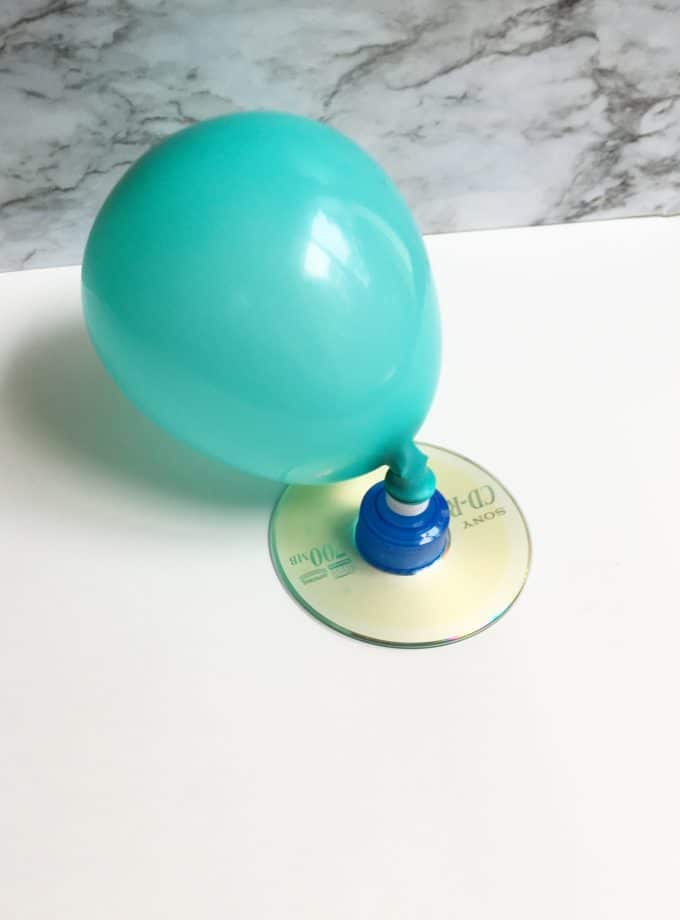
STEP 4: Now pop open the top and watch your hovercraft travel! Use a smooth surface like a floor or countertop.
💡TIP: Cover the center hole of the CD with a piece of tape and poke a few holes in the tape with a push-pin or small nail. This will slow down the flow of air and allow your hovercraft to hover longer.
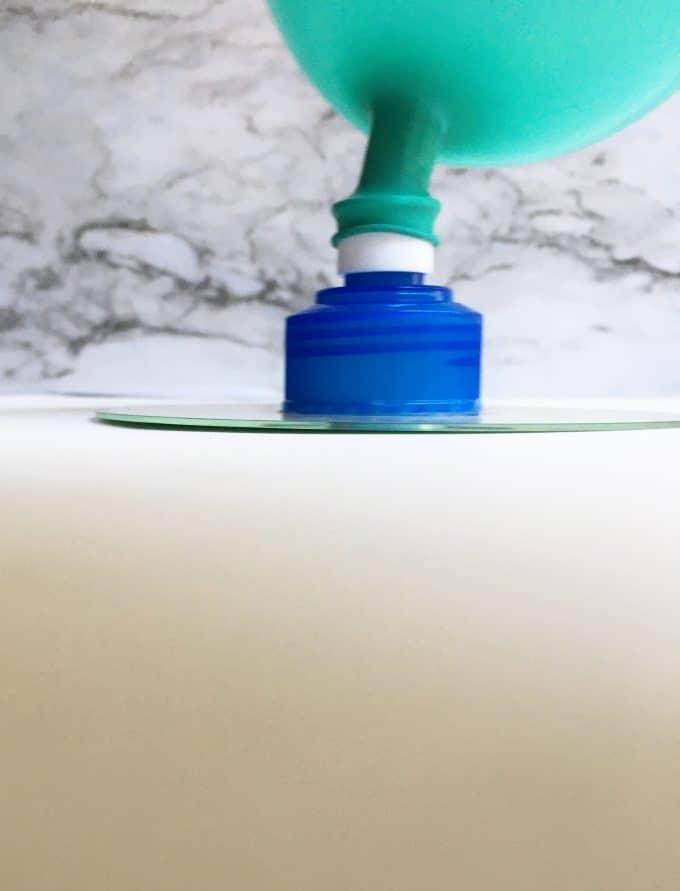
Hovercraft Tip
Cover the center hole of the CD with a small piece of tape and poke several tiny holes through the tape with a pushpin. This slows the airflow and may allow your hovercraft to hover longer.
How Does A Hovercraft Work?
A hovercraft is also known as an Air Cushion Vehicle (ACV) because it rides on a cushion of air rather than wheels.
When you blow up the balloon, you store energy in the stretched rubber. As soon as the pop-top opens, air rushes out beneath the CD. The moving air spreads underneath the hovercraft and creates a thin cushion between the CD and the surface below.
This cushion of air reduces contact with the surface, which reduces friction. With less friction slowing it down, the hovercraft can glide smoothly across the floor.
What Is Friction?
Friction is a force that resists motion when two surfaces rub against each other.
You experience friction every day when:
- A toy car slows down on carpet.
- Your shoes grip the ground when you walk.
- A book slides across a table and eventually stops.
Normally, friction slows objects down. Hovercrafts are designed to reduce friction by creating a layer of air between the vehicle and the surface.
Because the hovercraft is riding on air, it can move more easily than an object sliding directly on the ground.
👉 Try this friction experiment to learn more
What Is Air Pressure?
Air pressure is the force exerted by air molecules pushing against surfaces.
When the balloon releases air beneath the hovercraft, the pressure beneath becomes greater than the pressure above. This pressure difference helps support the hovercraft and allows it to glide.
The same principle is used in many real-world engineering systems that rely on moving air.
What Creates Lift?
Lift is an upward force that helps an object rise above a surface.
In this hovercraft project, the escaping air creates a small amount of lift beneath the CD. While the hovercraft doesn’t fly, the air cushion slightly lifts it above the surface, reducing friction and making movement easier.
Real Hovercrafts
Real hovercrafts use powerful engines and fans to create large cushions of air beneath the vehicle.
Because they ride on air instead of wheels, hovercrafts can travel across:
- Water
- Ice
- Mud
- Sand
- Grass
- Pavement
Some hovercrafts are even large enough to carry passengers, vehicles, and cargo.
👉 Ready to explore more ways objects move? Try a Balloon Car, Rubber Band Car, Fan Powered Car, or Paper Helicopter activity. Each project investigates force, motion, energy, and engineering design in a different way.
Hovercraft Engineering Challenge
Real engineers test and improve their designs.
Instead of building your hovercraft once, challenge yourself to investigate what changes its performance.
Which Balloon Works Best?
Test:
- Small balloon
- Medium balloon
- Large balloon
Measure:
- Distance traveled
- Hover time
Which Surface Works Best?
Test your hovercraft on:
- Tile
- Hardwood
- Laminate
- Smooth tabletop
How does friction affect movement?
Can Your Hovercraft Carry Cargo?
Add small items such as:
- Paper clips
- Coins
- Erasers
- Small blocks
How much weight can your hovercraft carry before performance changes?
Can You Improve The Design?
Try changing:
- Balloon size
- Amount of air
- Number of holes in the tape
- Weight of the hovercraft
Record your observations and compare results.
Get Your Free Printable Hovercraft STEM Project
Download the free printable hovercraft project guide, engineering challenge sheet, and observation pages to extend the learning.
Run multiple trials and compare your results.
Hovercraft FAQ
What surface works best for a hovercraft?
Smooth surfaces such as tile, laminate, hardwood, and countertops usually allow the hovercraft to move most easily because they create less friction.
Why won’t my hovercraft move?
Make sure the balloon contains enough air, the pop-top is fully open, and the hovercraft is placed on a smooth surface.
Can I use a DVD instead of a CD?
Yes. Both CDs and DVDs work well for this project.
Why does the hovercraft slow down?
As air escapes from the balloon, the cushion of air becomes smaller. Friction increases and the hovercraft gradually slows down.
Is this a good science fair project?
Yes. Hovercrafts are excellent for science fair projects because you can test variables such as balloon size, weight, and surface type.
What science concepts does a hovercraft demonstrate?
This activity explores air pressure, friction, force, motion, lift, energy transfer, and engineering design.
Can younger kids make this project?
With adult assistance for the hot glue, many younger children can help build and test the hovercraft while older students can design investigations and collect data.
More Movement STEM Activities
This hovercraft project is part of a larger group of movement-based STEM activities that explore force, friction, energy, and motion. Kids can compare different ways objects move using air, stored energy, gravity, and engineering design.
- Balloon Car
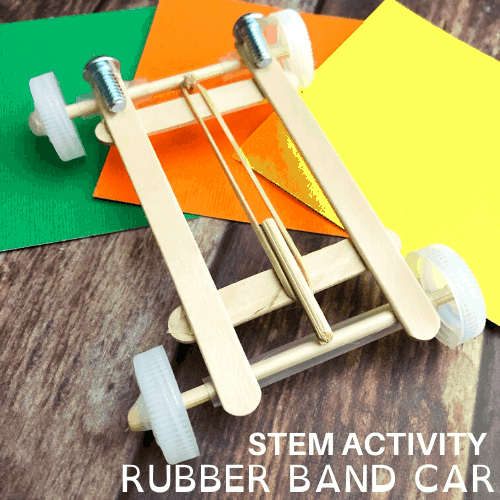
- Rubber Band Car
- Fan Powered Car
- Water Wheel
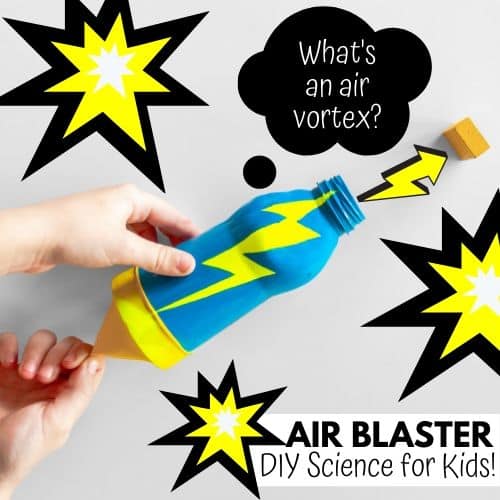
- Air Cannon
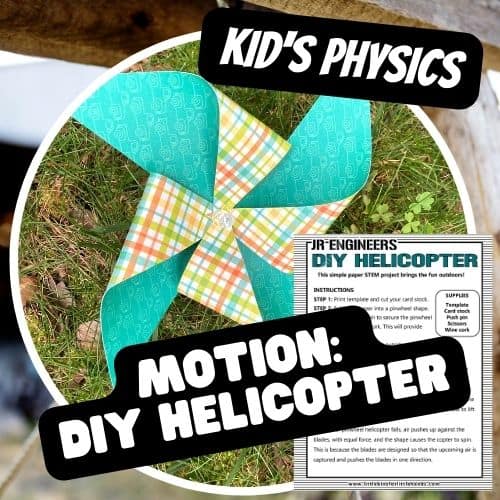
- Paper Helicopter
- Marble Run
- Windmill STEM Challenge

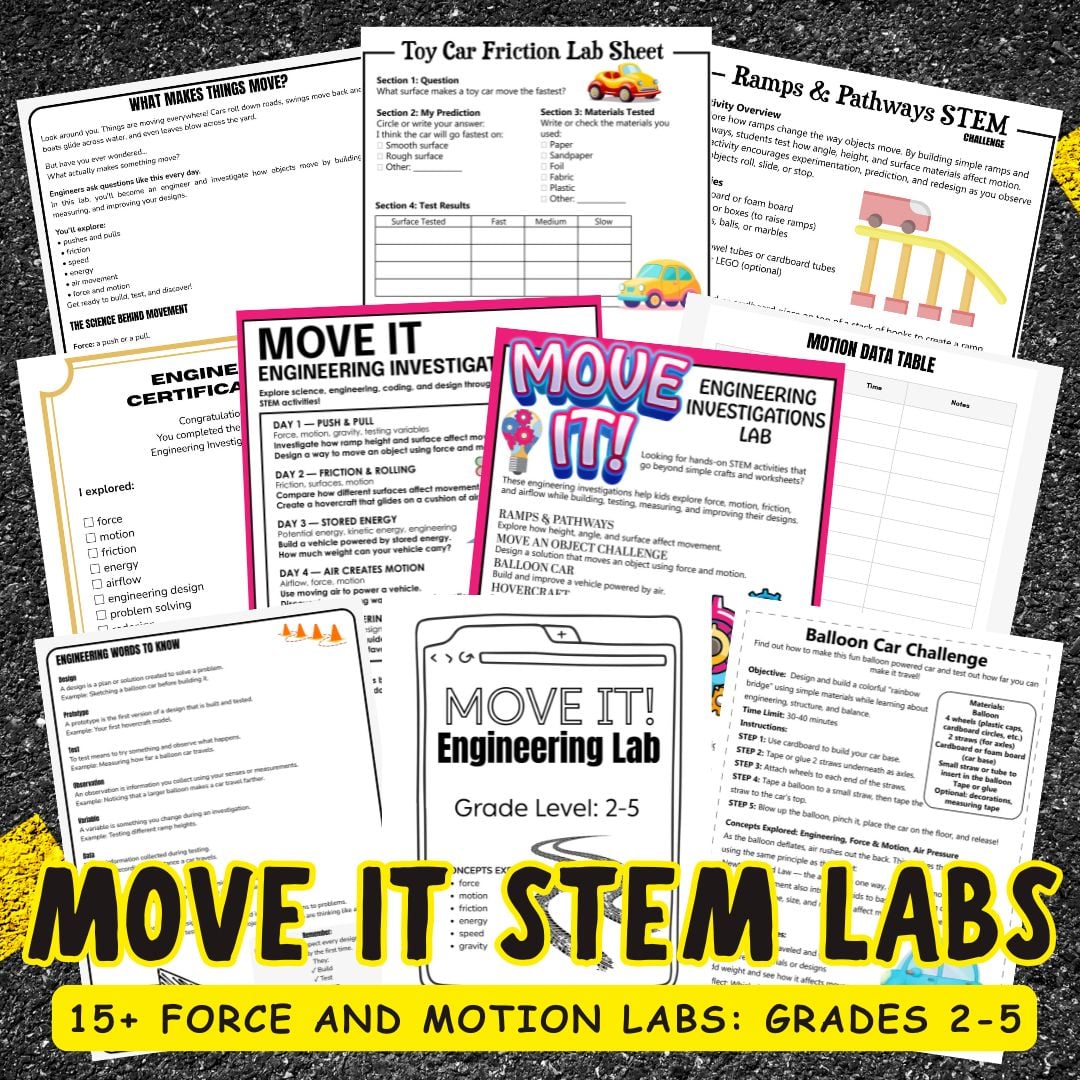
Move It! Engineering Investigations Lab
Help kids explore force, motion, friction, airflow, and energy through hands-on engineering challenges that encourage them to build, test, measure, and improve designs.
✔ Engineering investigations that go beyond worksheets
✔ 5-day STEM plan included
✔ Engineering notebook and planning pages
✔ Build, test, redesign, and improve challenges
✔ Grades 2–5
👉 Get the Complete Lab