

Have you ever wondered how fast you can catch something falling? Reaction times can vary from person to person, and this simple test can help you measure how quick you are! Let’s explore the science behind reflexes with this reaction time experiment!

What Is Reaction Time?
When you see an object falling, your eyes send signals to your brain to process the visual information. Your brain sends signals to your muscles to move and catch the object. This whole process is called a reaction. Biology is exciting!
💡The efficiency of your neural pathways influences reaction time and can vary based on many factors, like age, focus, and practice.
Nervous System
The nervous system is like a communication network in your body. It sends messages between the human brain, spinal cord, and the rest of the body. When you see the ruler start to fall, your eyes send a message to your brain. Then, your brain quickly tells your hand muscles to move and catch the ruler. This process happens in a split second, thanks to your nervous system!
Reflexes
Reflexes are your body’s automatic responses to things around you. When you touch something hot, your body quickly pulls your hand away without you thinking about it. This is a reflex! Reaction time is how quickly you can respond to something you see, hear, or feel.
💡This experiment tests how quickly your body and brain work together to catch a falling ruler. Who has the faster reaction time?
- Reflexes are fast, automatic responses.
- Reaction time is how long it takes for your brain to tell your muscles to move.
- Practice can help improve reaction time.
Reaction Time Lab
Grade Level: This experiment is suitable for grades 4 to 8.
💡This reaction time experiment makes a great science fair project for kids! See our suggestions further below!
Supplies:
- Participants
- A ruler (12 inches)
- Observation sheet (see below for free printable)
- Pencil
Instructions:
💡 This is a great tool to measure alertness and cognitive ability. Use the free printable below to record times.
- Find a flat surface with ample space to drop the ruler and catch it without obstructions.
- Sit comfortably at a table with your arm extended and hand hanging over the edge.
- Have your partner hold the ruler vertically with the zero mark at the top between your thumb and the index finger.
- Without warning, your partner will release the ruler.
- The goal is quickly catching the ruler between your thumb and index finger.
- Record the measurement on the ruler at the point where you caught it. This is your reaction time.
- Repeat the test 5 more times and record each result.

How To Apply the Scientific Method
💡 This is a great opportunity to learn about the scientific method and variables!
Ask a Question: How does practice affect your reaction time? Do different conditions (like closing your eyes, hearing a sound, etc.) affect reaction time?
Research: Explore how reflexes and reaction times work in the human body. Reaction time is influenced by a variety of factors including fatigue, distractions, and age.
Hypothesis: Formulate a hypothesis. Example: “If I practice catching the ruler multiple times, then my reaction time will improve.”
Experiment: Follow the steps above to measure reaction times under different conditions. Use a partner to ensure the ruler is dropped randomly. Record your measurements each time. Try adding variations, like changing the hand used or doing the test with and without looking.
Observations and Data: Record each attempt’s result on the observation sheet and note any noticeable differences between attempts or conditions.
Analysis: Calculate the average reaction time from your trials and analyze how it changed with different conditions. What was your overall performance?
Conclusion: Summarize your findings. How did your reaction time change with each trial? Did different conditions affect it? Was your hypothesis supported?
Share Results: Create a poster board or presentation that includes your question, hypothesis, experiment steps, data, and conclusion.

💡See our science fair board set up here with free printables!
Having a good reaction time offers several benefits over having a slow reaction time:
- Quick Responses for Improved Safety
- Better Reflexes in Sports and Athletics (including hand-eye coordination)
- Improved Gaming Skills for Video Gamers and Computer Users
- Increased Cognitive Function for Quick Decision-Making
Extension Activities
- Two-Handed Test: Right hand or left hand? Try catching the ruler with both hands and compare the reaction times. Does one hand have a slower response time? Is there a significant difference?
- Reaction Time with Distraction: Introduce a distraction or background noise (like music or talking) during the test and see how it affects reaction time.
- Age Comparison: Test with different age groups and compare results to see if reaction time varies.
Free Printable Reaction Time Worksheet

More Fun Ways To Test Your Brain

Printable Science Projects For Kids
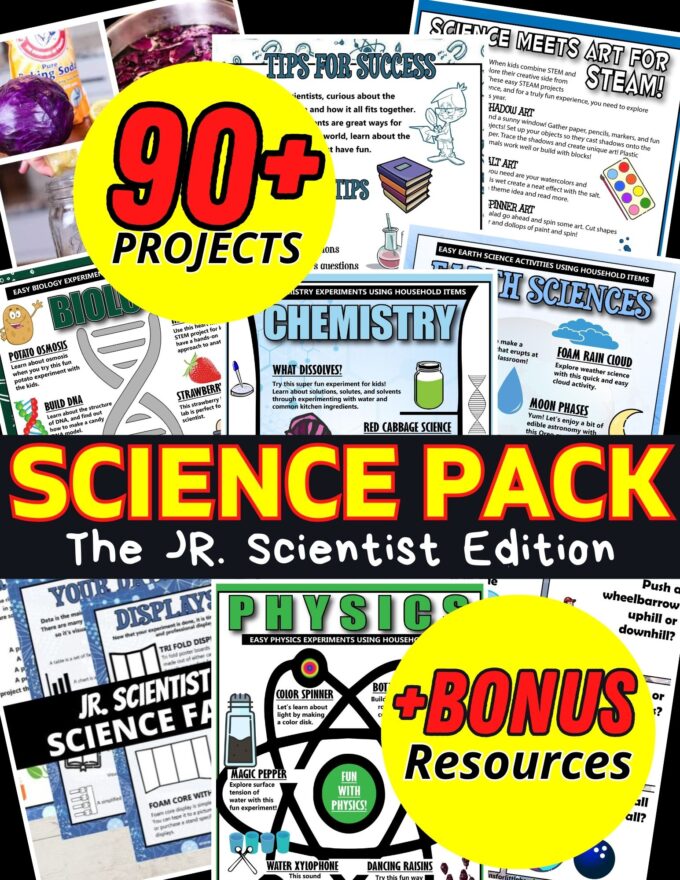
If you’re looking to grab all of our printable science projects in one convenient place plus exclusive worksheets and bonuses like a STEAM Project pack, our Science Project Pack is what you need! Over 300+ Pages!
- Bonus Quick Grab Packs for Biology, Earth Science, Chemistry, and Physics
- 90+ classic science activities with journal pages, supply lists, set up and process, and science information. NEW! Activity-specific observation pages!
- Best science practices posters and our original science method process folders for extra alternatives!
- Be a Collector activities pack introduces kids to the world of making collections through the eyes of a scientist. What will they collect first?
- Know the Words Science vocabulary pack includes flashcards, crosswords, and word searches that illuminate keywords in the experiments!
- My science journal writing prompts explore what it means to be a scientist!!
- Bonus STEAM Project Pack: Art meets science with doable projects!