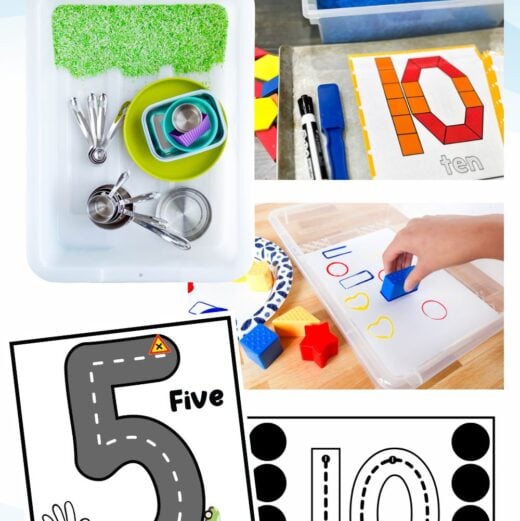
Preschool math activities can be simple, playful, and hands-on! Practice counting, number recognition, patterns, sorting, comparing, measuring, sequencing, and shapes with easy activities young kids can actually do.
These preschool math ideas are a great fit for ages 3–6 at home, in a preschool classroom, or at a learning center.
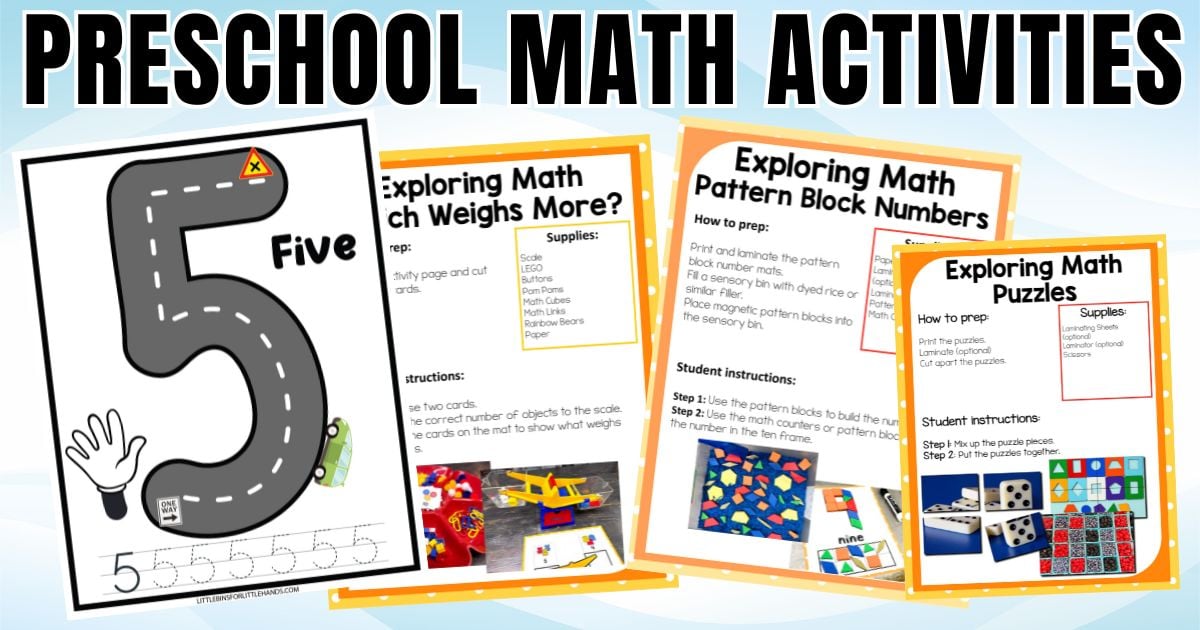
Math for Preschoolers
Preschool math is less about formal lessons and more about helping kids build early number sense through play.
Young children can explore math by counting real objects, matching quantities to numbers, sorting items, making patterns, comparing groups, measuring, and playing simple games.
You do not need complicated supplies either. Dice, blocks, pom-poms, buttons, pattern blocks, toy animals, cups, scoops, and other everyday materials can all become useful preschool math tools.
Repetition is important too. Kids might practice counting with pom-poms one day, roll a die and find numbers the next day, and play a counting game later in the week. The skill stays familiar while the activity feels new.
👉 Looking for more hands-on learning? Explore our Preschool Activities for science, STEM, art, sensory play, and more.
Preschool Math Activities
Use these simple preschool math ideas to practice important early skills with real materials, games, and printable activities.
Encourage kids to touch or move each object as they count. This helps connect each number word with one object. Start with numbers 1–10 and increase the amount when kids are ready.
You can also use a ten frame to help kids begin to see quantities rather than relying only on memorized counting.
👉 Try our Black Dot Ten Frame.
Turn it into a simple game by having kids color, cover, or point to the matching number each time they roll.
These quick activities work well when you only have a few minutes for math practice.
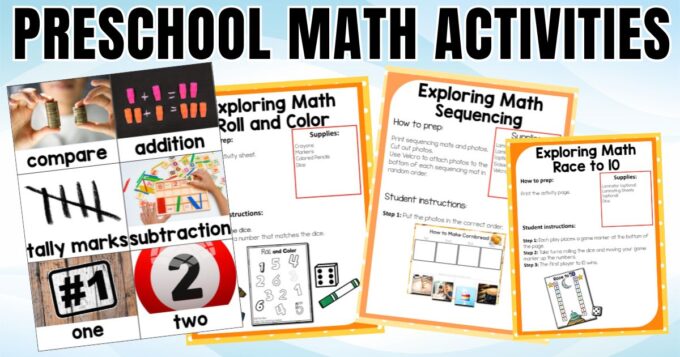
Number Recognition Activities
Number recognition means being able to identify a written numeral and begin to connect it to the quantity it represents.
💡 Try number hunts, dice games, matching activities, number building, and hands-on counting.
Build Numbers With Pattern Blocks: Pattern blocks make number practice much more hands-on.
Kids can cover each numeral with pattern blocks and then use counters or additional blocks to show the matching quantity on a ten frame.
👉 Try our Pattern Block Numbers activity for numbers 1–10.
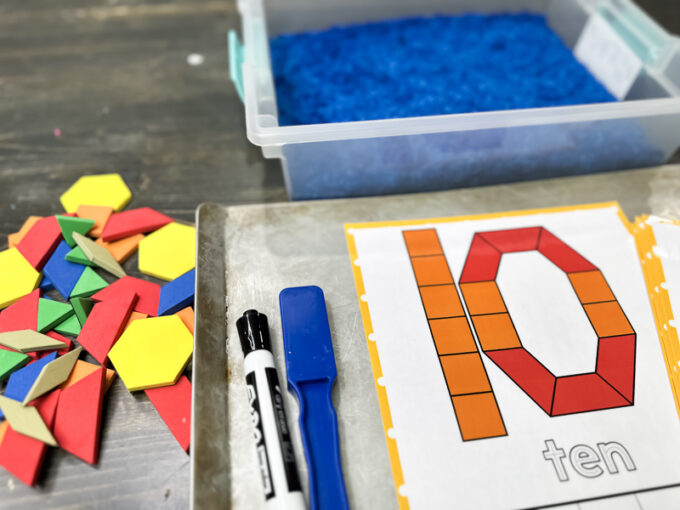
This activity combines number recognition, counting, one-to-one correspondence, shapes, spatial reasoning, and fine motor practice.
💡Drive the Numbers: Add a toy car to number practice and let kids drive along a large printed numeral while saying its name.
👉 You can try one of our number road activities inside the free Preschool STEAM Starter Guide.
One-to-One Correspondence
One-to-one correspondence means understanding that each object counted gets one number word.
A child may be able to recite the counting sequence before fully understanding that the last number counted tells how many objects are in a group.
- Count and Move: Put a small group of objects in a pile. Have kids move one object into a cup, tray, or ten frame each time they say a number.
- Count With Picture Cards: Choose a number card and place the matching number of manipulatives beside it.
- Pom-poms, mini erasers, buttons, math counters, or LEGO bricks all work well.
- Dice and Counters: Roll a die and place one counter for every dot. Roll again and compare the quantities.
Pattern Activities
Patterns help preschoolers notice order, repetition, and relationships.
Start with a simple AB pattern such as:
red, blue, red, blue
or
bear, block, bear, block.
Finish the Pattern: Create the beginning of a pattern with blocks, buttons, pom-poms, or picture cards and ask what should come next.
Make Your Own Pattern: Give kids two colors or two types of objects and have them create a repeating pattern.
Try a New Pattern: Once AB patterns are easy, explore AAB, ABB, or ABC patterns.
Patterns can also be made with movement:
clap, stomp, clap, stomp
or
jump, jump, clap, jump, jump, clap.
⭐️ The AB Pattern activity shown in our preschool math collection is included in the I Can Explore Math Pack for an easy print-and-use option.
Sorting and Classifying
Sorting helps preschoolers notice how objects are the same and different.
Give kids a mixed collection of objects and ask them to sort them into groups.
Try sorting:
- buttons by color
- blocks by size
- toy animals by type
- pattern blocks by shape
- pom-poms by color
- coins by type
Once everything is sorted, change the rule. Can the same objects be sorted another way?
💡 Sorting builds early classification and problem-solving skills while introducing useful math language.
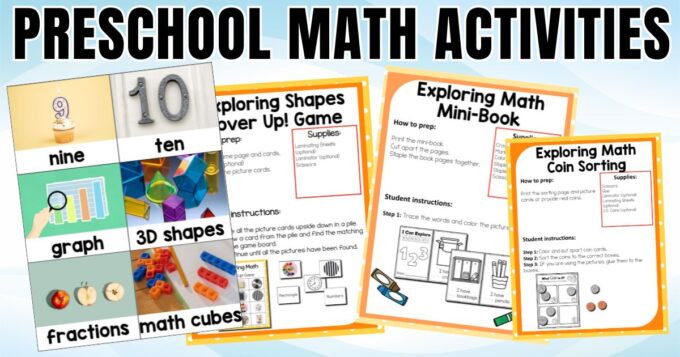
Comparing More and Less
Preschoolers can begin using comparison words such as more, less, same, bigger, smaller, taller, shorter, heavier, and lighter.
Compare Two Groups: Make two small groups of counters or blocks.
Ask:
- Which has more?
- Which has less?
- Are they the same?
Count each group to check.
💡 Build and Compare: Build two block towers and compare their heights. Which is taller? Which is shorter? Can you make them the same height?
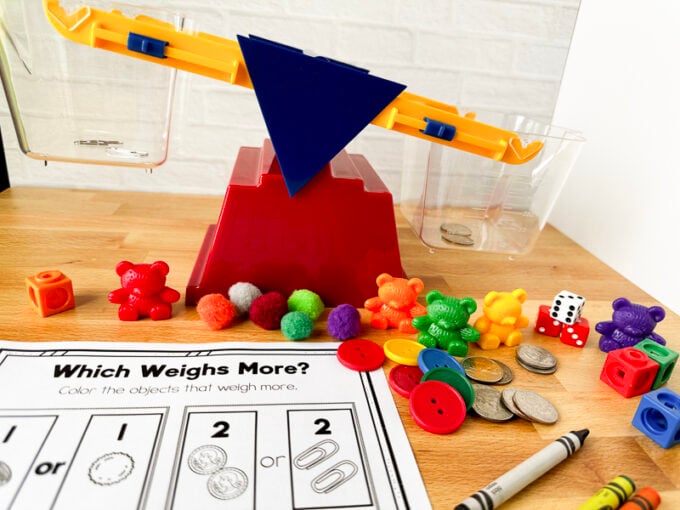
Explore Weight With a Balance Scale
A balance scale is a fun way to make comparing weight visible.
Kids can count and compare different classroom manipulatives while watching what happens to each side of the scale.
Use simple math words such as more, less, heavier, lighter, and same as you explore.
⭐️ The Which Weighs More? activity shown here is included in our I Can Explore Math Pack. Kids use number cards, a balance scale, and simple manipulatives to combine counting with comparing weight.
💡 Preschoolers love investigating how things work. Explore more hands-on ideas with our Preschool Science Activities.
Preschool Measurement Activities
Preschool measurement starts with comparing and exploring rather than exact measurements.
Longer or Shorter: Put two crayons, blocks, strips of paper, or classroom objects beside each other and compare their lengths.
Taller or Shorter: Build block towers and compare their heights.
Measure With Blocks: Use LEGO bricks, linking cubes, or other objects of the same size as nonstandard measuring tools.
- How many blocks long is the book?
- How many cubes tall is the container?
Scoop and Measure: Set up a sensory bin with dry rice and add measuring cups, spoons, bowls, and small containers.
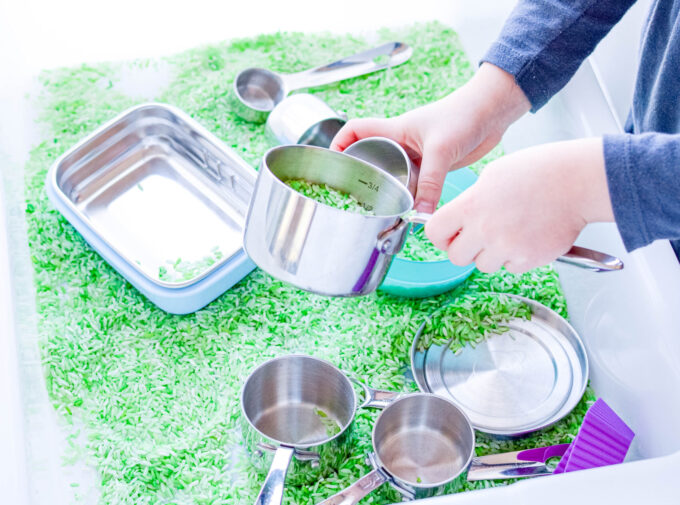
Let kids scoop, fill, pour, and compare while you ask:
- Which container holds more?
- Which holds less?
- How many scoops fill the bowl?
- Which cup is bigger?
- Can you fill this container halfway?
This is an easy way to explore capacity, comparing, counting, and early measurement through sensory play.
👉 For another simple measurement idea, try our preschool volume activity.
💡 Measurement is also an easy way to connect math with science and STEM because kids can predict, test, compare, and describe what happens.
Sequencing Activities
Sequencing helps preschoolers understand order and what happens first, next, and last.
Give kids a few picture cards showing a familiar event and have them place the pictures in order.
Try sequences such as:
- making a simple snack
- getting dressed
- planting a seed
- completing a recipe
- building something
Talk through the sequence together using words such as first, next, then, and last.
⭐️ A ready-to-use picture sequencing activity is also included in the I Can Explore Math Pack.
Simple Preschool Math Games
Games are one of the easiest ways to reinforce early math skills without making practice feel like a chore.
Try:
- dice games
- number matching
- roll and color
- Race to 10
- picture matching
- cover-up games
- sorting games
- simple board games
Preschool math games can practice counting and number recognition while also building turn-taking, following directions, and problem-solving.
⭐️ The Race to 10 and Roll and Color activities shown in our preschool math collection are included in the I Can Explore Math Pack.
👉 Our Printable Board Game Pack has even more easy games for playful learning.
Shapes for Preschoolers
Shapes are another important part of early math, but you do not need to turn every shape activity into a formal lesson.
- Preschoolers can trace, match, sort, build, and look for shapes in their environment.
- Try a simple shape hunt around the classroom or house. Look for circles, squares, triangles, and rectangles in everyday objects.
- Pattern blocks are another easy way to combine shape recognition with spatial reasoning and building.
👉 Looking for more shape activities? Explore our Preschool Shapes Collection for printable shape games and hands-on learning.
Math and Preschool STEM
Math naturally fits into STEM because kids use numbers, patterns, measurement, sorting, comparing, and spatial thinking while they build and investigate.
A preschool STEM activity might include:
- counting how many blocks are used in a tower
- comparing two ramps
- measuring a structure with cubes
- sorting materials before building
- finding shapes in a design
- making a pattern
- predicting which object will travel farther
The math does not need to be a separate lesson. It can be part of the hands-on exploration.
👉 Explore our Preschool STEM Activities for simple building, engineering, science, and problem-solving ideas.
Add Math to Preschool Art
Art is an easy way to explore early math concepts such as shapes, patterns, size, position, and spatial reasoning.
Try Shape Stamping: Dip simple shapes into paint and stamp them onto paper to create pictures, patterns, and designs.
As kids work, talk about the shapes they are using:
- What shape did you stamp?
- How many sides does it have?
- Can you make a pattern?
- Can you use two shapes to create a picture?
- Which shape did you use the most?
👉 Try our Shape Art Activity for an easy preschool math and art connection.
This hands-on activity combines shape recognition with creative process art, giving kids plenty of room to experiment.
Easy Preschool Math With Everyday Materials
You probably already have most of what you need for hands-on preschool math.
Try using:
- LEGO bricks or blocks for counting and measuring
- buttons for sorting and comparing
- pom-poms for counting
- pattern blocks for shapes and number building
- dice for counting and number recognition
- toy animals for sorting
- measuring cups for capacity
- coins for sorting
- crayons for comparing length
- playdough for making numbers and shapes
Keep activities short and repeat favorites often.
A simple five-minute counting, sorting, or comparing activity can provide plenty of meaningful math practice for young kids.
Printable Preschool Math Activity Pack
Want preschool math activities already planned and ready to use?
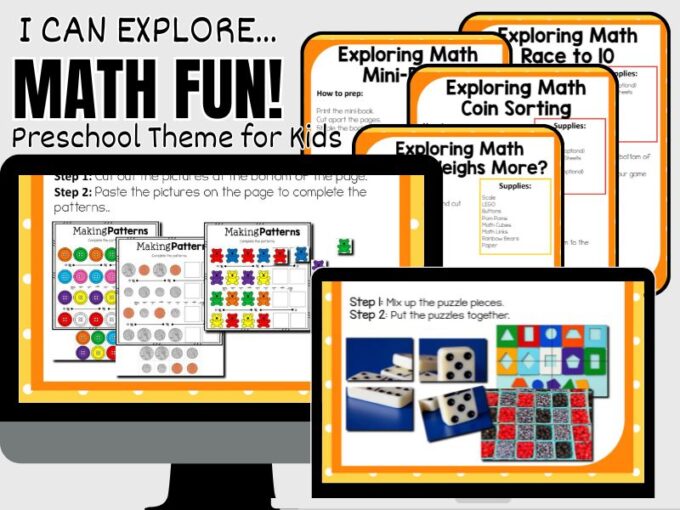
The I Can Explore Math Pack is designed for ages 3–6 and includes hands-on games, printable centers, number activities, puzzles, and activity mats.
Kids can explore:
- counting and numbers 1–10
- Pattern Block Numbers
- Race to 10
- Roll and Color
- AB patterns
- coin sorting
- comparing more and less
- Which Weighs More?
- sequencing
- shape games and matching
- number and shape puzzles
- early math vocabulary
Many of the activities can be laminated and reused with dice, pattern blocks, pom-poms, counters, coins, LEGO bricks, and other common classroom materials.
Use one activity for quick practice or set up several as rotating preschool math centers.
⭐️ Tip: Grab the Preschool Themes Mega Bundle if you want an even larger collection of 25 preschool learning themes. Year-round hands-on learning ready to go!
Free Preschool STEAM Starter Guide
Not sure where to start?
Grab our free Preschool STEAM Starter Guide for simple activities you can use right away, including a number road for playful number recognition.
It is an easy way to add science, STEM, art, and early math to your preschool day without complicated prep.
👉 GET THE FREE PRESCHOOL STEAM MINI GUIDE
More Preschool Activities
Preschool learning does not need to be divided into separate subjects.
Counting can happen during science, shapes can show up in art, and measurement can become part of a STEM challenge.
Continue exploring our:
- Preschool Activities for a mix of hands-on learning ideas
- Preschool Science Activities for easy investigations
- Preschool STEM Activities for building and problem-solving
- Art Activities for Kids for hands-on creative projects
- Preschool Color Activities for hands-on color mixing, identification, and games
- Preschool Shape Activities for fun ways to explore all the shapes
Preschool Math FAQ
What math should a preschooler know?
Preschoolers can begin exploring counting, number recognition, one-to-one correspondence, patterns, sorting, comparing, shapes, sequencing, and simple measurement.
How high should preschoolers be able to count?
Many preschoolers work on counting to 10 and then continue beyond 10 as they are ready. Understanding that numbers represent quantities is more important than simply memorizing a long counting sequence.
What is one-to-one correspondence?
One-to-one correspondence means matching one number word to each object being counted. Having kids touch or move each object while counting is an easy way to practice.
What are good hands-on preschool math activities?
Counting manipulatives, rolling dice, making patterns, sorting objects, using a balance scale, measuring with blocks or cups, playing number games, and building numbers with pattern blocks are all simple choices.
How can I teach preschool math at home or in the classroom?
Work math into everyday play. Count toys, sort objects, compare sizes, make patterns, measure with blocks or cups, and play simple games. Short, repeated experiences work well for young children.
Do preschoolers need math worksheets?
No. Printable mats, games, and activity cards can be useful tools, but much of preschool math can happen through counting, sorting, building, comparing, measuring, and playing with real objects.