
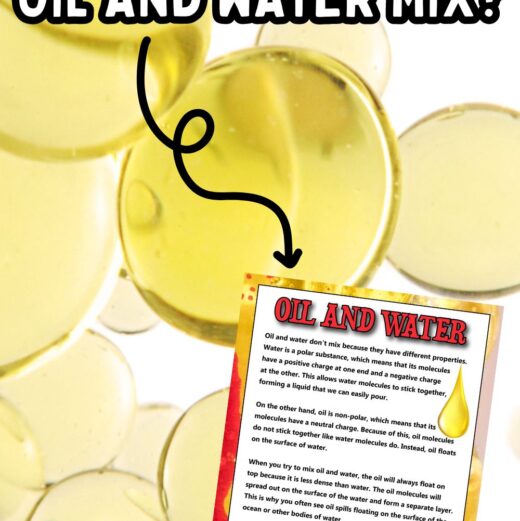
Why don’t oil and water mix, no matter how hard you shake them? Oil and water are immiscible liquids that don’t combine or form a single layer. This is because they have different densities and polarities that separate them. Understanding why these two substances behave this way can be fun and fascinating!

Properties of Oil and Water
- Oil is a thick, slippery liquid used for cooking and in things like lotion.
- Water is the clear liquid we drink and use to wash our hands.
Oil and water are both liquids, but they behave very differently.
Water (H₂O) is a polar molecule, but it does not have a full positive charge. Instead, water has a partial positive charge on the hydrogen atoms and a partial negative charge on the oxygen atom. Because of this, water molecules stick together, the positive end of the molecule sticks to the negative end of another.
On the other hand, non-polar molecules like oil don’t have specific positive or negative charged areas. They do not interact well with polar molecules like water. This is one of the main reasons why oil and water don’t mix—oil is nonpolar, while water is polar.
Watch the Video:
Oil and Water Science
What Is Density?
One of the main reasons oil and water don’t mix is because of density. Density is how much “stuff” is packed into a space. Water is denser than oil, so it’s heavier for the same amount. That’s why the oil floats on top when you pour oil into water.
💡Explore more density experiments [here].
What Is Polarity?
Another reason oil and water don’t mix is their polarity. Water is a polar molecule—it has tiny electric charges that make water molecules stick together like magnets! Conversely, oil is nonpolar, so the oil molecules don’t have these charges, so water and oil don’t like to mix.
Immiscible: Why Oil and Water Stay Apart
Because oil and water don’t mix, we call them immiscible. Immiscible means that two liquids cannot mix. Oil will always separate from water, even if you shake them, because of their different polarities and densities.

Oil and Water Science Experiments
These hands-on science experiments will help you see why oil and water are immiscible and how density and polarity play a big role. Try them out and discover the science for yourself!
Recommended Grade Level: K-8. Younger students (grades K-2) can observe that oil and water don’t mix. It’s great introduction to how liquids have different properties to each other. Older students (grades 3-5) can start discussing density in simple terms such as oil is less dense than water. While middle school students (grades 6-8) can learn more about molecular structures and why oil and water don’t mix (oil is nonpolar, water is polar).
Make Salad Dressing
Shake up some oil, water, and vinegar to make a tasty dressing. Watch how the oil floats to the top and separates after sitting still. What is an emulsion?
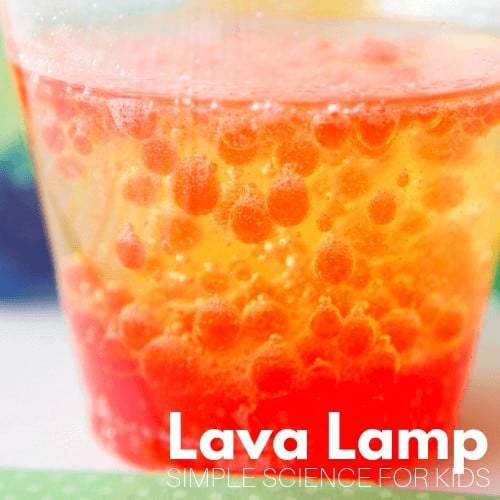
Create a Lava Lamp
Fill a bottle with water, oil, and a few drops of food coloring. Then drop in an effervescent tablet and watch the colorful bubbles move up and down!
Build a Density Tower
Create distinct layers of different liquids (like oil, water, syrup, and dish soap) in a tall glass. See how each separate layer stays in place because of their different densities!
💡 For a simplified version, use just oil and water! Which one will sink to the bottom?
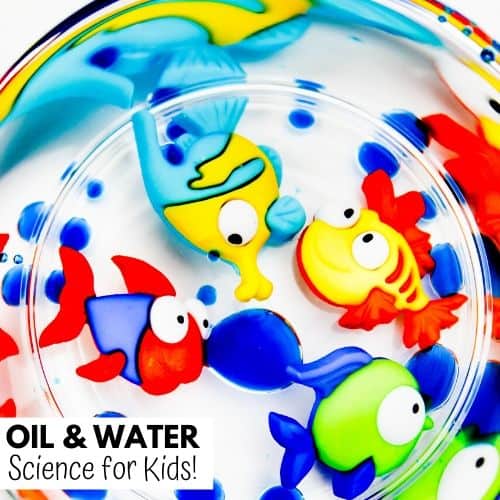
Oil and Water with Color Drops
Drop food coloring into oil and water. The colors stay in the water and create cool effects when they move!
Fireworks in a Jar
Mix a few drops of food coloring with oil, then pour this into a jar of water. The oil will stay on top, but watch as the food coloring slowly moves down, looking like fireworks as it spreads through the water!
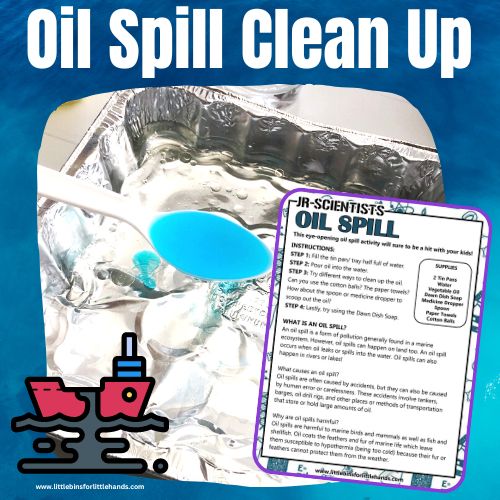
Oil Spill Experiment
Simulate an oil spill by adding oil to a container of water and then trying to clean it up using different materials like cotton balls, sponges, or paper towels. This helps show how hard it can be to clean oil from water because oil floats on top and is immiscible.
Salt Volcano
Fill a clear jar with water and add oil on top. Sprinkle salt into the jar and watch what happens! The salt temporarily pulls the oil down through the water before it floats back up. This is another fun way to see how oil and water don’t mix.
Oil and Water Vocabulary
- Density: How much something weighs for its size.
- Polarity: Whether or not a molecule has electric charges that help it stick to other molecules.
- Nonpolar: A molecule that doesn’t have electric charges and doesn’t stick to water.
- Immiscible: When two liquids don’t mix together, like oil and water.
- Separate: When two things move apart and don’t mix together.
These fun activities will help you see why oil and water are immiscible and how density and polarity play a big role. Try them out and discover the science!

Printable Science Projects For Kids
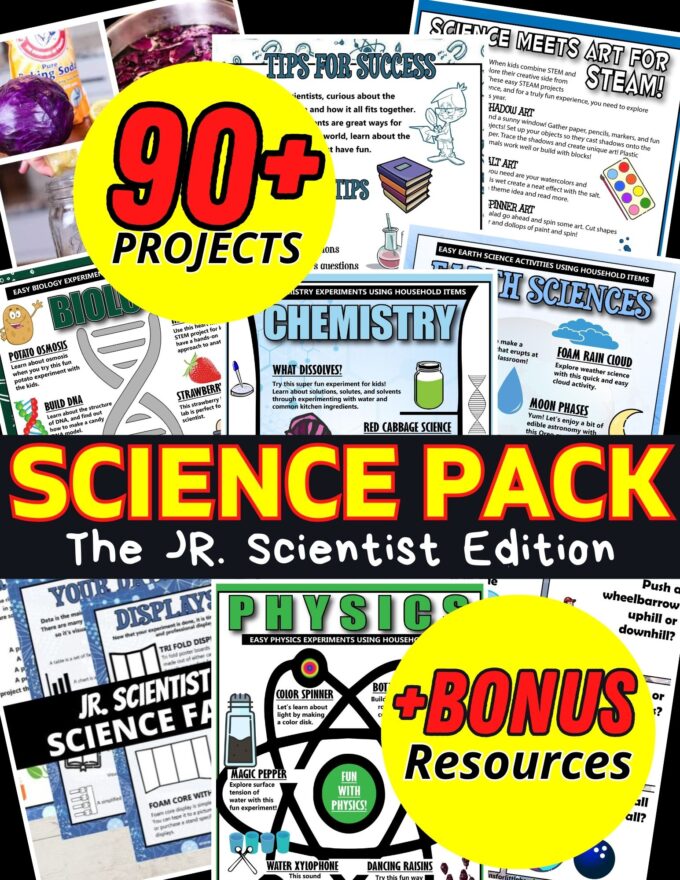
If you’re looking to grab all of our printable science projects in one convenient place, plus exclusive worksheets and bonuses like a STEAM Project pack, our Science Project Pack is what you need! Over 300+ Pages!
- 90+ classic science activities with journal pages, supply lists, set up and process, and science information. NEW! Activity-specific observation pages!
- Best science practices posters and our original science method process folders for extra alternatives!
- Be a Collector activities pack introduces kids to the world of making collections through the eyes of a scientist. What will they collect first?
- Know the Words Science vocabulary pack includes flashcards, crosswords, and word searches that illuminate keywords in the experiments!
- My science journal writing prompts explore what it means to be a scientist!!
- Bonus STEAM Project Pack: Art meets science with doable projects!
- Bonus Quick Grab Packs for Biology, Earth Science, Chemistry, and Physics