


Shape activities for preschool and kindergarten can be much more than naming circles and squares! Kids can build, trace, sort, hunt for, match, stamp, and play with shapes while developing early geometry and spatial reasoning skills.
These hands-on shape activities are easy to use at home, in a preschool classroom, or in kindergarten centers. Start with a few familiar 2D shapes and add more as kids are ready.

Shapes for Preschool and Kindergarten
Learning about shapes helps kids notice how objects are alike and different, describe what they see, and understand how shapes fit together.
For younger preschoolers, start with familiar shapes such as circles, squares, triangles, and rectangles.
Kindergarteners can begin looking more closely at sides, corners, curved lines, straight lines, and how shapes can be combined to make new designs.
Shapes also connect naturally with math, STEM, art, sensory play, and everyday observation.
💡 Explore more Preschool Learning Activities for hands-on science, STEM, art, sensory play, and early learning.
2D Shapes to Learn
Keep shape vocabulary simple and useful.
- Circle: A round shape with no straight sides or corners.
- Triangle: A shape with 3 straight sides and 3 corners.
- Square: A shape with 4 equal sides and 4 corners.
- Rectangle: A shape with 4 sides and 4 corners. Opposite sides are the same length.
- Oval: A curved shape that looks like a stretched circle.
- Pentagon: A shape with 5 sides.
- Hexagon: A shape with 6 sides.
- Rhombus or Diamond: A shape with 4 equal sides.
You can introduce stars, hearts, crescents, and other familiar shapes too, but kids will get the most benefit from actually using and comparing shapes rather than simply memorizing a long list.
Hands-On Shape Activities
Use simple materials such as blocks, playdough, craft sticks, pom-poms, stickers, paper, paint, and everyday objects to make shape learning active.
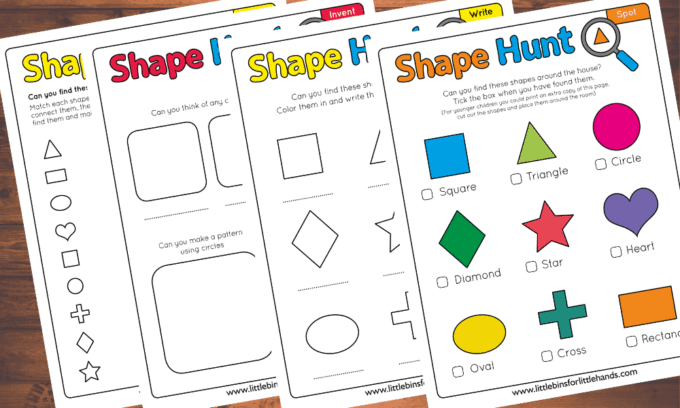
💡 Can you find a circle? A rectangle? A triangle? Try looking at clocks, windows, signs, books, plates, crackers, blocks, and other familiar items.
👉 Grab this shape hunt and other fun hunts here.
Encourage kids to explain what they notice:
- What shape do you see?
- How do you know?
- Does it have straight or curved sides?
- How many corners can you find?
Once everything is sorted, change the rule. Can kids sort the same objects by color or size instead? Sorting helps build shape recognition, classification, and early math thinking.
Talk about the lines and corners as they work. Tracing is also an easy way to combine shape recognition with fine motor practice.
For even more drive-and-learn practice, our Road Mats Pack includes road-style mats for shapes, numbers, and letters. It’s an easy way to add fine motor play and early learning with toy cars.

Make Shapes With Playdough
Playdough makes shape learning wonderfully hands-on.
Roll playdough into long pieces and use them to form squares, triangles, rectangles, and other shapes. Kids can also use shape cutters or press objects into the dough.
👉 Try our Shape Playdough Mats for an easy reusable activity.
Ask:
- How many sides does your shape have?
- How many corners?
- Can you make the shape bigger?
- Can you make a smaller one?
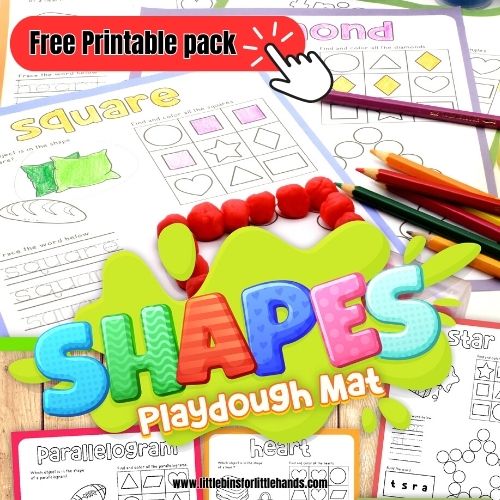
Free Shape Pattern Block Printable
Grab our free shape pattern block printable for an easy hands-on way to explore 2D shapes. Kids can build and cover shapes with pattern blocks while noticing how smaller shapes fit together.
Use it for shape recognition, spatial reasoning, matching, and fine motor practice in a preschool or kindergarten center.
Build Shapes
Building shapes adds an easy STEM connection.
Use craft sticks, straws, pipe cleaners, LEGO bricks, magnetic building pieces, or other construction materials to make shapes.
Kids quickly discover that some shapes need corners while others have curved sides.
Try questions such as:
- How many pieces did you need?
- Can you turn a square into a triangle?
- What happens if you add another side?
- Can you build a shape inside another shape?
The Building Shapes activity in our I Can Explore Shapes Pack uses simple connectors and building materials to let kids construct and identify different shapes.
👉 Explore more building activities for kids for simple engineering fun.

Dot Shapes
Dot markers, mini erasers, pom-poms, buttons, or counters are an easy way to build a shape’s outline.
Kids can place one object at a time around a circle, square, triangle, or other shape while naming it. This adds fine motor practice and can even include a little counting.
⭐️ The ready-to-use Dot Shapes activity shown here is included in our I Can Explore Shapes Pack.
Find Shapes in Everyday Objects
Help kids notice that geometric shapes are all around them.
- A donut looks like a circle.
- A cracker may look like a square.
- A picture frame may look like a rectangle.
- A slice of watermelon may look like a triangle.
Have kids match real-world pictures or objects with the shape they resemble.
⭐️ The What Shape Is It?, Seek and Find, and Matching Game activities in our printable pack give kids additional ways to practice making these connections.
Shape Sensory Bin
Add shapes to sensory play for an easy hands-on sorting activity.
Hide foam shapes, plastic shapes, blocks, or laminated paper shapes in a bin filled with rice, shredded paper, or another favorite sensory material.
Kids can find a shape, name it, and place it into a matching cup or container.
⭐️ The Sensory Sorting activity in our I Can Explore Shapes Pack combines shape recognition, sorting, and sensory play.
Shape Games
Games are an easy way to repeat shape recognition without making practice feel repetitive. Try:
- shape memory
- matching games
- shape bingo
- shape I Spy
- simple board games
- cover-up games
- shape scavenger hunts
Play a Shape Board Game: Roll a shape cube and move to the next picture that matches the shape.
Play a Matching Game: Match a geometric shape with an everyday object that has the same basic shape.
Play Cover Up: Choose a shape card and find a matching picture on the game board.
⭐️ Ready-to-use versions of these games are included in the I Can Explore Shapes Pack.
Shape Art Activity
Art is one of the easiest ways to explore shapes creatively.
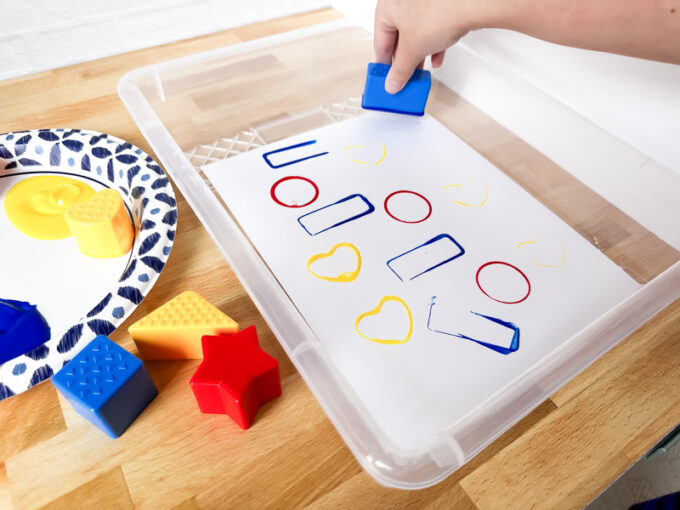
Make Shape Prints: Dip blocks, shape-sorter pieces, sponges, or other washable objects into paint and press them onto paper. Kids can make:
- repeating patterns
- pictures
- rows of shapes
- overlapping prints
- abstract designs
👉 Try our Shape Art Activity for an easy math and art connection.
👉 Looking for more creative ideas? Explore our Preschool Colors Activities or Art Activities for Kids.
Explore Shapes With Shadows
Shapes can even become part of a simple science investigation.
Shine a flashlight on blocks, toys, or other objects and observe the shadows they make.
Ask:
- What shape is the shadow?
- Does it look like the object?
- What happens when you turn the object?
- Does the shadow change?
👉 Try our Shadow Activities for Preschoolers for more easy light and shadow investigations.
👉 Explore even more Preschool Science Activities.
Shapes and Early Math
Shapes are an early geometry skill, but shape play also builds sorting, patterning, comparing, and spatial reasoning.
Try:
- Make a Pattern: Circle, square, circle, square.
- Compare Shapes: How is a square different from a triangle?
- Sort by Sides: Put shapes with the same number of sides together.
- Build With Pattern Blocks: Combine smaller shapes to make larger pictures and designs.
👉 Explore our Preschool Math Activities for more counting, patterns, sorting, and hands-on math.
Shapes and STEM
Shapes are also an important part of building and engineering.
Kids use spatial reasoning when they decide how pieces fit together, which shapes stack well, and how smaller shapes can make a larger structure.
Try building a tower, house, bridge, or simple structure and talk about the shapes used along the way.
👉 Explore our Preschool STEM Activities for more building and problem-solving ideas.
Printable Shape Activities Pack
Want shape activities already planned and ready to use?
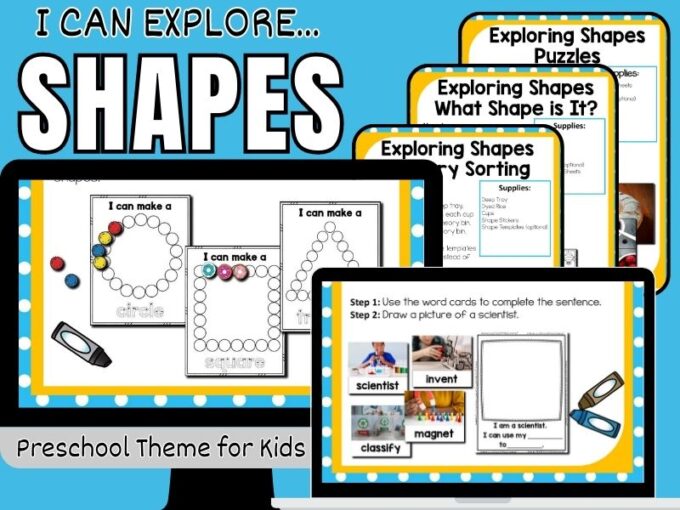
The I Can Explore Shapes Pack is designed for ages 3–6 and includes 14 hands-on activities, printable games, puzzles, sorting activities, and easy learning centers.
Kids can explore shapes with:
- Dot Shapes
- Building Shapes
- Seek and Find
- Shape Printing
- Sensory Sorting
- What Shape Is It?
- Shape Mini-Book
- Shape Crown
- Writing Center activities
- Tracing Cards
- Shape Board Game
- Matching Game
- Cover Up Game
- Shape Puzzles
Use one activity for quick practice or set up several as rotating preschool or kindergarten centers.
Many of the activities can be laminated and reused with dry-erase markers, manipulatives, sensory materials, and other common classroom supplies.
⭐️ Tip: Grab the Preschool Themes Mega Bundle if you want 25 year-round preschool learning themes.
Tips for Teaching Shapes
Keep shape learning active and conversational.
Instead of asking only, “What shape is this?” try:
- How many sides do you see?
- How many corners?
- Are the sides straight or curved?
- Where can you find this shape in the room?
- Can you build it?
- Can you make it with playdough?
- How are these two shapes alike?
- How are they different?
- What can you make from these shapes?
The goal is not just memorizing shape names. Kids are also building observation, spatial reasoning, classification, comparison, and problem-solving skills.
Shape Activities FAQ
What shapes should preschoolers learn first?
Start with circles, squares, triangles, and rectangles. Add ovals, pentagons, hexagons, and rhombuses as kids are ready.
What shapes should kindergarteners know?
Kindergarteners can recognize common 2D shapes and begin describing them by their sides, corners, and other features.
What are good hands-on shape activities?
Shape hunts, playdough shapes, building shapes, sorting, matching games, sensory bins, tracing, puzzles, and shape printing are all easy choices.
How do you teach shapes without worksheets?
Use blocks, playdough, craft sticks, sensory materials, toys, art supplies, and everyday objects. Kids can build, sort, hunt for, compare, and create with shapes.
Why are shape activities important?
Shape activities build early geometry skills, as well as spatial reasoning, observation, sorting, comparison, fine motor skills, and problem-solving.






I think this is a fantastic post. Geometry always looked boring in the books but now when you share a new way to learn, absorb and grasp geometry rules, it appears quite appealing to me and it may to the kids too. Tell me where to buy some such interesting games too.
This is an interesting activity that parents can teach their kids. Geometry and shapes, kids will like to spend time with such things. Even I shall try my hands on it. I really loved the new concept and will definitely share it with my friends too. I thank the author for this!
Thank you so much! It’s a great open ended math and STEAM activity for all ages!
Hi, I was wondering where do you print the shapes from?
This is where I found it:
“I printed off some geometric shape patterns from this site as it had some different sizes to offer”
.
I then cut them out and traced them onto the foam sheets. I made as many as I could so we would have lots of variety and colors! I set them out with popsicle sticks and magnetic numbers for an invitation to play and explore geometric shapes!”
Thanks!
Thanks a lot for this post. We are starting our homeschooling activities with my 8, 5, and 3 year sons. This is a great way of getting involved with geometry for the little ones.
Terrific! Glad you can use it!
This is a terrific idea, I love the tactile nature of it. Fun and learning all rolled up together. Thank you!
Great activity!