
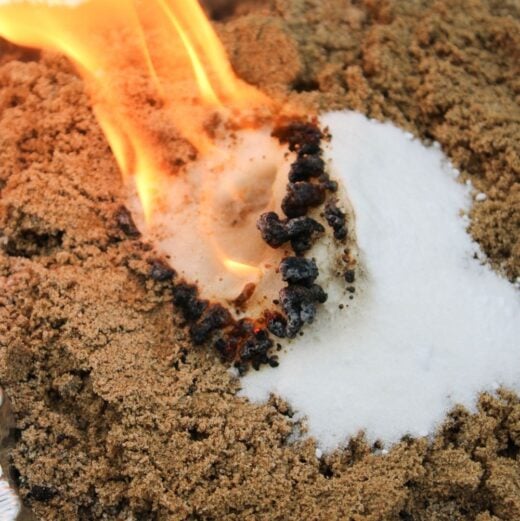
Simple ingredients like baking soda and sugar create a fiery chemical reaction that produces a slithering black snake. The carbon sugar snake experiment is an exciting, visual way to explore chemistry, heat reactions, and gas formation in your backyard or outdoor classroom.

Carbon Sugar Snake Experiment
Field of Science: Chemistry
Grade Level: 3rd–6th grade
Concepts Explored: Chemical reactions, combustion, decomposition, carbon dioxide gas formation, physical vs. chemical change, exothermic reactions
Set this one up outdoors, and get ready to see sugar combustion in action. The carbon sugar snake experiment demonstrates what happens when heat triggers chemical changes in a sugar and baking soda mixture.
This simple sugar mixture transforms when ignited with lighter fluid, producing black carbon, carbon dioxide gas, and water vapor. The heat causes a thermal decomposition of sugar, creating pressure that forces the growing, twisting snake form to push up and out of the sand.
As the flames die down, you’re left with a dark, worm-like structure made from solid elemental carbon. This experiment provides an unforgettable way to explore how new substances are created through chemical change.
🔎 Explore more fantastic science experiments for kids here.
Supplies Needed
- 1–2 cups of dry sand
- Small aluminum pie tin or baking tray
- 4 tablespoons sugar
- 1 tablespoon baking soda (also known as sodium bicarbonate)
- Lighter fluid
- Small bowl and spoon
- Water (for extinguishing)
- Adult supervision required 🛑
Sugar Snake Instructions
Watch the Video:
- Pour 1–2 cups of dry sand into the bottom of the aluminum pie tin.
- In a small bowl, mix 4 tablespoons of sugar with 1 tablespoon of baking soda.
- Scoop the sugar mixture into a mound or pile in the center of the sand.

- 🛑 With adult help, gently pour lighter fluid over the pile to thoroughly saturate it.
- 🛑 With adult help, carefully ignite the open flame using a lighter.

- Watch as the black carbon snake begins to rise, twist, and grow.
💧Once complete, pour water over the dish to extinguish and allow everything to cool completely before discarding.


Carbon Sugar Snake Science
This dramatic reaction is a clear example of a chemical change caused by heat. When the sugar and baking soda are ignited, two key reactions take place:
- The sugar (sucrose) when heated melts and burns, breaking down into solid carbon, water vapor, and hot gases like carbon dioxide.
- Baking soda (sodium bicarbonate) also decomposes into carbon dioxide gas, water vapor, and sodium carbonate, a white powdery substance you can see left in the snake’s base.
🔎 Learn more about chemical changes here.
Because the sugar doesn’t burn entirely due to a lack of oxygen in the center of the pile, it leaves behind black carbon, the same substance found in charcoal. The buildup of hot gases like carbon dioxide creates pressure beneath the surface, pushing the soft, spongy carbon ash upward into a snake form.
The entire process is an exothermic reaction, meaning it releases heat. The sand insulates the area and helps contain the reaction, while the lighter fluid provides a quick ignition. This setup allows for sustained burning at high temperatures, enabling the snake to grow several inches long.

More Facts for Kids
Related Science Activities for Kids
Elephant Toothpaste Experiment: Another fun and fast chemical reaction that creates dramatic foamy results. Like the carbon sugar snake, it uses simple ingredients to explore gas production and reaction speed.
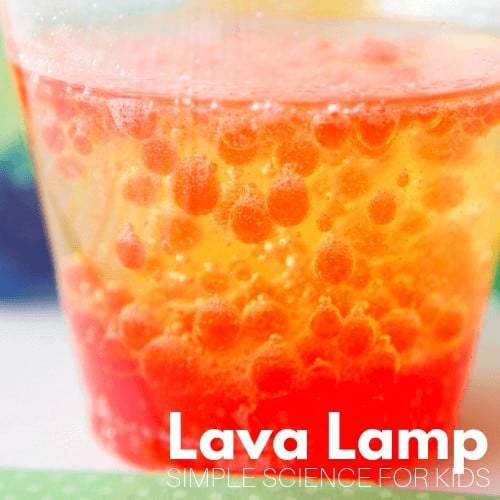
Lava Lamp Science Project: A great follow-up for observing gas bubbles and density in action. While not a combustion reaction, it shows how gas forms and moves through liquids.
Baking Soda and Vinegar Volcano: Also involves baking soda and carbon dioxide gas formation, but uses an acid-base reaction instead of heat—perfect for comparing types of chemical reactions.
Density Tower Experiment: A quieter experiment that explores how different materials behave when layered. Helps reinforce observation skills and the concept of matter, just like in the snake experiment.
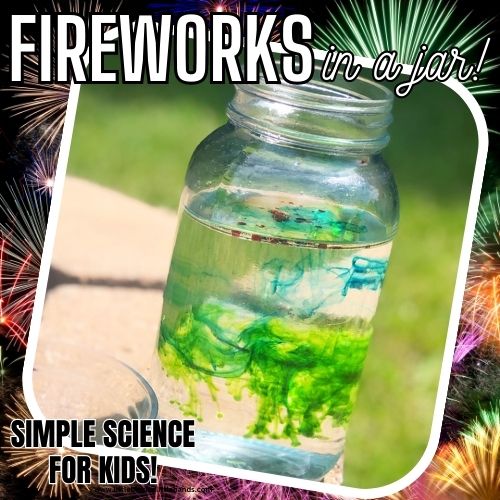
Fireworks in a Jar: Another visual way to explore how substances interact, using oil, water, and food coloring to mimic slow chemical movement.
Alka-Seltzer Rocket Experiment: Builds on the idea of gas buildup and pressure to launch a container—similar to how gas expands in the carbon sugar snake.



Join the Library Club Today!
Support Real Learning with Real Projects! When you join the Library Club Membership, you’re not just getting instant access to our complete library of art and STEM printables—you’re helping us keep hands-on, high-quality learning alive. Thoughtfully created resources made by real people who care about inspiring kids through creativity, curiosity, and connection.