
Do cranberries sink or float? Find out with this easy cranberry sink or float experiment for kids! Start with fresh cranberries, then test acorns, pumpkin seeds, and other small fall objects to see which sink and which float.
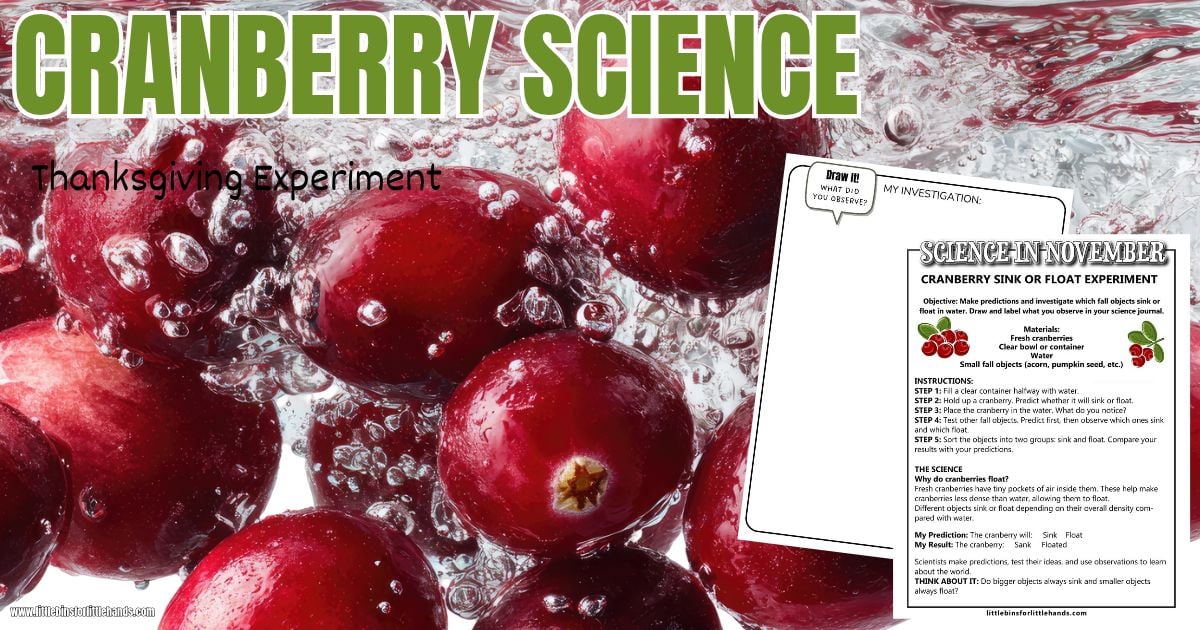
This simple Thanksgiving science experiment encourages kids to make predictions, test ideas, and compare results while exploring density and buoyancy. It’s perfect for preschool, elementary classrooms, homeschool, and November science centers.
Cranberry Sink or Float Experiment
Field of Science: Physical Science
Grades: PreK–3
Concepts: Density, buoyancy, sinking and floating, predictions, observation
Can you predict which fall objects will float? Start by testing fresh cranberries, then try a variety of natural materials to see what happens. Grab the free Science in November printable below and start investigating!
Supplies Needed
- Fresh cranberries
- Clear bowl or container
- Water
- Small fall objects (acorns, pumpkin seeds, leaves, small twigs, etc.)
- Paper towels
- Free printable Cranberry Sink or Float Experiment sheet
How to Do the Cranberry Sink or Float Experiment
STEP 1: Fill a clear bowl or container halfway with water.
STEP 2: Hold up a fresh cranberry. Ask kids to predict whether it will sink or float.
STEP 3: Place the cranberry in the water. Watch what happens. Does it stay at the surface or sink to the bottom?
STEP 4: (Optional) Choose a few other fall objects to test, such as an acorn, pumpkin seed, or small twig. Predict before placing each object in the water.
STEP 5: Sort the objects into two groups: sink and float. Compare the results with the original predictions.
Science Tip: Try adding objects of different sizes! Does being bigger always mean an object will sink?
Free Cranberry Sink or Float Printable
Use our free Science in November: Cranberry Sink or Float Experiment printable to guide the activity.
The one-page printable includes:
- A simple science objective
- Materials and step-by-step instructions
- An explanation of why cranberries float
- A place to choose a cranberry prediction and record the result
- A guiding question to encourage scientific thinking
- Reusable investigation pages
Kids can also draw and label their observations in a science journal.
Why Do Cranberries Float?
Fresh cranberries usually float because they contain tiny pockets of air inside the fruit.
These air pockets help make the cranberry less dense than water. An object that is less dense than water will float, while an object that is more dense than water will generally sink.
- Density describes how much mass something has compared with the amount of space it takes up.
- Buoyancy is the upward force water exerts on an object. When the upward buoyant force balances an object’s weight, it can float.
The air pockets inside a cranberry help it displace enough water to stay at the surface.
👉 Explore more fun examples of buoyancy here
Look Inside a Cranberry
Want to see what helps cranberries float? Have an adult carefully cut a fresh cranberry in half. Look at the inside of the fruit.
🔎 Can you spot the small spaces inside? These air-filled spaces are one reason fresh cranberries float so well.
💡 Ask Kids: What do you think would happen if a cranberry didn’t have those air pockets?
Test More Fall Objects
Once you’ve discovered that cranberries float, turn the activity into a larger fall sink-or-float experiment. Collect a few small seasonal objects from outside or around the classroom. Try testing:
- Acorns
- Pumpkin seeds
- Small leaves
- Twigs
- Pinecones
- Small pebbles
Before adding each object to the water, ask kids to predict whether it will sink or float. Then test their predictions and compare the results.
Fall Sink or Float Sorting Chart
| Fall Object | Prediction | Result |
|---|---|---|
| Cranberry | Sink / Float | Sink / Float |
| Acorn | Sink / Float | Sink / Float |
| Pumpkin seed | Sink / Float | Sink / Float |
| Leaf | Sink / Float | Sink / Float |
| Small pebble | Sink / Float | Sink / Float |
🔎 Encourage kids to draw their own chart or use a science notebook to record what happens.
Does Size Determine Whether Something Sinks or Floats?
Not necessarily! A large object can float, while a much smaller object can sink. For example, a large piece of wood may float while a tiny pebble sinks.
That’s because floating depends on an object’s overall density compared with the liquid, not simply how big or heavy it is.
🔎 Try This: Compare a small pebble with a larger twig. Which one floats?
💡 This is a great way to help kids discover that scientists need to test ideas rather than rely only on what an object looks like.
Turn It Into a Simple Science Investigation
Want to add more scientific thinking? Use the activity to practice making predictions and collecting evidence.
- Science Question: Which fall objects sink and which float?
- Prediction: Choose an object and decide whether you think it will sink or float.
- Test: Place the object in water and observe what happens.
- Record: Draw or write the result in a science journal.
- Compare: Sort the objects into two groups and look for patterns.
- Conclusion: Were your predictions correct? What did you discover about sinking and floating?
Questions to Ask Kids
- Do cranberries sink or float?
- What did you predict before testing?
- Why do you think cranberries float?
- Which other fall objects floated?
- Which objects sank?
- Do bigger objects always sink?
- Did any results surprise you?
- What other materials could you test?
Teacher Tips for Thanksgiving Science
Keep it simple. You only need fresh cranberries, a container of water, and a few small fall objects to get started.
Set up a science center. Place the materials in a shallow tub with a towel underneath and let kids test objects one at a time.
Focus on predictions. Encourage kids to make a prediction before each test, even if they aren’t sure of the answer.
Use a science journal. Have kids draw and label the objects that sink and those that float.
Adapt for different grades. Preschool and kindergarten students can focus on sorting and observation. Older elementary students can discuss density and buoyancy.
More Thanksgiving Science Experiments
Keep exploring with more easy Thanksgiving science experiments for kids! These hands-on investigations use simple supplies and are perfect for November classrooms and science centers.
- Corn Kernel Absorption Experiment: Explore how dried popcorn kernels change when soaked in water, vinegar, saltwater, and oil.
- Potato Osmosis Experiment: Investigate how water moves in and out of potato cells using fresh water and saltwater.
- Dancing Corn Experiment: Make corn kernels move in a fizzy mixture while exploring gas bubbles and buoyancy.
- Cranberry Chemistry: Explore chemical reactions with cranberry juice and baking soda.
Printable Thanksgiving Science and STEM Activities
Looking for more ready-to-use Thanksgiving science and STEM activities?
Our STEMS-Giving Thanksgiving Activity Pack includes seasonal science investigations, engineering challenges, and printable activities to make November learning easy!
With hands-on projects and simple supplies, it’s a great resource for elementary classrooms, homeschool, and Thanksgiving STEM centers.
Explore the Thanksgiving STEM Pack

Frequently Asked Questions
Do cranberries sink or float in water? Fresh cranberries usually float because they contain small air pockets that help make them less dense than water.
Why do cranberries have air pockets? Cranberries naturally develop air-filled spaces inside the fruit. These spaces contribute to their low overall density and help them float.
Do all fruits float in water? No. Different fruits have different densities and internal structures. Some float, while others sink. Try comparing cranberries with grapes or blueberries.
Can I use frozen cranberries? Fresh cranberries are best for this experiment. Frozen cranberries may behave differently because freezing and thawing can affect the fruit’s structure.
Is sink or float a science experiment? Yes! Kids make predictions, test objects, observe results, and compare findings. It provides a simple introduction to scientific investigation.
What science concepts does this experiment teach? This activity introduces density, buoyancy, prediction, observation, sorting, and comparing results.