

This season set up a dissolving gingerbread men science activity to enjoy a tasty treat while you learn simple chemistry. Dissolving food is a super simple science activity that’s a must try for young kids. Celebrate your holiday with Christmas Science and STEM activities!
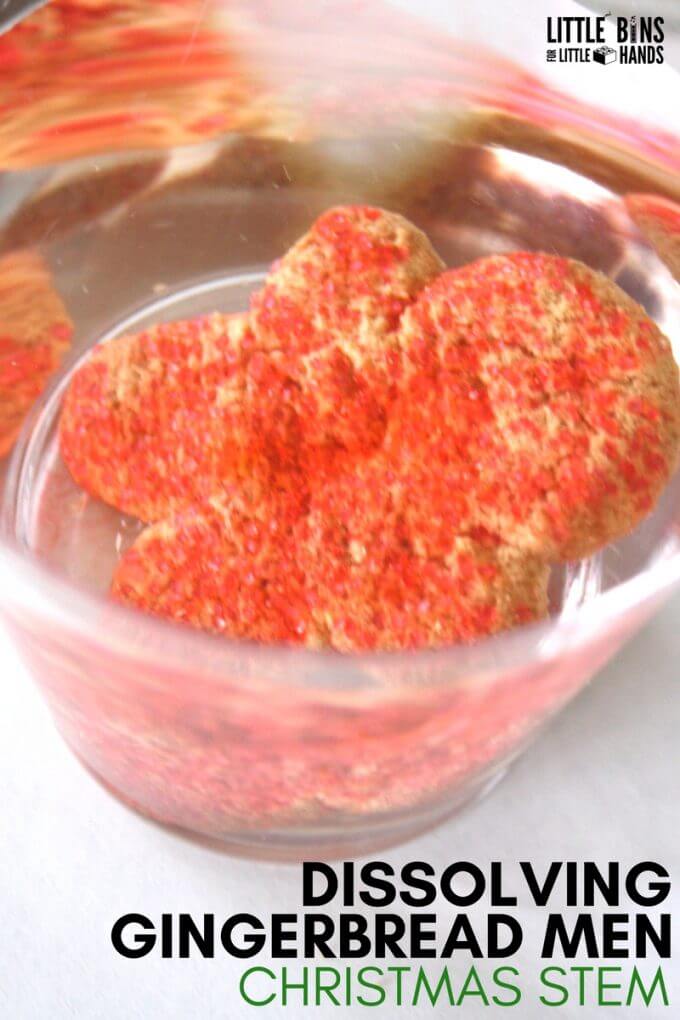
Explore Gingerbread Science This Festive Season
Science is so important for young kids! Exposing kids to simple science activities like our dissolving gingerbread man experiment below encourages curiosity.
Kids have a lot of questions and setting up simple science experiments is a cool way to encourage science skills like observing, testing, and questioning.
Keep this experiment simple with younger kiddos, and simply talk about they think will happen, and what they can see happening, and why they think that is.
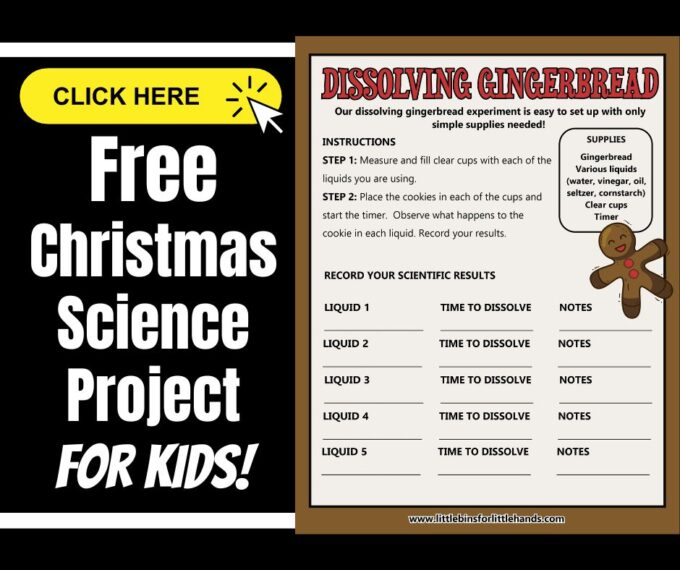
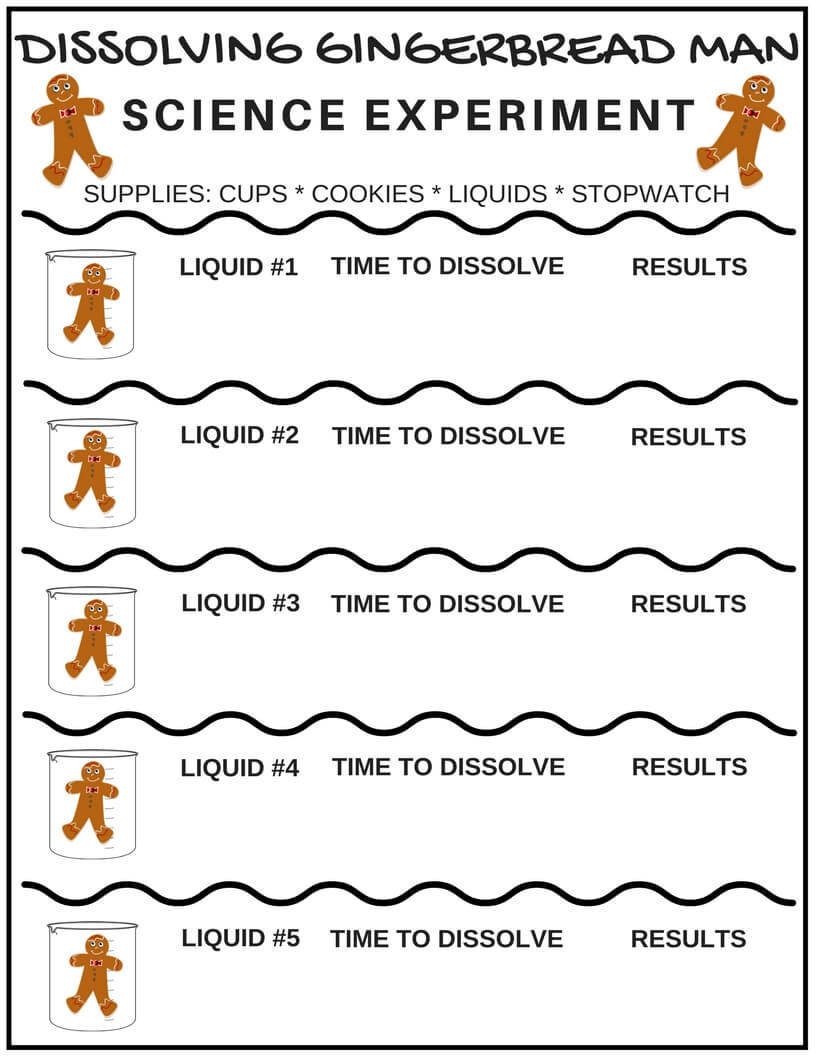
For older kids, grab the free printable science worksheet to record their results, and write down their conclusion. Learn more about applying the scientific method below.
Want more fun gingerbread man theme ideas? Check out our list of gingerbread STEM activities!
Dissolving Gingerbread Man Experiment
Supplies:
- clear cups
- different liquids – eg. oil, corn syrup, water, juice or milk, vinegar
- timer
- printable science worksheet to record your observations (see further down)
Instructions:
STEP 1: To begin a dissolving gingerbread man experiment, fill clear plastic cups with different liquids.
STEP 2: Have your kids predict what they think will happen to the cookies in the different liquids. You can even have them draw the cookie!
💡Apply the scientific method to this experiment and use variables!
STEP 3: Place a cookie in each cup. Note the cookie’s characteristics before you add it to the liquid. Is it hard, soft, bumpy, rough, or smooth? A good scientist is always making observations!
STEP 4: Wait and watch! Are there any immediate changes to the cookies? Set a time of 5-10 minutes for this experiment.
STEP 5: At the end of the selected time, make more observations about the cookies! Did a specific liquid or temperature liquid have more or less of an effect on the cookie? What are the characteristics of the cookie now?
STEP 6: Remove the cookie (or what’s left) from the liquid and observe it more closely. The kids can touch the cookie as well and record its new characteristics—it’s squishy, I bet!
STEP 7: If you had the kids draw a picture of the cookie to start, have them draw a picture of what the cookie looks like now!
STEP 8: Draw some conclusions! What do the kiddos think about what happened to the cookies, and were their predictions correct?
Dissolving Cookie Science
The process of dissolving cookies in different liquids involves a combination of physical changes and chemical changes. Let’s break down the simple science behind it for kids.
Learn more about physical changes, chemical changes, and phase changes!
Ingredients of Cookies: Cookies typically contain flour, sugar, butter, eggs, and baking soda. Various bonds hold these ingredients together.
Liquid Interaction: When you place a cookie in a liquid, like water, milk, or juice, the liquid interacts with the cookie’s ingredients.
Dissolving Sugar and Salt: Sugar and salt are soluble in water, which can dissolve. As the cookie absorbs the liquid, the water interacts with the sugar in the cookie, causing it to dissolve. This is a physical change.
Fats and Oils: Butter in cookies contains fats. Fats are hydrophobic, which means they don’t mix well with water. Instead, they repel water. This is why you might observe the cookie becoming greasy when it absorbs a liquid. This is also a physical change.
Chemical Changes: Baking soda is a leavening agent in cookies. It reacts with acids (which might be present in certain liquids) to produce carbon dioxide gas. This gas gets trapped in the cookie, making it rise and giving it a light and fluffy texture.
Changing Texture: As the cookie absorbs liquid, it can become softer. This change in texture is due to the hydration of ingredients like flour, which swells as it absorbs water.
Experimenting with Different Liquids: Different liquids can have varying effects on cookies. Water might make the cookie soggy, while milk could add a creamy texture. Some liquids may also enhance flavors.
This simple experiment helps kids understand the concepts of solubility, hydration, and the effects of different substances on food properties. It’s a fun and hands-on way to introduce them to basic chemistry and the science of everyday items like cookies.
Try These Gingerbread Activities
- Gingerbread Playdough
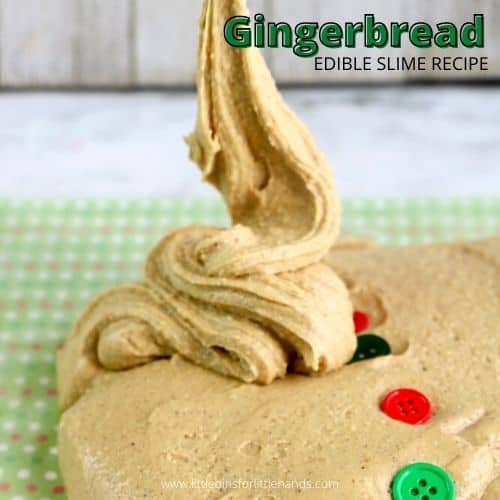
- Gingerbread Slime
- Gingerbread I-Spy
- Gingerbread Paper House
- Gingerbread Tesselations
- Salt Crystal Gingerbread Men
- Borax Crystal Gingerbread Men
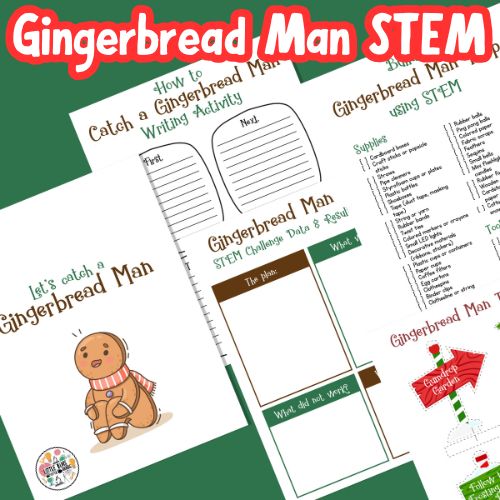
- Gingerbread Man Trap STEM Challenge

More Fun Dissolving Experiments
- What Dissolves in Water
- Dissolving Candy Canes
- Dissolving Candy Hearts
- Classic Skittles Science
- Floating M&Ms
Printable Christmas STEM Project Pack
200+ PAGES OF HOLIDAY THEME STEAM, STEM, Science, and Art!
- 25+ Christmas theme science and STEM activities with printable sheets, instructions, and useful information all using easy-to-source materials perfect for limited-time needs. Includes a holiday theme engineering pack with fun, problem-based challenges for kids to solve! NEW observation sheets included.
- Try a Santa’s Letter airplane challenge or take the gingerbread house-building challenge!
- Explore the five senses with a specially designed Santa’s Lab pack.
- Try a mini nature study with your favorite type of Christmas tree.
- Try your hand at building shapes with gumdrop structure challenge cards or build shapes with jingle bells. Or try the Christmas-themed paper chain challenge!
- Christmas Screen-free Coding activities include algorithm games, binary code ornaments, and more!
- Explore 6+ Christmas Art Projects with famous artist-inspired activities that combine art history, process art techniques, and more with simple to-do ideas.


4 Comments
Comments are closed.