
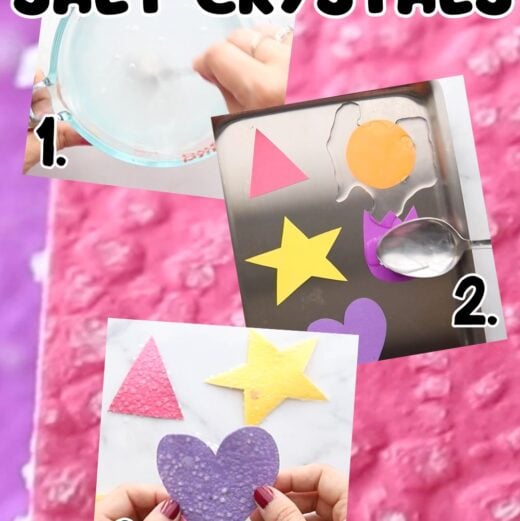
Growing salt crystals is a simple and engaging way to explore crystal formation, solubility, and evaporation using everyday materials. This easy science experiment works year-round and is perfect for home learning or classroom science activities.
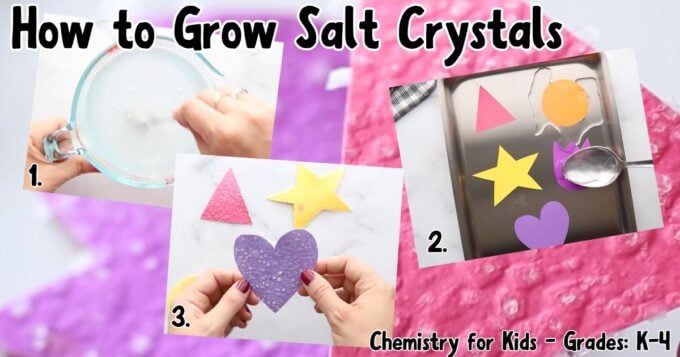
Salt crystals grow more slowly than borax crystals, which makes this a great long-term observation experiment and a borax-free option for younger students.
Salt Crystal Experiment at a Glance
Field: Chemistry
Grades: K–4
Concepts Explored: Solubility, evaporation, crystal formation, saturated solutions
Supplies Needed
- Table salt
- Hot water (not boiling)
- Jar, cup, or shallow dish
- Spoon
- Measuring cup
- Paper towel, string, pipe cleaner, or paper shapes (optional)
How to Grow Salt Crystals
This experiment works by dissolving salt in hot water to create a saturated solution. As the water evaporates, the salt comes back out of solution and forms crystals.
First, make a saturated salt solution.
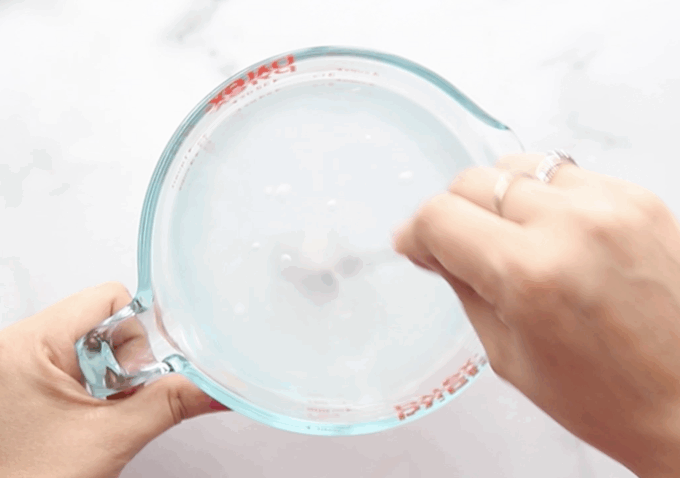
Heat 1 cup of water until hot (tap hot is fine). Slowly stir in salt, one tablespoon at a time, until no more salt dissolves and some salt settles at the bottom. This means the solution is saturated.
Next, prepare a surface for crystal growth.
Choose a surface such as a paper towel, paper shape, string, or pipe cleaner. Place flat surfaces in a shallow dish, or suspend string or pipe cleaners inside a jar using a pencil or stick.

Then, add the salt solution.
Carefully pour the saturated salt solution into the jar or over the prepared surface until it is fully soaked but not floating.

Allow the crystals to grow.
Place the container in a warm, undisturbed location. As the water slowly evaporates over the next few days, salt crystals will begin to form.

Observe and record changes.
Check the experiment once per day. Crystals typically begin forming within 24–48 hours and continue to grow as evaporation occurs.
Tips for Best Results
- Leave the experiment undisturbed while crystals are forming
- Warm, dry locations encourage faster evaporation
- Larger crystals form when the solution evaporates slowly
- Do not move the container once crystals begin forming

How It Works: Salt Crystal Science
When salt dissolves in hot water, it forms a solution. The water acts as the solvent, and the salt is the solute. Hot water can dissolve more salt than cold water, which allows you to create a saturated solution.
As the water evaporates, the dissolved salt no longer has anywhere to stay. The salt particles come back together and form solid crystals. This process is called crystallization.
Salt crystals grow slowly because sodium chloride has a stable crystal structure that forms small cubic crystals as it comes out of solution.
👉 Learn more about how crystals form in our What Are Crystals? guide.
Different Types of Salt Crystals
- Table salt forms small, cubic crystals
- Sea salt and rock salt create more irregular crystal shapes
- Epsom salt forms long, needle-like crystals (different chemical structure)
Salt Crystals vs. Borax Crystals
Salt crystals grow slowly and remain relatively small, making them ideal for younger learners and classrooms that prefer borax-free activities. Borax crystals grow faster and form larger, more dramatic crystals.
If you want overnight crystal growth, borax crystals are a better option. For patience-based observation and long-term study, salt crystals work best.
Salt Crystal Variations to Try
Once you understand how to grow salt crystals, you can use the same method to create themed crystal projects throughout the year:
- Salt Crystal Hearts
- Salt Crystal Snowflakes
- Salt Crystal Leaves
- Salt Crystal Easter Eggs
- Holiday crystal shapes
👉 Explore more hands-on ideas in our Crystal Experiments for Kids collection.
NGSS Guiding Questions
- What happens when salt dissolves in water?
- How does evaporation affect crystal formation?
- Why do crystals form as water disappears?
FAQ: Growing Salt Crystals
How long does it take to grow salt crystals?
Salt crystals usually begin forming within 24–48 hours. Full crystal growth may take several days to a week, depending on evaporation speed.
Why aren’t my salt crystals growing?
The solution may not be saturated enough, the environment may be too cool or humid, or the container may have been disturbed during evaporation.
What type of salt works best for growing crystals?
Table salt works well and creates small cubic crystals. Sea salt and rock salt may produce more irregular crystal shapes.
Is this salt crystal experiment safe for kids?
Yes. This is a borax-free experiment using household salt. Adult supervision is recommended when handling hot water.
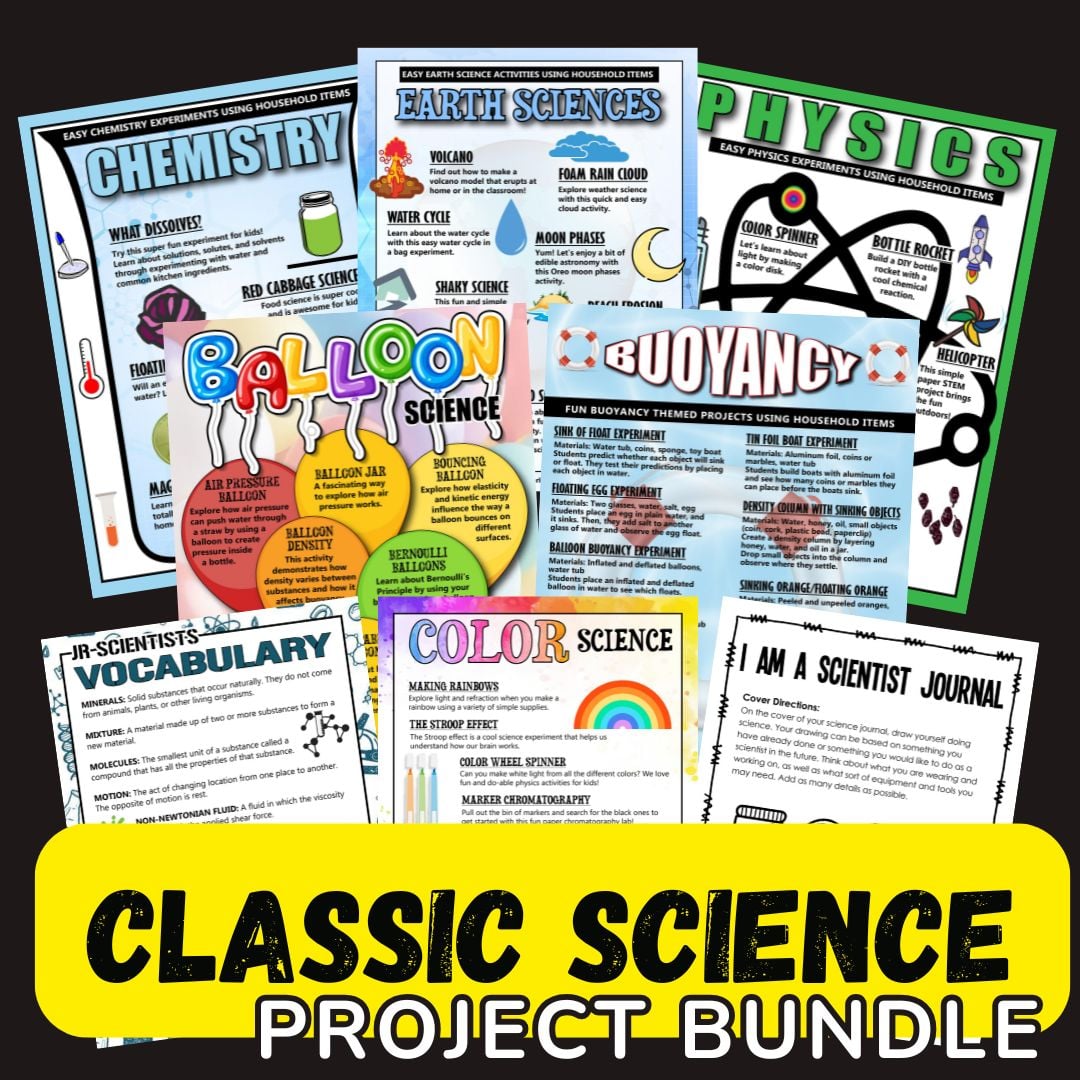
Printable Elementary Science!
Want to do meaningful science — but not start a full unit yet? This starter lab provides quick, hands-on investigations across multiple science topics, allowing students to explore how science works before diving deeper into any one subject.
Perfect for regularly trying science without extensive planning. Grades: K–5.