
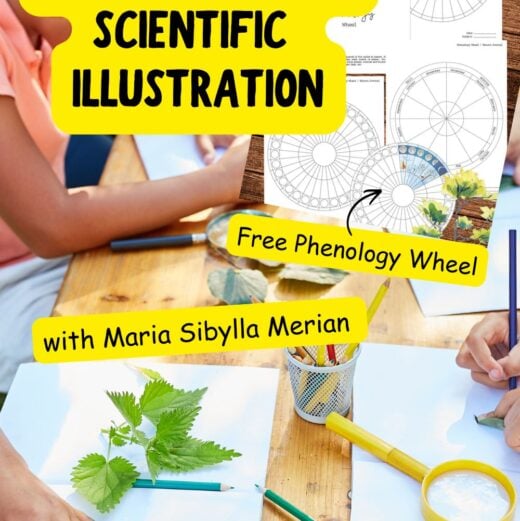
Before cameras existed, scientists relied on careful observation and detailed drawings to study the natural world. In this hands-on STEAM activity, kids will create their own scientific illustrations of plants and insects — just like Maria Sibylla Merian did.
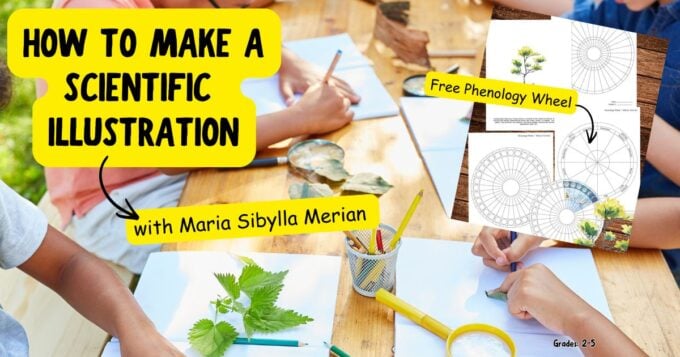
This hands-on STEAM activity strengthens observation skills, patience, and biological understanding while blending art and science. It is part of our larger collection celebrating inspiring female scientists.
👉 Explore all of our Women in STEM activities here.
How to Create a Scientific Illustration
Supplies Needed
- White paper or sketchbook
- Pencil
- Colored pencils
- Magnifying glass
- Leaves, flowers, seed pods, or photos of insects
- Optional: preserved insect specimen
Step-by-Step Instructions
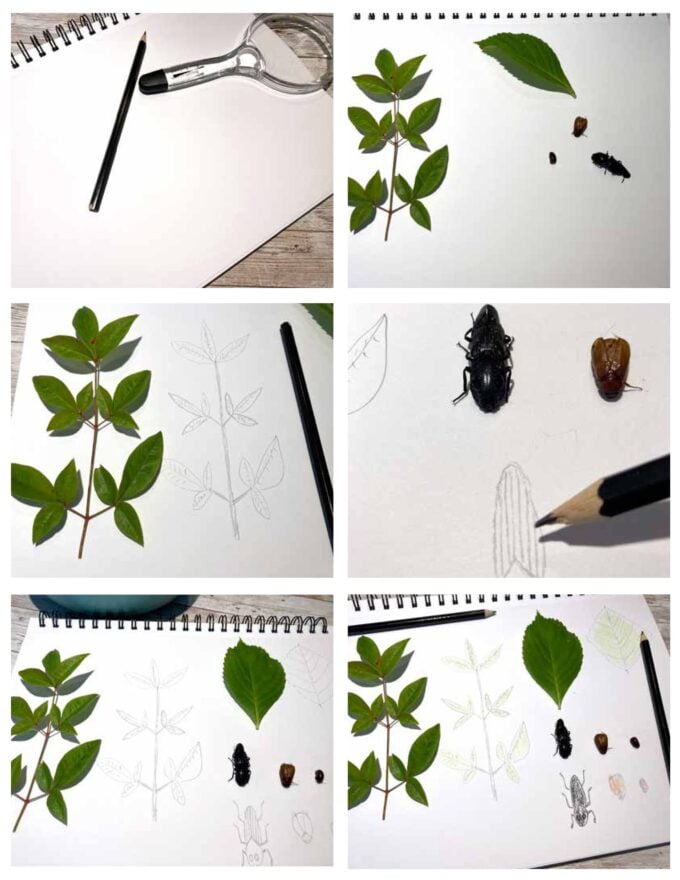
Step 1: Collect or Choose a Specimen
Go outside and collect several leaves, flowers, or natural objects. If observing insects, use photos or preserved specimens — do not harm living insects.
Step 2: Observe Carefully
Use a magnifying glass to look closely at your specimen.
Encourage students to notice:
- Leaf veins and patterns
- Stem structure
- Insect body segments
- Antennae and legs
- Wing texture
- Tiny hairs or ridges
Remind them: scientists do not rush.
Step 3: Sketch the Basic Shape
Lightly draw the outline first. Focus on correct proportions before adding details.
Step 4: Add Fine Details
Slowly add the small features you observed. The goal is accuracy, not decoration.
Step 5: Add Color and Shading
Use colored pencils to show realistic color variation and texture.
Step 6: Label Important Parts
Turn the drawing into a true scientific illustration by labeling structures.
For leaves:
- Blade
- Veins
- Margin
- Stem
For insects:
- Head
- Thorax
- Abdomen
- Antennae
- Wings
- Legs
The Science Behind Scientific Illustration
Field: Biology & Scientific Observation
Grades: 2–5
Concepts Explored: Observation skills, plant structures, insect anatomy, life cycles, scientific documentation
Scientific illustration is more than art. It is a scientific tool.
When students draw something carefully, they process more information than when they only look at it. This strengthens:
- Attention to detail
- Structural understanding
- Memory retention
- Scientific reasoning
Leaves contain veins that transport water and nutrients throughout the plant. Insects have three main body sections: head, thorax, and abdomen. Careful observation helps scientists understand how organisms grow, survive, and adapt.
💡 Tip: Have students compare two different leaves side by side and identify structural differences.
Who Was Maria Sibylla Merian?
Maria Sibylla Merian (1647–1717) was a scientist and artist who carefully studied insects and plants. At a time when many people misunderstood insect life cycles, she documented metamorphosis through detailed illustrations.
She traveled to South America to observe insects in their natural habitats and published books filled with hand-colored scientific drawings.
Her work helped change how scientists understood butterflies, caterpillars, and other insects.
Like Jane Goodall observing chimpanzees centuries later, Merian proved that careful observation leads to discovery.
Make It a Science Project
Turn this into a deeper investigation:
- Compare two different leaf species.
- Record similarities and differences.
- Research the plant names.
- Create labeled illustrations for both.
- Write a short explanation of structural differences.
Older students can:
- Illustrate stages of metamorphosis
- Compare juvenile vs adult insects
- Create a full life cycle illustration panel
👉 Students can compare two different leaf species and record structural differences. For more plant investigations, explore our plant science activities for kids.
Extend the Learning: Start a Phenology Journal
Scientists who track seasonal changes in nature are practicing phenology — the study of how plants and animals change throughout the year.
Instead of observing just once, choose one plant or tree and track it weekly. Notice:
- When buds appear
- When leaves fully open
- When flowers bloom
- When insects visit
- When leaves change color
Use our printable Phenology Wheel Nature Journal to record seasonal changes over time.
👉 Download the Phenology Wheel here.
More Facts for Kids
- Maria Merian was one of the first scientists to accurately document insect metamorphosis.
- She combined art and science in a time when few women were recognized in science.
- Scientific illustration is still used in biology textbooks today.
- Careful drawing can reveal details that photos sometimes miss.
Extension Activities
- Pair with a butterfly life cycle activity
- Study parts of a plant and illustrate each section
- Keep a weekly nature observation journal
- Connect to a Jane Goodall-style animal behavior observation project
Scientific Illustration FAQ
What age is this scientific illustration activity best for?
Grades 2–5 are ideal. Younger students can focus on simple observation and labeling, while older students can add detailed anatomical labels and research components.
Do students need real insects for this project?
No. Leaves and plant materials work perfectly. Students can also use high-quality photos for careful observation.
Is this art or science?
It is both. This STEAM activity combines biological observation with artistic skill and scientific documentation.
How does this connect to Maria Sibylla Merian?
Maria Sibylla Merian carefully observed and illustrated insects to document metamorphosis. This activity helps students practice the same detailed observation skills she used in her scientific work.
Related Science Activities
- Butterfly Life Cycle Activities
- Insect Life Cycle Worksheets
- Parts of a Plant Worksheets
- Women in STEM Projects
- Nature Observation Activities
- STEAM Activities for Kids
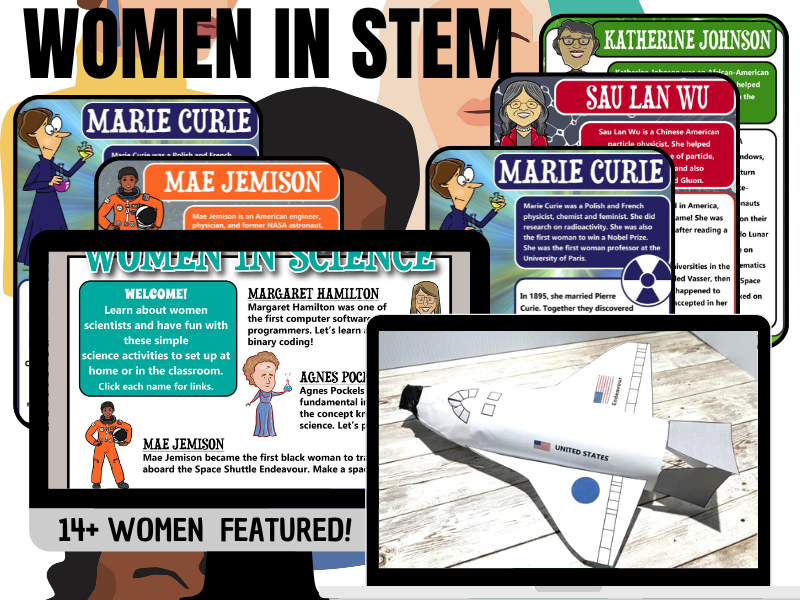
Explore More Women in STEM
This activity is part of our larger Women in STEM collection, featuring inspiring scientists, engineers, and mathematicians.
✔ Kid-friendly biographies
✔ Hands-on STEM investigations
✔ Easy-to-use printables
I
👉 See everything included in the Women in STEM Project Pack here. Included with the All-Access Pass