
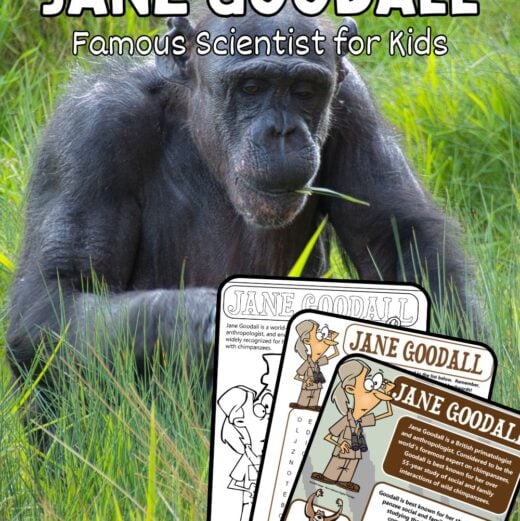
Celebrate the life and work of Jane Goodall, one of the world’s most famous scientists, with this engaging mini science project pack for kids. Kids will explore her groundbreaking discoveries about chimpanzees, practice animal observation, and learn about conservation through activities, crafts, and worksheets.

Jane Goodall Activities for Kids
This pack makes it easy to introduce kids to women in STEM while exploring big science ideas, such as animal behavior, habitats, and ecosystems. Additionally, explore the related science activities, journal prompts, and teaching tips below.
Scientists like Jane Goodall spent years carefully observing animals and recording what they discovered. Kids can practice the same type of scientific thinking with our free animal research project template.
Field of Science: Biology, Ecology, Environmental Science
Grade Level: Best for K–5 (adaptable for older students, too)
Science Concepts Explored:
- Animal behavior and observation
- Habitats and ecosystems
- Conservation and endangered species
- The role of scientists in studying the natural world
- Women in STEM history
Supplies Needed
- Jane Goodall biography printable
- Jane Goodall coloring page
- Word search puzzle
- Chimpanzee puppet craft printable
- Crayons or markers
- Scissors and a glue stick
- Paper bag
- Read: “The Story of Jane Goodall” (Amazon Affiliate Link)
How to Use the Jane Goodall Mini Project Pack
Read & Discuss
Begin with the biography sheet to learn about Jane Goodall’s early life and her chimpanzee studies in Tanzania.

Color & Learn
Use the coloring page to reinforce simple facts about Goodall. Perfect for early finishers, substitute plans, after-school and library groups, or quiet time at home.

Search & Discover
Complete the word search to find important science and conservation vocabulary, like habitat, extinction, and deforestation. Use the vocab words to write the journal prompts below.

Create & Make
Assemble a chimpanzee puppet using the printable template and a paper bag, or create a jungle scene and add the chimpanzee to it.

Jane Goodall Science Information
Jane Goodall’s studies showed that chimpanzees:
- Use tools, such as sticks, to collect termites
- Express emotions like joy, sorrow, and grief
- Form strong family bonds and communities
Her discoveries transformed the way scientists understand animals and helped launch the modern conservation movement. Goodall’s work continues today through the Jane Goodall Institute, which protects chimpanzees and their habitats worldwide.
🔎 Teaching kids about her story introduces ecology, empathy, and the importance of protecting our planet—while also showing the impact of women in science.
NGSS Guiding Questions
- What do animals need from their habitats to survive?
- How do scientists study and observe animals in the wild?
- Why is it important to protect endangered animals and their environments?
Teaching Tips
- Differentiate by Grade: Younger students can focus on coloring and the puppet craft, while older students complete the word search and write short reflections.
- Cross-Curricular Links: Pair this pack with literacy (biographies), social studies (famous people), or art (puppet design).
- Discussion Starter: Ask students what qualities made Jane Goodall a good scientist—curiosity, patience, and compassion.
Journal Prompts
- If you could study any animal in the wild, which one would you choose and why?
- What do you think would be the hardest part about being a scientist like Jane Goodall?
- How can kids help protect animals and their habitats today?
Follow in Jane Goodall’s Footsteps: Animal Research Activity
One of the most important things Jane Goodall did as a scientist was carefully observe animals and record what she noticed. She spent years watching chimpanzees in the wild and writing down their behaviors, habitats, and interactions.
Kids can practice the same type of scientific observation with our free A–Z Animal Research Sheets.
Each page includes space to record:
- What the animal eats
- Where it lives (habitat)
- Size, weight, and lifespan
- Physical traits and adaptations
- Interesting behaviors
- Whether it is endangered
- The animal’s role in its ecosystem
Teacher Tip: Have students choose an animal to research and then share their findings “like a field scientist”—one fact about habitat, one about behavior, and one about conservation.
Free Printable Jane Goodall Mini Pack
Make sure to grab the free Jane Goodall activities for kids here.
Related Science Activities for Kids
Looking for more ways to inspire young scientists? Pair these Jane Goodall activities with related animal science and Women in STEM projects.
Explore More Animal Science
- Animal Habitats Activities for Kids – Learn how animals survive in different environments.
- Animal Adaptations Science Pack – Discover how animals change to survive in their ecosystems.
- Animal Life Cycles Activities for Kids – Study butterflies, frogs, bees, and birds with printable packs.
- Migration and Hibernation Activities – Explore how animals prepare for seasonal changes.
Learn About More Women in STEM
- Marie Curie X-Ray STEAM Project – Explore X-rays with a simple art and science activity.
- Amelia Earhart Airplane Challenge – Make an airplane launcher and explore aerodynamics.
- Margaret Hamilton’s Code – Learn about binary code and the work of Margaret Hamilton.
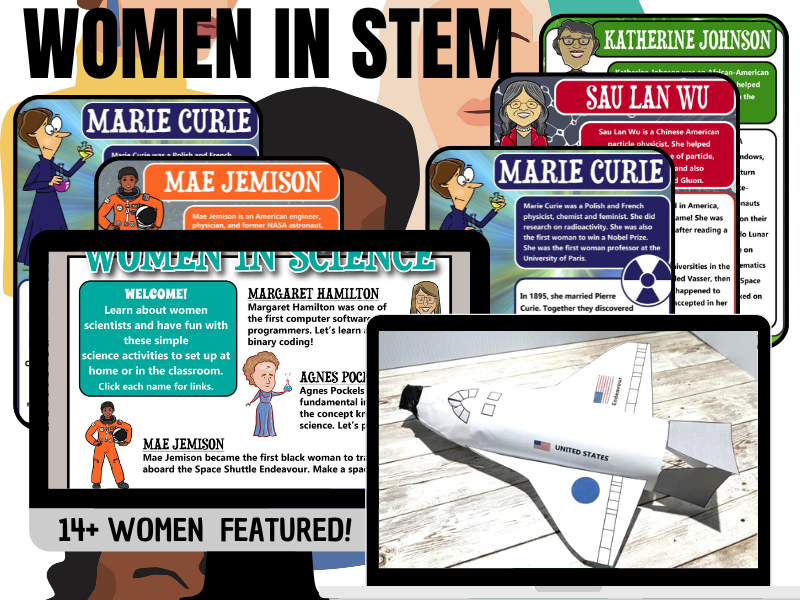
- Women in STEM Project Pack – Hands-on activities and mini-biographies of inspiring women in science.
Explore More Women in STEM
This activity is part of our larger Women in STEM collection, featuring inspiring scientists, engineers, and mathematicians.
✔ Kid-friendly biographies
✔ Hands-on STEM investigations
✔ Easy-to-use printables
I
👉 See everything included in the Women in STEM Project Pack here. Included with the All-Access Pass