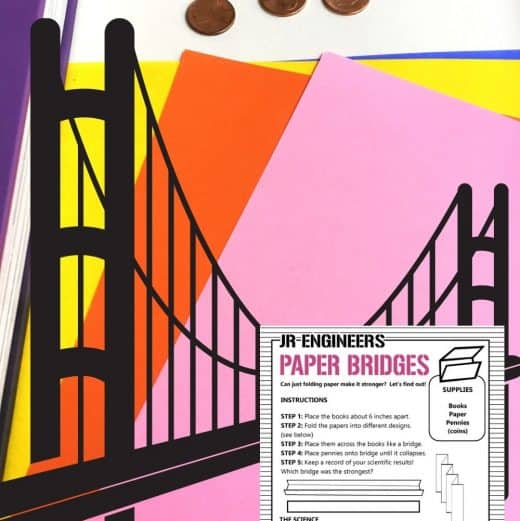
Can one sheet of paper hold dozens of coins? In this hands-on paper-bridge STEM challenge, kids design, test, and improve their own bridge to discover how engineers make structures strong by using shape rather than stronger materials.
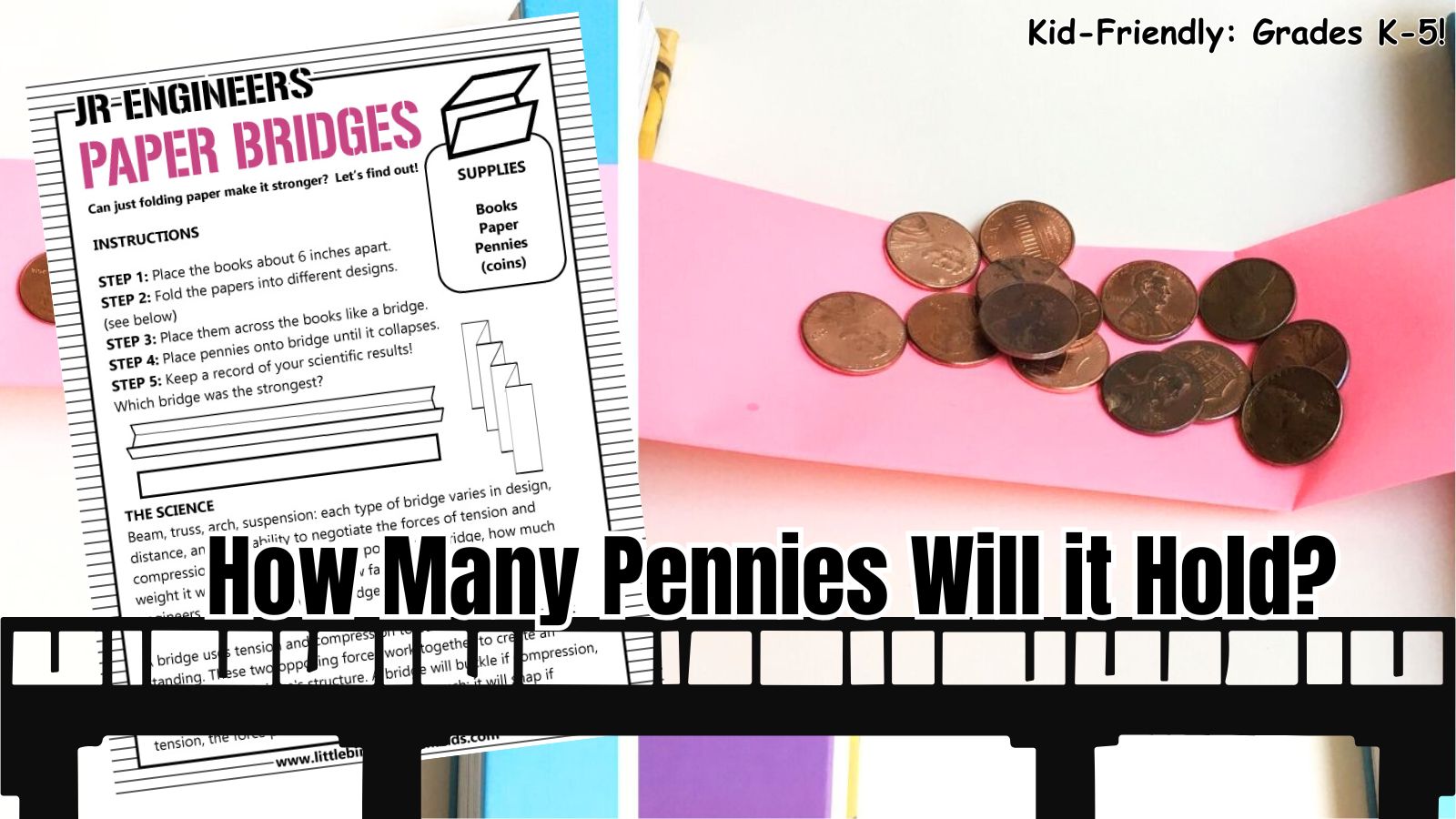
This simple engineering activity works in classrooms, homeschool lessons, and at-home learning — and naturally introduces forces, stability, and problem solving.
What Kids Learn
Looking for more hands-on design challenges? Explore our full collection of engineering activities in the Engineering Projects Hub.
Field: Engineering & Physical Science — Forces and Structures
Grades: K–5
Concepts Explored: compression, tension, load distribution, structural strength, redesign
Supplies
- Pencil & paper for recording (optional)
- Paper (copy paper works best)
- 2 stacks of books
- Coins or small weights
How To Build a Paper Bridge
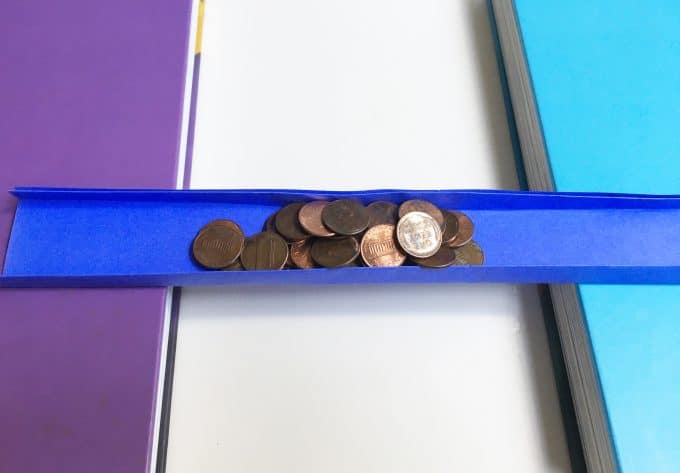
- Place two stacks of books about 6 inches apart.
- Lay one flat sheet of paper across the gap.
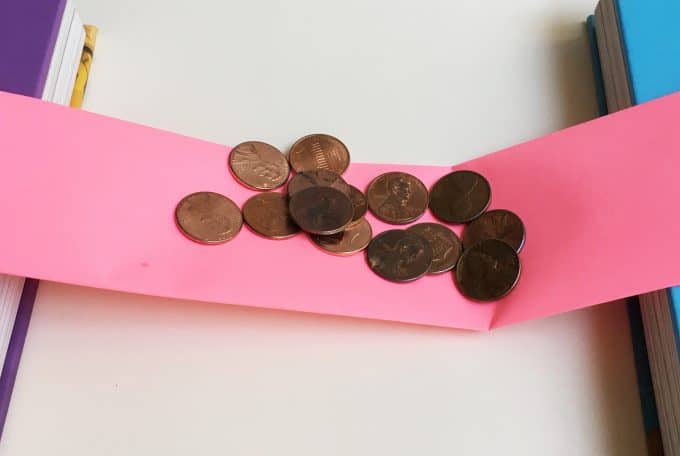
- Add coins one at a time until the bridge collapses.
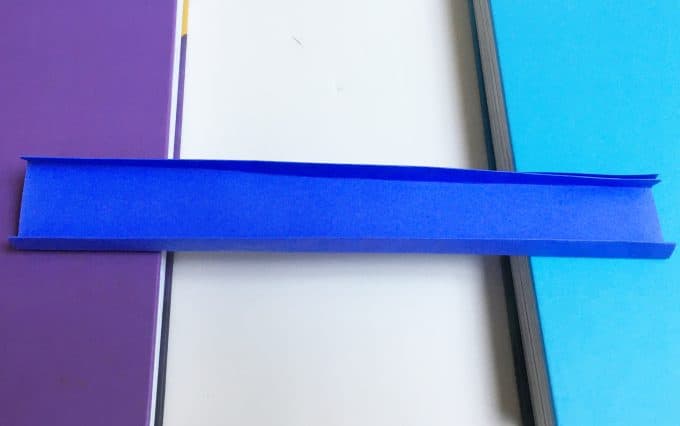
- Redesign the paper — fold, curve, or layer it.
- Test again and record results.
- Compare which design held the most weight.
Challenge:
Can you design a bridge that holds 50 coins?
Encourage multiple attempts — real engineers rarely succeed on the first try.
The Science Behind the Strongest Paper Bridge
Every bridge must handle forces that push and pull on it.
Two important forces act on structures:
Compression — pushing force pressing inward
Tension — pulling force stretching outward
A flat sheet bends easily because all the compressive force is concentrated in one spot. When kids change the shape, they change how the forces travel.
They quickly notice:
- folded paper spreads force outward
- curved paper supports weight downward
- ridges prevent bending
- layered paper increases stiffness
Engineers don’t usually start by choosing stronger materials — They start by choosing smarter shapes.
💡 That’s why bridges use arches, beams, and trusses instead of solid slabs.
Why Folding Makes Paper Stronger
Flat paper concentrates weight along a single line.
Shaped paper distributes weight across a structure. This spreading of force is called load distribution. The more evenly the weight spreads, the less the bridge bends — and the stronger it becomes.
💡 Kids are discovering structural engineering using only paper.
NGSS Connections
- How can we make a structure stronger?
- What design changes improved performance?
- How does shape affect stability?
- Why did some bridges fail while others worked?
Make It a Real Investigation
Engineers improve designs by changing one feature at a time.
Try adjusting only one variable:
- fold width
- arch height
- number of layers
- distance between supports
Have kids predict first, then test.
Ask:
What changed?
What stayed the same?
Which design worked best — and why?
Guide students to notice that stronger bridges don’t just use more material — they use better shapes to spread force across the structure.
👉 This cycle of testing and improving is called the engineering design process.
Frequently Asked Questions
Why does folded paper hold more weight?
Folding distributes the force across the structure rather than bending a single flat surface.
What shape makes the strongest paper bridge?
Curved and ridged shapes usually work best because they distribute compression forces.
How far apart should the books be?
About 5–7 inches. Increasing the gap makes the challenge harder.
Is this science or engineering?
It’s engineering — kids design, test, fail, and improve using science ideas.
What age group works best?
Kindergarten through middle school. Younger kids explore, older kids analyze results.
💡 After testing your paper bridge, extend the learning with related engineering challenges below.
Explore More Bridge Building Ideas
Ready to keep testing structures? Try these variations:
- Gumdrop and toothpick bridge — build a 3D frame structure
- Spaghetti bridge — explore lightweight materials
- Skeleton bridge — remove material but keep strength
- Printable bridge design pack — simple engineering exploration
Try More Engineering Challenges
Use the same design → test → improve thinking:
- Straw boats challenge — test floating vs sinking designs
- Paper chain challenge — maximize strength with limited materials
- Egg drop challenge — protect an object from force
- Marshmallow tower challenge — build height with stability
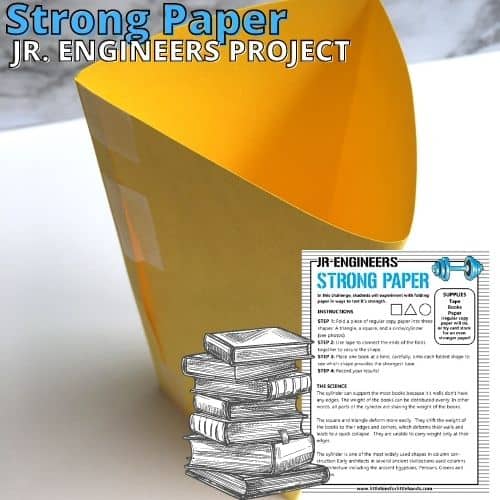
- Strong paper shapes investigation — discover how shape changes strength
Helpful Teaching Resources
Use these resources to support discussion and vocabulary:
Printable Elementary Science!
Want to do meaningful science — but not start a full unit yet? This starter lab provides quick, hands-on investigations across multiple science topics, allowing students to explore how science works before diving deeper into any one subject.
Perfect for regularly trying science without extensive planning. Grades: K–5.