
Put a spooky spin on a classic bridge-building challenge with this Skeleton Bridge STEM Activity! Kids use cotton swabs as pretend bones to design, build, and test a bridge that can hold weight. It’s a simple, hands-on way to explore engineering, strong structures, and problem-solving using everyday supplies. Grab the free printable STEM challenge sheet and see how strong your skeleton bridge can be!

Skeleton Bridge Halloween STEM Challenge
Best for grades 1–5: Younger kids focus on design and creativity, while older kids explore structure and strength.
STEM Concepts Covered:
- Engineering Design Process: Brainstorm, plan, build, and test a bridge.
- Forces & Balance: Explore how weight is distributed across a structure.
- Structural Stability: Discover what makes a bridge strong or weak.
- Problem-Solving & Teamwork: Adjust designs and collaborate to improve strength.
The Challenge:
Build a bridge using only bones (aka cotton swabs) that is at least one foot long and sits at least one inch off the ground or table. Sounds too easy? Or does it?
Many STEM projects use critical thinking, math, and engineering skills, and this one is no exception. Attention to detail is a must, and we encourage pre-planning! This can be a timed challenge or not depending on the time you have available.
Grab the free printable Skeleton Bridge STEM Challenge
Grab the free bridge building STEM project here.
Time Needed:
30 minutes or more if time allows!
Encourage kids to spend up to 5 minutes discussing their design ideas and doing rough sketches. Then, allow 20 minutes to build your bridge. Plus, another 5 minutes to talk about the challenge, what worked and what didn’t.
Materials:
- Cotton Swabs
- Tape
- 100 Pennies
Variations:
Do you have older kids? To add an extra layer to the challenge, create a specific structure or bridge or choose a type to build. Give them a few minutes to research different bridge types and draw a design!
🔎 Find more printable bridge design ideas here.
Do you have younger kids? Let them explore the materials and test how they work together to complete the challenge. Set up two blocks or books and have them build a bridge spanning the distance you choose.
Extend The Challenge:
Can you build a bridge that can hold the weight of a roll of pennies or of another predetermined object?
Skeleton STEM Challenge Setup:
STEP 1: Give out supplies to each kiddo or group.

STEP 2: Give 5 minutes for a planning phase (optional).
STEP 3: Set a time limit (20-25 minutes is ideal) for groups or individuals to build their bridges.

STEP 4: Once the time is up, have the kids set up their bridge for everyone to see. Test the skeleton bridge design to see how much weight it can hold.

STEP 5: If it works for you, have each kiddo share his/her thoughts on the challenge. A good engineer or scientist always shares his/her findings or results. Use our questions for reflection here to encourage communication skills.
Ask a few questions:
- What was the most challenging thing about this Halloween STEM challenge?
- What would you do differently if you could try the bridge challenge again?
- What worked well and what didn’t work well during this STEM challenge?
STEP 6: Have fun!
💡 Why not pair this Halloween STEM challenge with our printable roll and build a skeleton game!

Balance, Structure, and Strength for Bridge Building
When engineers design bridges, they think about three key ideas: balance, structure, and strength.
Balance means making sure the weight of an object is spread out evenly so it doesn’t tip or fall. In your skeleton bridge, balance helps keep the bridge steady while holding weight. If one side is heavier or weaker, the bridge can collapse!
Structure refers to how the parts of your bridge are connected. A good structure uses shapes that add stability—like triangles. Triangles are strong because they don’t change shape easily when force is applied. Try using triangle shapes in your design to make it more stable.
Strength is all about how much weight a bridge can hold before breaking or bending. The more balanced and well-structured your bridge is, the stronger it becomes. Materials like cotton swabs might look light and flimsy, but when connected in smart ways, they can hold surprising amounts of weight!
Engineers test their bridges again and again to find weak points and improve their designs. You can do the same—observe where your bridge bends or breaks and redesign to make it stronger next time!
Real-World Connection
Real engineers use the same ideas of balance, structure, and strength when designing bridges all around the world! From suspension bridges like the Golden Gate Bridge to arch bridges made of stone, every type must be able to support its own weight and the people or vehicles that cross it.
Engineers carefully test materials, shapes, and designs to make sure their bridges are safe and sturdy. Just like in the Skeleton Bridge Challenge, they sketch ideas, build models, and test how well their structures hold up under pressure. Your mini bridge is a small version of the same problem engineers solve every day!
More Halloween Science and STEM Activities


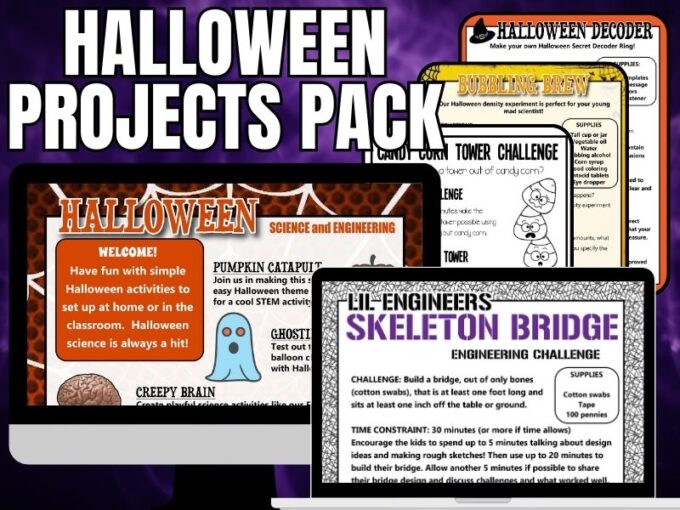
Printable Halloween STEM Activities Pack
150+ Pages of Halloween-Themed Materials! This Halloween project pack is suitable for home, school, and group use for kids in grades Kindergarten through elementary but is scalable for many ages and abilities.



Thanks for putting all this out there!