
Can a single sheet of paper really hold a stack of heavy books? In this hands-on STEM challenge, kids fold paper into different shapes and test which one survives the most weight. Some designs collapse instantly — but one shape can hold far more than anyone expects.
This simple experiment turns ordinary paper into a real engineering investigation as kids explore force, stability, and why buildings use columns instead of boxes.
👉 New to engineering? Start with our Engineering Resources Hub to learn key concepts, then try more hands-on ideas in our Engineering Projects Hub.
Which Paper Shape Is The Strongest?
Kids test three folded paper structures:
- Triangle prism
- Square prism
- Cylinder
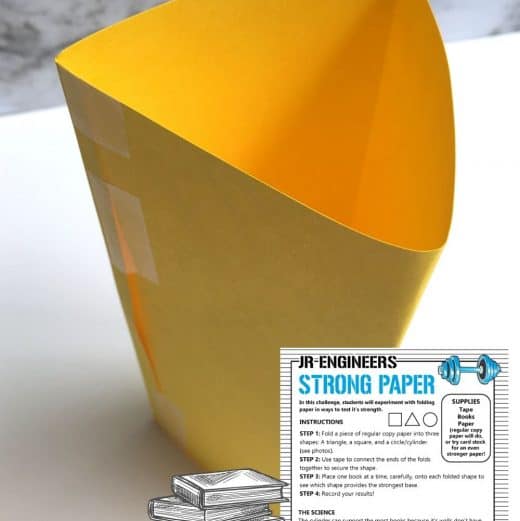
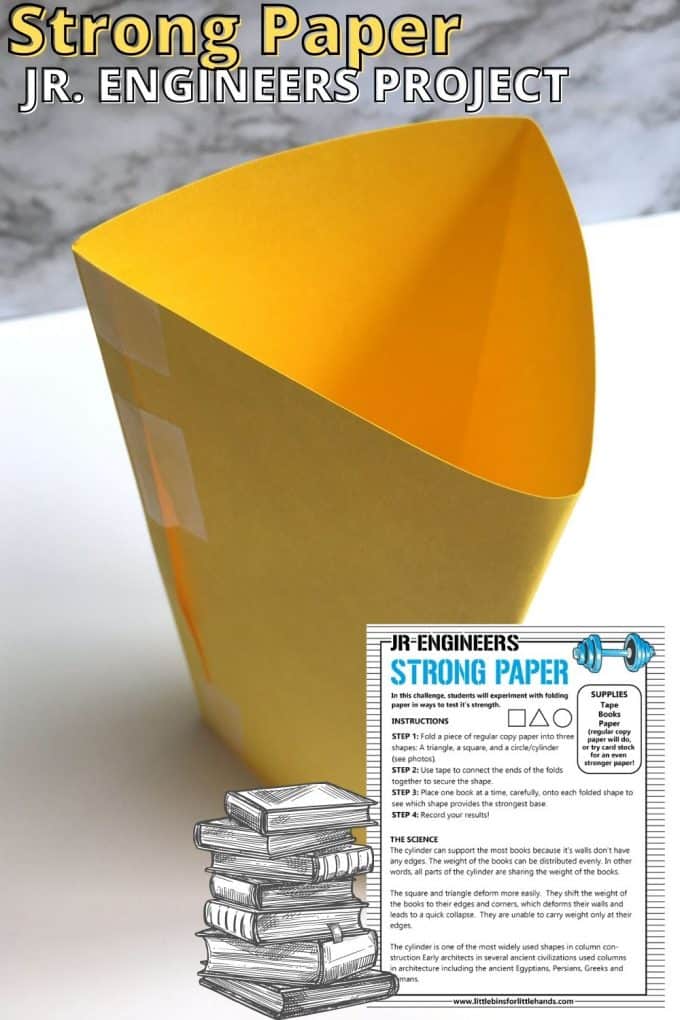
Most kids find that the cylinder holds the most books. But why? The answer has to do with how force moves through a structure.
The Science Behind Strong Paper Shapes
Field: Engineering — Structural Engineering
Grades: K–5
Concepts Explored: Force, compression, load distribution, structural stability
When weight presses down on an object, it exerts a downward force. Engineers call this compression.
Different shapes handle compression differently:
- Squares push force toward edges
- Triangles push force toward corners
- Cylinders spread force around the entire wall
Because the cylinder has no corners, no single weak point forms. The entire shape works together to support the load.
Engineers call this load distribution — and better distribution means stronger structures.
That’s why columns in buildings, silos, pipes, and towers are round. Ancient Egyptians, Greeks, and Romans all used cylindrical columns for this exact reason.
Let’s test the theory!
Supplies Needed
- Paper (copy paper works best to start)
- Tape
- Stack of books
Optional:
- Cardstock for comparison
- Recording sheet
How To Make Strong Paper Structures
Step 1: Build Your Shapes
Fold paper into three columns:
- Triangle
- Square
- Cylinder
Tape the ends to hold the shape together.

Step 2: Test The Strength
Place books one at a time carefully onto each structure.
Step 3: Record Your Results
| Shape | Number of Books |
|---|---|
| Triangle | |
| Square | |
| Cylinder |

NGSS Guiding Questions
- How does the shape of a structure affect how much weight it can hold?
- Where does the force travel when weight is added?
- Why do some shapes collapse faster than others?
- How do engineers make buildings stronger?
Quick Answers
- Engineers choose shapes before choosing materials.
- Shape changes how force moves through a structure.
- Corners create weak points.
- Curved surfaces spread weight evenly.
What Students Should Observe
As books are added, watch closely:
- Do the walls bend or stay straight?
- Does collapse happen suddenly or slowly?
- Where does it fail first — middle, edge, or corner?
- Does height affect strength?
Structures fail at weak points, not randomly.
Why The Cylinder Wins
In square and triangle columns, the force concentrates at the edges and corners. Those areas bend first, causing collapse.
In a cylinder, the force travels around the entire wall. Instead of one weak point, the whole structure shares the load.
💡 More sharing = more strength.
Make It An Engineering Challenge
Try improving the design. Change only one variable at a time:
- Taller vs shorter column
- Wide vs narrow cylinder
- Single vs double layer paper
- Copy paper vs cardstock
Engineers test designs systematically — not by guessing.
Real World Connection
Many structures around us use cylindrical design:
- Pillars
- Water towers
- Pipes
- Storage tanks
- Silos
Shape is often more important than material strength.
👉 Want more hands-on design challenges? Explore our Engineering Projects Hub for dozens of build-and-test activities.
More Paper Engineering Challenges
Try these next:
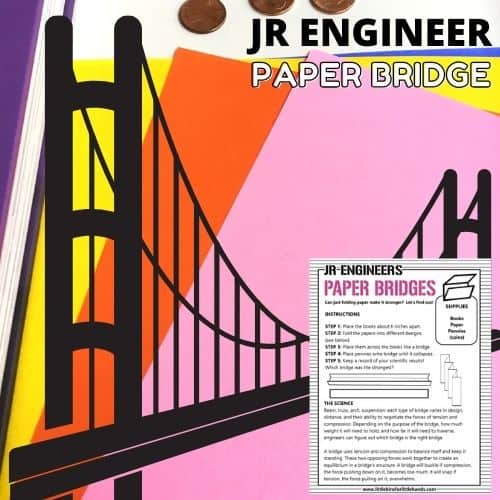
- Paper Bridge Challenge
- Paper Chain STEM Challenge
- Walking Through Paper Challenge
- Paper Grabber STEM Challenge
- Paper Tower STEM Challenge
- Paper Airplane Aerodynamics


FAQ
Why is a cylinder stronger than a square column?
A cylinder distributes force along its curved wall rather than concentrating weight at its corners. Because no single weak point forms, the structure can support more load before collapsing.
Does thicker paper make it stronger?
Thicker paper usually increases strength, but shape matters more than material thickness. A thin cylinder can often hold more weight than a thick square column.
Is this science or engineering?
It is both. Students observe how forces act on structures (science) and improve a design to make it stronger (engineering).
Do real buildings use this idea?
Yes. Columns, pillars, pipes, tanks, and towers are often cylindrical because curved surfaces better handle compression forces.
STEM Resources To Get Started
Learn how engineers think and design solutions in our Engineering Resources Hub.
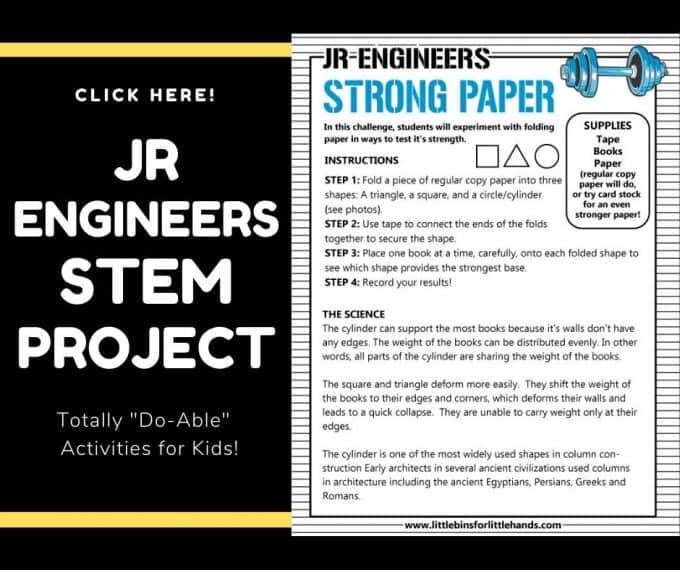
Free Printable Strong Paper STEM Challenge
Grab the recording sheet and challenge instructions to turn this activity into a full STEM lesson.
Printable Elementary Science!
Want to do meaningful science — but not start a full unit yet? This starter lab provides quick, hands-on investigations across multiple science topics, allowing students to explore how science works before diving deeper into any one subject.
Perfect for regularly trying science without extensive planning. Grades: K–5.