
Are you ready to take the penny boat challenge? Design a simple tin foil (aluminum foil) boat and see how many pennies it can hold before it sinks. This easy foil boat STEM challenge is a fun way to explore buoyancy and test engineering skills using simple materials.
We love easy STEM projects for kids, and this aluminum foil boat challenge is always a hit at home or in the classroom!
Explore Buoyancy With a Tin Foil (Aluminum Foil) Boat
Buoyancy is what allows objects to float in water. In this foil boat STEM challenge, kids design and build a simple boat that can hold the most pennies without sinking.
By changing the shape and size of the boat, kids can explore how buoyancy works and discover what makes some designs float better than others.
How to Make an Aluminum Foil Boat That Floats
The key to this challenge is shape. A flat piece of foil sinks quickly, but a boat shape spreads out weight and allows more water to push up underneath it.
The wider and more evenly balanced your boat is, the more pennies it can hold before sinking!
Penny Boat Challenge
Grade Level: 2nd–5th Grade
Objective: Explore the principles of buoyancy and engineering design by building a boat that can hold the most pennies without sinking.
Want a printable version of this challenge?
Make it even easier to get started with our free STEM challenge pack—perfect for home or classroom use.
👉 Grab your free STEM challenge pack here.
Supplies:
- Large bowl of water
- Green food coloring (optional)
- 30 plus pennies per boat
- 8″ Aluminum foil squares
Make a Foil Boat and Test It!
Watch the Video:
STEP 1: Add a drop of green or blue food coloring (optional) to your bowl and fill 3/4 with water.
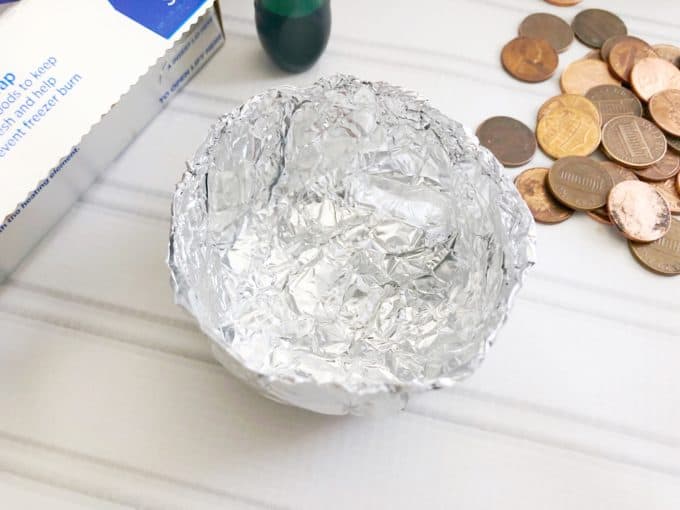
STEP 2: Cut two 8″ aluminum foil squares for each boat. Then form a small boat from the aluminum foil. Time for kids to use their engineering skills!
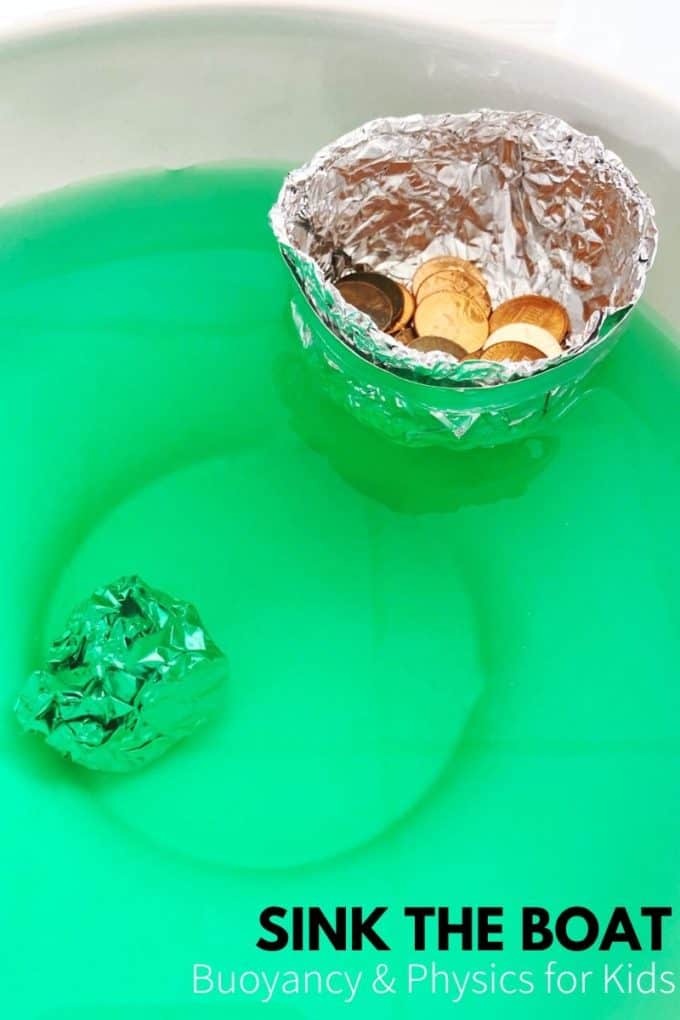
STEP 3: For comparison, put 15 pennies on the other square of tin foil (not the boat), and have the kids ball it up and place it in the water. What happens? It sinks!

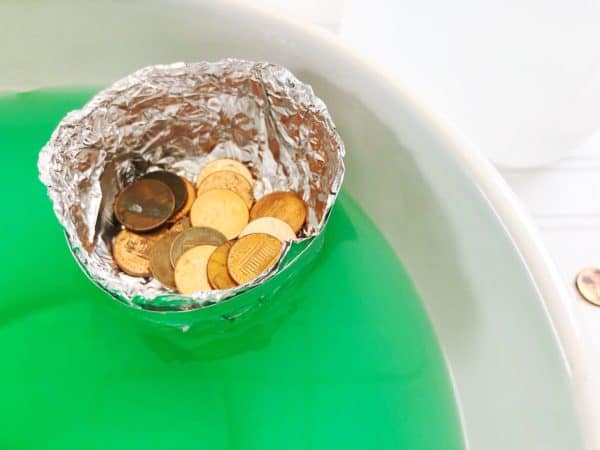
STEP 4: Place your boat in the water and see if it floats. Reshape if it doesn’t! Then, slowly add the pennies one at a time. How many pennies can you count before it sinks?
STEP 5 (optional): Extend the challenge by rebuilding your boat to see if it can hold even more pennies. Can your boat hold 100 pennies?
Reflection Questions
Use these questions to encourage critical thinking and discussion during the challenge:
- Design Choices:
- What shape did you choose for your boat, and why?
- Did your boat’s shape help it float better?
- Successes and Challenges:
- What part of your boat design worked the best?
- What was the hardest part of building your boat?
- Science Connection:
- Why do you think your boat floated or sank?
- How did adding pennies change your boat in the water?
- Problem-Solving:
- If you built your boat again, what would you change?
- Did you try different ways to stack or spread out the pennies?
- Teamwork:
- Did you work with a partner? How did you help each other?
- Did you share or use any ideas from other groups?
- Real-World Connections:
- How do real boats carry heavy things without sinking?
- Can you think of another object that floats in water?
- Personal Reflection:
- What did you learn about building a boat?
- What was your favorite part of the challenge?

Why Do Foil Boats Float? (Buoyancy Explained)
This penny boat challenge is all about buoyancy—how well something floats in water.
Even though the foil ball and the foil boat use the same material and number of pennies, they behave very differently.
The foil ball sinks because it is compact and takes up less space, so there isn’t enough upward force from the water to keep it afloat.
The foil boat floats because its shape spreads out the weight and increases surface area. This allows more water to push upward against it, helping it stay afloat.
In simple terms: bigger shape = more support from the water!
Frequently Asked Questions
Why does a foil boat float?
A foil boat floats because its shape spreads out weight and allows water to push upward against it. This upward force is called buoyancy.
Why does the foil ball sink?
The foil ball is compact and takes up less space, so there isn’t enough upward force from the water to keep it floating.
How can you make a foil boat hold more pennies?
Make the base wider and spread the weight evenly. A larger surface area helps the boat float longer.
How many pennies can a foil boat hold?
It depends on the design! Some boats can hold over 100 pennies when the weight is evenly distributed.
More STEM Challenges to Try
If you enjoyed this foil boat challenge, try one of these easy engineering activities next:
• Straw Boat Challenge – Design a boat using straws and test how much it can hold.
• Paper Bridge Challenge – Can folded paper hold weight?
• Spaghetti Bridge – Test strength with simple materials.
• Egg Drop Challenge – Protect your egg from a fall.
• Marshmallow Tower – Build the tallest structure you can.

Printable STEM Challenge Pack
Want more easy engineering activities like this?
Get 80+ doable STEM challenges with printable instructions, data sheets, and reflection questions—all in one place.