

When time is limited and the budget is small, these quick STEM challenges are a fun and effective way to keep kids learning through hands-on building and problem-solving. Designed for short class periods, STEM clubs, and fast group activities, these challenges work well for elementary through middle school students.
What Kids Learn with Quick STEM Challenges
Quick STEM challenges do more than keep kids busy—they help develop problem-solving skills, creativity, and confidence through hands-on exploration.
As kids design, build, test, and improve their ideas, they naturally practice important STEM skills while learning that there is often more than one way to solve a problem.
These activities encourage kids to:
- Think critically and solve real-world problems.
- Ask questions and test their ideas.
- Build, redesign, and improve their creations.
- Measure, compare, and record results.
- Practice teamwork and communication.
- Develop perseverance when their first idea doesn’t work.
Whether you have five minutes or an entire class period, STEM challenges are an easy way to introduce engineering, science, and creative thinking with simple materials. See what works (and what doesn’t). This spaghetti marshmallow tower challenge is a classic favorite!

Try These Quick STEM Challenges
Whether you have 5 minutes, 30 minutes, or a single class period, these STEM challenges focus on designing, building, testing, and improving—without complicated setup or expensive materials.
👉 Find more engineering activities for kids here
| If you have… | Try… |
|---|---|
| 5 Minutes | Paper Chain, Paper Clips, Balloon Rocket |
| 15 Minutes | Cup Tower, Paper Bridge, Boat Challenge |
| 30 Minutes | Catapult, Marble Run, Wind Powered Car |
| 45+ Minutes | Egg Drop, Solar Oven, Rube Goldberg |
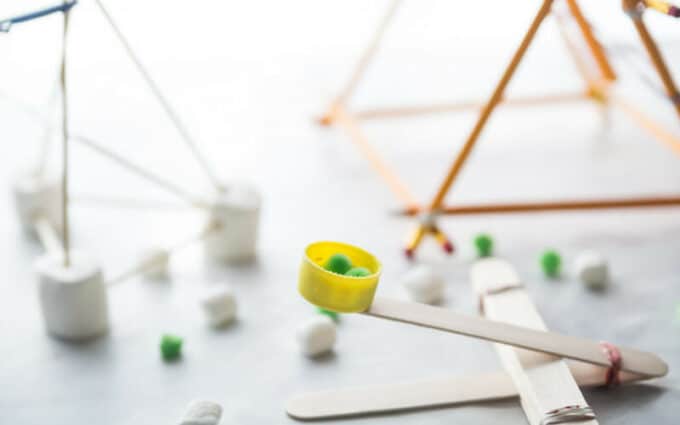
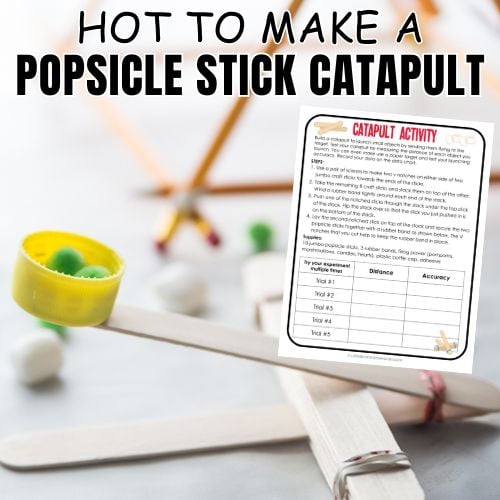
1. Design and Build a Catapult
Kids design and build a working catapult using simple materials. Encourage them to test distance, accuracy, or strength.
👉 Check Out: Catapult activities
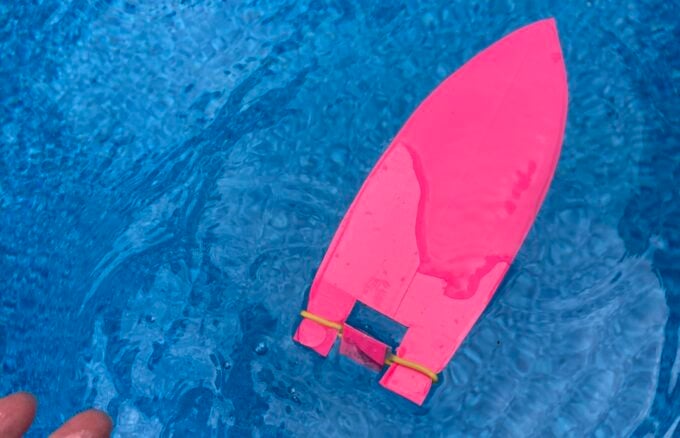
2. Build a Boat That Floats
Challenge kids to design a boat that floats—and then test how much weight it can hold.
Two easy setup options:
- Build boats from recyclables and test them in a tub of water
- Use one square of aluminum foil and test with pennies or washers
Use the same weight item for accurate comparisons.
👉 Check Out: Penny Boat, Straw Boat, and Paddle Boat activities here
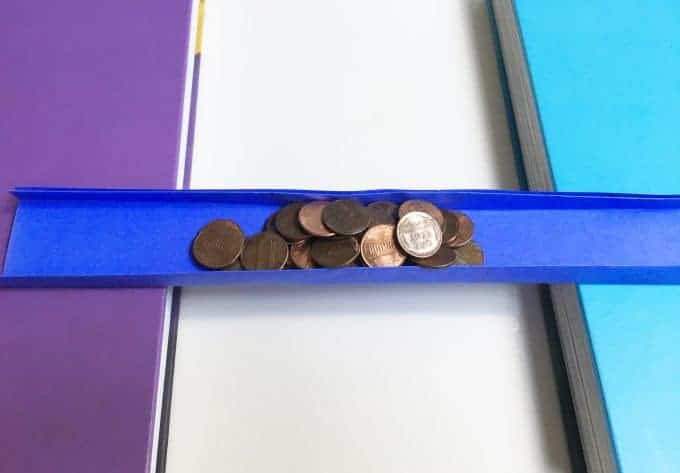
3. Design a Paper Bridge
Using paper, tape, pennies, and two stacks of books, kids build a bridge that spans a gap and supports weight.
Extensions for older kids:
- Try different materials (foil, cardstock, wax paper)
- Compare strength and flexibility
👉 Check Out: Paper Bridge
4. Egg Drop STEM Challenge
Design a way to drop an egg from a height without it breaking. Kids can use whatever materials are available and redesign after each test.
👉 Check Out: Egg Drop Project
5. Spaghetti Marshmallow Tower
Build the tallest tower possible using spaghetti and a jumbo marshmallow. Test height, stability, and strength.
👉 Check Out: Spaghetti Marshmallow Tower Challenge
6. Build a Car That Goes
Challenge kids to design a car that moves using simple propulsion methods.
Options include:
Start with group brainstorming, then test different designs.
👉 Check Out: Self-Propelled Vehicle activities
7. Wind-Powered Car STEM Challenge
Design a car that moves using wind instead of pushing or pulling. Use a fan, cardboard sail, or folded paper to test how design changes affect speed and distance.
👉 Check Out: Wind Powered Car

8. Design a Marble Run
Build a marble run using LEGO, cardboard tubes, or recycled materials. Experiment with slopes, curves, and paths.
👉 Check Out: Marble Run , Marble Roller Coaster, or Marble Maze activities here
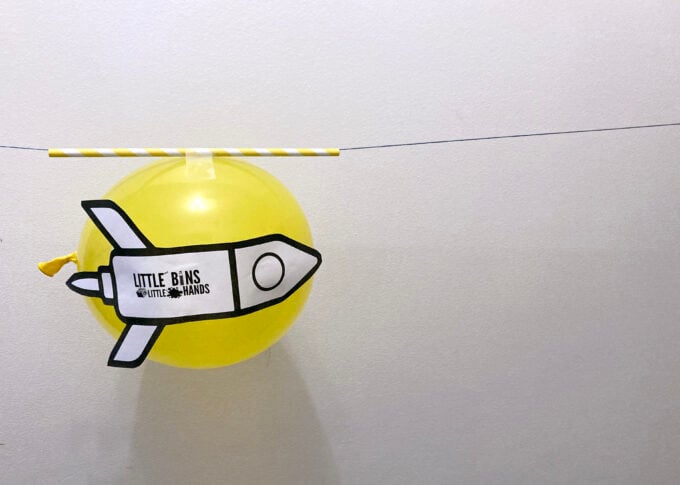
9. Balloon Rocket STEM Challenge
Set up balloon rockets using a balloon, straw, and string. Race them across the room and test changes to improve speed.
👉 Check Out: Balloon Rocket activity here
10. Build a Pulley System
Design a simple pulley system to lift or move objects more efficiently using string, cups, and cardboard tubes.
👉 Check Out: Pulley activities here
11. Rube Goldberg Machine
Create a simplified Rube Goldberg machine where one action triggers a chain reaction to complete a task.
12. Be an Architect for the Day
Challenge kids to design a structure that solves a problem, such as keeping something cool, strong, or protected.
👉 Check Out: Three Little Pigs STEM Challenge here
13. 100 Cup Tower Challenge
Using exactly 100 cups, build the tallest tower possible. This is quick to set up and great for groups.
👉 Check Out: Cup Tower Challenge
14. Paper Clip Strength Test
Create paper clip chains and test how much weight they can hold.
👉 Check Out: Paper Clip Challenge
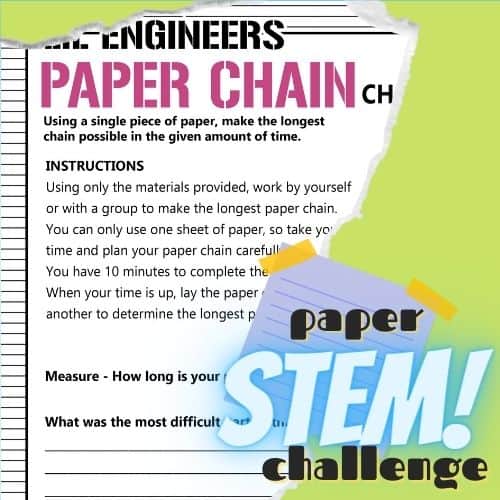
15. Paper Chain Challenge
Using a single sheet of paper, build the longest chain possible.
👉 Check Out: Paper Chain Challenge
16. Ice Insulation STEM Challenge
Design a container that keeps an ice cube from melting as long as possible using simple materials like cups, foil, or fabric.
👉 Check Out: Ice Melt Challenge
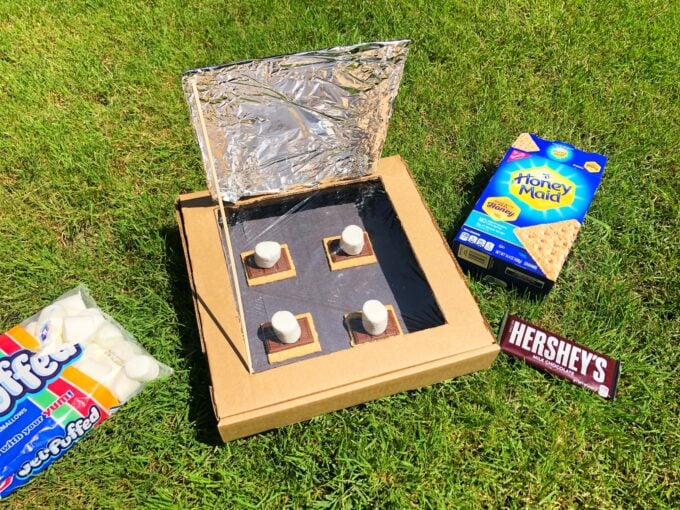
17. Solar Oven STEM Challenge
Design and build a DIY solar oven to melt marshmallows or chocolate using sunlight and household materials.
👉 Check Out: Solar Oven activity
Free Printable STEM Challenge Worksheets
Some of the best STEM challenges are also the simplest and least expensive. This free printable pack helps you get started quickly.
Worksheets include:
- STEM Design Process: Steps to Success
- 5 Quick STEM Challenges
- STEM Journal Pages
- Materials Master List
- How-to-Get-Started Instructions
Tips for Running Quick STEM Challenges
🔎 Tip 1- Plan in Short Time Blocks: Break challenges into planning, building, and testing phases.
🔎 Tip 2 – Use a Reusable STEM Bin: Keep materials like cups, tubes, string, foil, tape, and craft sticks ready to go.
🔎 Tip 3 – Choose Open-Ended Challenges: Avoid activities with one “right” answer.
🔎 Tip 4 – Keep Instructions Simple: One clear prompt works best.
🔎 Tip 5 – Encourage Teamwork or Solo Builds: Adjust challenges for pairs, groups, or individuals.
🔎 Tip 6 – Focus on Improvement: Testing and redesigning are part of the process.
🔎 Tip 7 – Add Themes for Engagement: Space, animals, or holidays add fun without extra prep.
🔎 Tip 8 – Use What You Have: STEM doesn’t require fancy tools—creativity matters more.
Think Like an Engineer
Every STEM challenge is an opportunity for kids to think like engineers.
👉 Instead of following step-by-step directions, kids solve a problem using the engineering design process.
- Ask – What problem am I trying to solve?
- Imagine – What are some possible solutions?
- Plan – Which idea should I try first?
- Create – Build and test the design.
- Improve – What worked? What could make it even better?
Encourage kids to view mistakes as part of the learning process. Every redesign helps them discover new ideas and build stronger problem-solving skills.
Adapt These STEM Challenges by Age
One of the best things about STEM challenges is that the same activity can be used with different age groups.
- Preschool: Focus on exploring materials, building simple designs, and asking questions about what happened.
- Kindergarten–2nd Grade: Encourage kids to make predictions, test ideas, and describe what worked or what they would change.
- Grades 3–5: Add measurements, compare different designs, collect data, and redesign based on the results.
- Middle School: Increase the challenge with engineering constraints such as limited materials, budgets, height requirements, or time limits. Encourage students to explain why one design worked better than another.
Frequently Asked Questions
What is a STEM challenge?
A STEM challenge is an open-ended activity where kids use science, technology, engineering, and math to solve a problem. Instead of following detailed instructions, children design, build, test, and improve their own solutions.
What supplies do I need for STEM challenges?
Most STEM challenges use inexpensive materials you already have, including paper, cardboard, craft sticks, tape, balloons, straws, string, plastic cups, aluminum foil, and recyclables.
How long do STEM challenges take? Some STEM challenges can be completed in just five minutes, while others work well as 30- to 60-minute classroom projects. Choose an activity that fits the amount of time you have available.
What age are STEM challenges best for? Many STEM challenges can be adapted for preschool through middle school by changing the level of difficulty, materials, or engineering requirements.
What is the engineering design process? The engineering design process is a simple way to solve problems by asking questions, planning, building, testing, and improving a design. It encourages kids to think creatively and learn from each attempt.
How can I make STEM challenges more difficult? Try limiting materials, setting time limits, adding weight or height requirements, collecting data, or asking kids to redesign their first prototype.
Why are STEM challenges important? STEM challenges help children develop problem-solving, critical thinking, creativity, teamwork, and perseverance while making science and engineering engaging and hands-on.
Printable Science Packs for Kids
Visit our SHOP for easy-to-print STEM and science lesson plans for the whole year. Or join us in the Little Bins Club.




Do you have materials available that say STEAM (with the A for Art) included? I’m trying to build a STEAM center and include more STEAM activities and would love to use your stuff!
Hi Susan,
I hear you! We don’t tend to do much with art here so I do not. Most of our resources are born from the projects my son is interested in doing. I will add it to the list to see if we can get some more STEAM going.
Do you have a complete STEM challenge activity pack? Like the sample you gave a freebie?
How do I print the activity pack?
Hi, you need to download the pack to your computer and print from there.
Sounds really great for my classroom. Could you please make the link to download the activity pack more obvious? I just simply cannot find it on the page. Thanks so much!!
Your website is awesome! Love love love your ideas! So many are so perfect right now for Emergency Distant Learning at our District. I teach STEM based courses to middle school… we are not able to finish the curriculum as it stands, so we are creating choice boards for our students. My colleagues and I are modifying a handful of your activities so that our kiddos can carry them out at home. Our kids are going to have a blast! Thank you so much for all you have done!!
Thank you Jodi! I am so glad that my resources can be of help!