
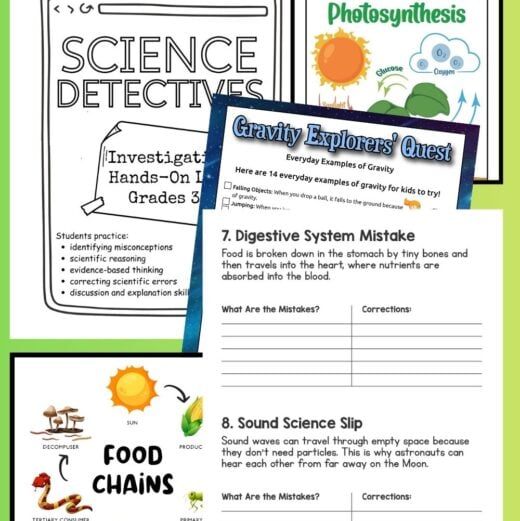
Kids are naturally curious about how the world works—but sometimes the explanations they come up with are not scientifically accurate. That’s actually an important part of learning science.
Students build a stronger understanding when they:
- ask questions
- investigate ideas
- compare evidence
- identify mistakes
- explain reasoning
- correct misconceptions
These science misconception activities encourage kids to think like science detectives while practicing observation, critical thinking, and evidence-based reasoning.
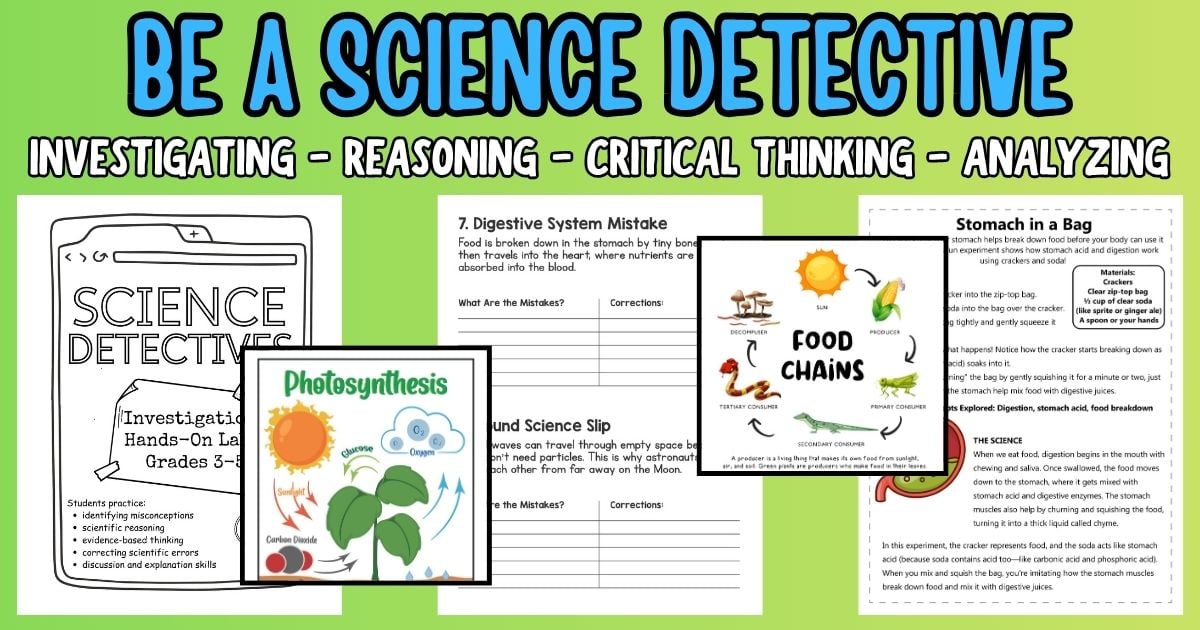
Science at a Glance
Field: Scientific Reasoning & Critical Thinking
Grades: 3–5
Concepts Explored: Observation, evidence-based thinking, scientific reasoning, correcting misconceptions, discussion skills, science explanations
👉 These science misconception investigations pair perfectly with our micro lessons, weird science question activities. Kids explore fascinating scientific mysteries, discuss theories, and think more deeply about how the world works.
What Is a Science Misconception?
A science misconception is an idea that sounds correct but is actually inaccurate.
Kids often develop misconceptions because:
- Scientific concepts can be abstract
- Every day language is confusing
- Observations are incomplete
- Incorrect information gets repeated
Instead of simply correcting mistakes, challenge students to investigate them.
The Science Detectives pack helps students:
- identify misconceptions
- explain scientific errors
- practice evidence-based thinking
- correct inaccurate explanations
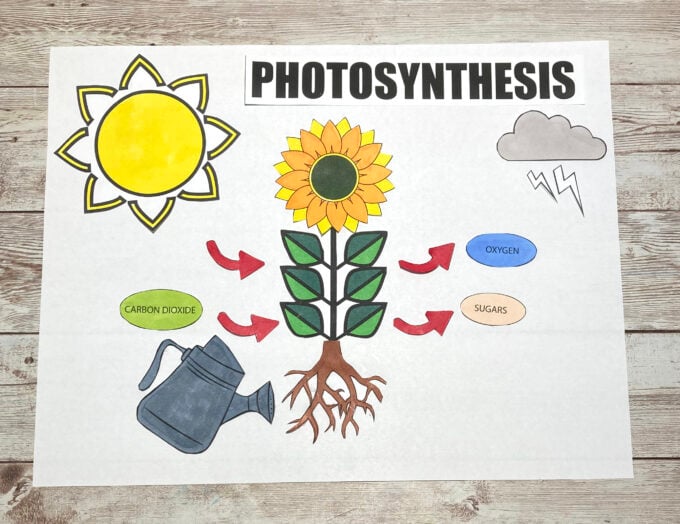
Plants Get Food From Soil
- The Misconception: Many kids believe plants “eat” soil.
- What Actually Happens: Plants make food through photosynthesis using sunlight, water, and carbon dioxide.
- Investigation Idea: Place one plant in sunlight and another in shade. Observe differences and discuss how sunlight helps plants make food. Learn about photosynthesis.
- Detective Question: What evidence shows plants need sunlight?
💡 In the Science Detectives Pack, kids analyze incorrect explanations about photosynthesis and identify scientific mistakes related to carbon dioxide, oxygen, and sugar production.
Gravity Pushes Things Down
- The Misconception: Some kids think gravity pushes objects downward.
- What Actually Happens: Gravity pulls objects toward massive bodies like Earth.
- Investigation Idea: Drop two objects from the same height and compare what happens.
- Detective Question: Does gravity push or pull?
💡 In the Science Detectives Pack, kids investigate incorrect explanations about gravity and why astronauts float on the Moon.
Liquids Stay Still
- The Misconception: Students sometimes believe liquids do not move or change shape.
- What Actually Happens: Liquids flow and take the shape of their container. Gases spread out to fill available space.
- Investigation Idea: Explore ice, water, and steam as you observe changes in their shapes and states.
- Detective Question: How do solids, liquids, and gases behave differently?
💡 In the Science Detectives Pack, kids correct misconceptions about states of matter while completing observation-based activities.

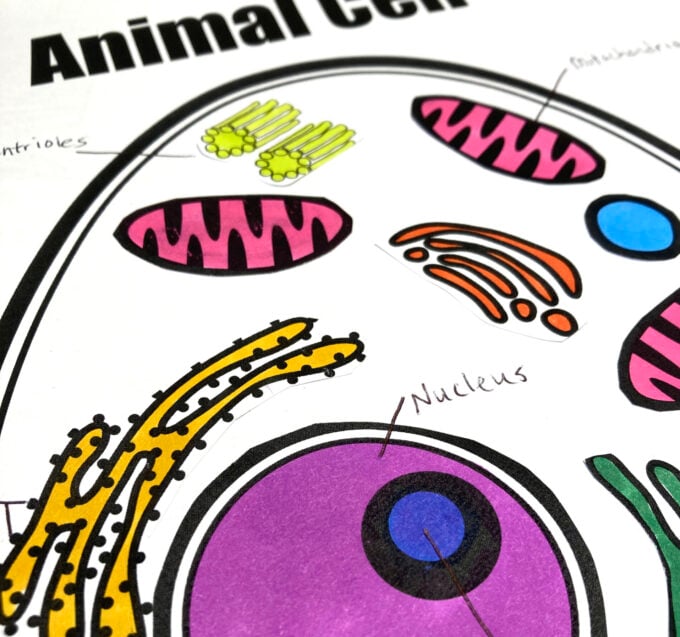
Only Plant Cells Have a Nucleus
- The Misconception: Some kids believe animal cells do not contain a nucleus.
- What Actually Happens: Both plant and animal cells contain nuclei that store genetic information.
- Investigation Idea: Compare plant cell and animal cell diagrams and identify shared structures.
- Detective Question: What parts do plant and animal cells have in common?
💡 In the Science Detectives Pack, kids investigate incorrect cell information and complete plant and animal cell labeling activities.
Electricity Works When Electrons Stop Moving
- The Misconception: Electricity can seem invisible and confusing to students.
- What Actually Happens: Electricity flows when electrons move through a complete circuit.
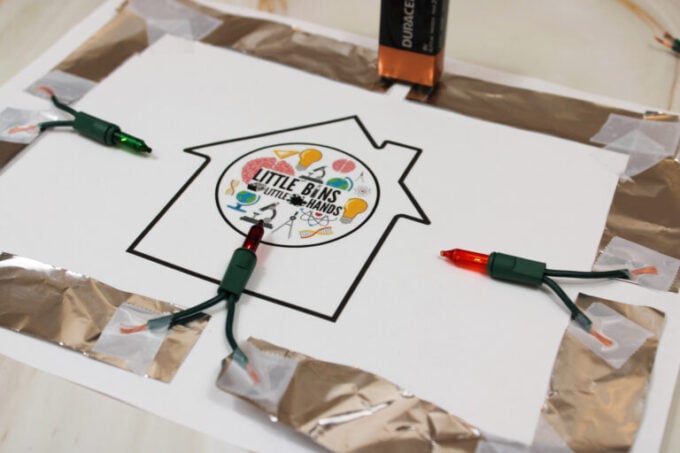
- Investigation Idea: Build a foil circuit and test what happens when the path breaks.
- Detective Question: Why does the bulb turn off when the circuit is incomplete?
💡 In the Science Detectives Pack, kids identify mistakes about circuits, electrons, and electricity before exploring hands-on circuit activities.
Tornadoes and Hurricanes Are the Same
- The Misconception: Students often mix up weather events.
- What Actually Happens: Tornadoes and hurricanes form differently and behave differently.
- Investigation Idea: Create a tornado in a bottle to model a rotating vortex.
- Detective Question: What causes air to spin?
💡 In the Science Detectives Pack, kids compare tornadoes and hurricanes while correcting weather misconceptions.

Food Travels Into the Heart
- The Misconception: Kids sometimes confuse body systems.
- What Actually Happens: Food moves through the digestive system and nutrients are absorbed in the small intestine.
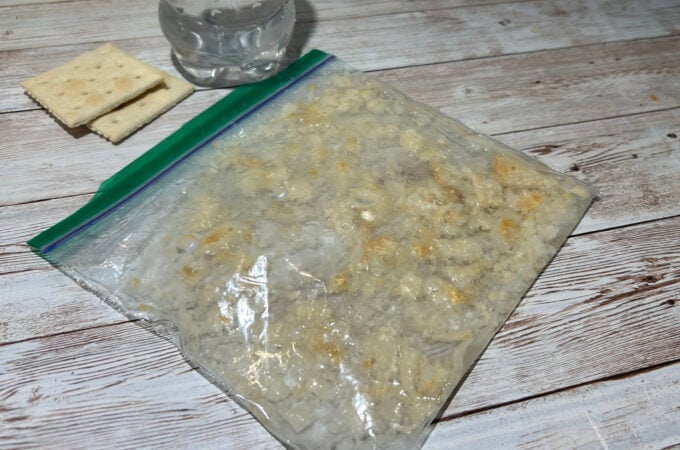
- Investigation Idea: Make a “stomach in a bag” model using crackers and soda to simulate digestion.
- Detective Question: How does the stomach help break down food?
💡 In the Science Detectives Pack, kids investigate digestive system misconceptions and complete digestion-based science activities.
Sound Travels Through Space
- The Misconception: Many students believe sound can travel anywhere.
- What Actually Happens: Sound needs particles like air, water, or solids to travel.
- Investigation Idea: Try cup and string phones or rubber band guitars to observe vibrations.
- Detective Question: What is vibrating to create sound?
💡 In the Science Detectives Pack, kids investigate misconceptions about sound waves and astronauts hearing sound in space.

Magnets Attract All Metals
- The Misconception: Students often think magnets stick to every metal.
- What Actually Happens: Magnets mainly attract iron, nickel, and cobalt.
- Investigation Idea: Test classroom objects with magnets and record predictions and results.
- Detective Question: What patterns do you notice about magnetic objects?
💡 In the Science Detectives Pack, kids explore magnetic misconceptions while completing prediction and observation activities.
Food Chains Start With Predators
- The Misconception: Some kids believe predators begin the food chain.
- What Actually Happens: Food chains begin with producers like plants.
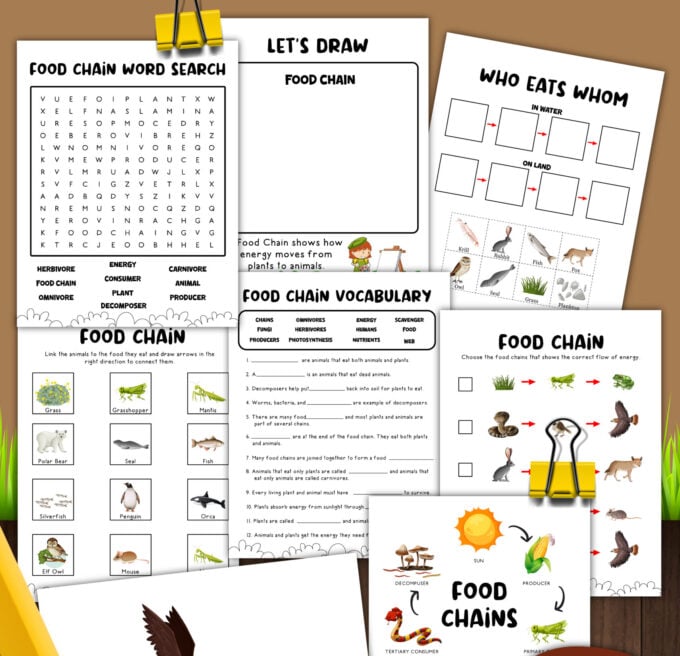
- Investigation Idea: Build simple food chains using pictures or cards.
- Detective Question: Where does energy originally come from?
💡 In the Science Detectives Pack, kids investigate ecosystem misconceptions while exploring producers, consumers, and decomposers.
Why Find-the-Flaw Science Activities Work
Traditional worksheets often focus on memorization. Science detective activities require kids to:
- analyze information
- identify mistakes
- explain evidence
- defend reasoning
- communicate scientific ideas clearly
This leads to deeper understanding and stronger long-term learning.
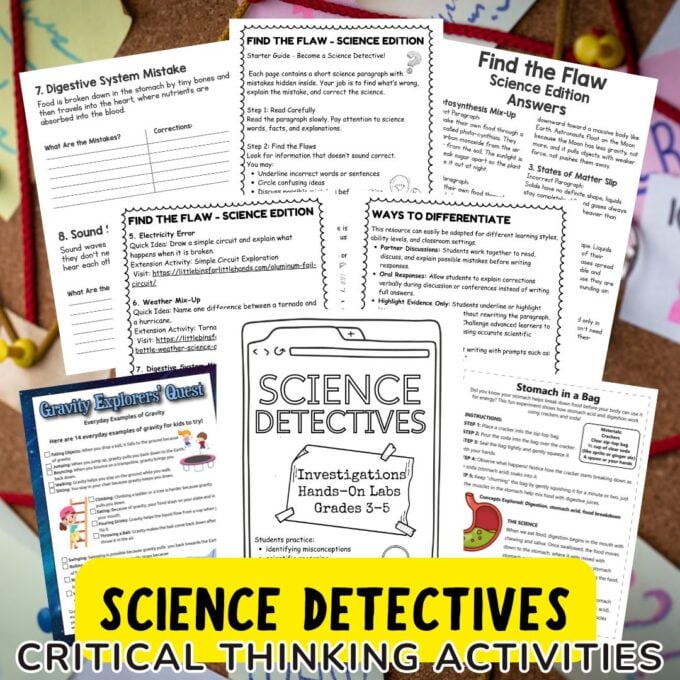
The Science Detectives pack includes:
- misconception investigations
- answer keys
- observation pages
- extension labs
- diagrams
- discussion prompts
- hands-on STEM activities
Ways to Use Science Detective Activities
These activities work well for:
- science centers
- STEM enrichment
- early finishers
- review days
- small groups
- morning work
- homeschool science
- partner discussions
- informal assessment
Most investigations take about 5–10 minutes to complete (hands-on experiment time is extra).
Grab the Science Detectives Investigation Pack
👉 The Science Detectives: Find the Flaw Investigations Pack helps students practice:
- scientific reasoning
- observation
- evidence-based thinking
- identifying misconceptions
- correcting scientific errors
Perfect for classrooms, homeschool learning, STEM clubs, and science enrichment.
Science Misconceptions FAQ
Why are science misconceptions important?
Science misconceptions help teachers understand how kids are thinking. Investigating mistakes encourages deeper learning, stronger reasoning, and better scientific explanations.
What age are science detective activities best for?
These activities work especially well for grades 3–5 but can easily be adapted for younger or older kids with discussion support.
How do you teach critical thinking in science?
Encourage kids to ask questions, compare evidence, explain reasoning, investigate mistakes, and test ideas through hands-on science activities.
Are science misconception activities NGSS aligned?
Yes. These activities support important science practices such as asking questions, analyzing information, developing explanations, and using evidence.
Can science detective activities be used in groups?
Absolutely. Many students enjoy solving misconceptions together through partner work, discussions, and collaborative investigations.
What topics are included in the Science Detectives pack?
The pack includes investigations on photosynthesis, gravity, states of matter, cells, electricity, weather, digestion, sound, magnetism, ecosystems, and food chains.