
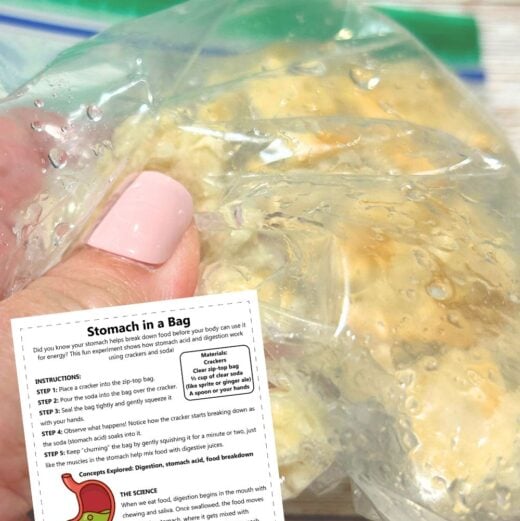
What really happens when food meets stomach acid? In this easy Stomach in a Bag experiment, kids can watch a cracker break down just like it does in the digestive system. With only a few simple supplies, you’ll have a squishy, hands-on way to explore how the stomach helps us digest food.

Digestion Science Concepts for Kids
- Digestion and the digestive system
- The role of stomach acid in food breakdown
- How stomach muscles churn food into chyme
Grade Level: Elementary (K–5)
Field of Science: Biology – Human Body
Explore Life Science: Digestion is part of life science — the study of living things and how they survive. Along with this experiment, kids can try building a lung balloon model, exploring the heart rate experiment, or creating a robot hand project to see how different body systems work together.
Supplies for the Stomach in a Bag Science Project
- Crackers (any type)
- Clear zip-top bag
- ½ cup clear soda (like Sprite or ginger ale)
- Spoon (optional)
- Hands for squishing!
How to Do the Stomach in a Bag Experiment
Step 1: Place a cracker into the zip-top bag.
Step 2: Pour the soda into the bag over the cracker.
Step 3: Seal the bag tightly.
Step 4: Gently squeeze and squish the bag with your hands to imitate stomach muscles churning.
Step 5: Observe what happens to the cracker as the soda (stomach acid) soaks in and breaks it down.
👉 Use our Stomach in a Bag Observation Sheet here to record what happens before and after.
Human Body Science: How Digestion Works
Digestion begins in the mouth with chewing and the production of saliva. Once swallowed, food travels down to the stomach, where it is mixed with powerful digestive juices. Stomach acid (hydrochloric acid in real life) and enzymes break down food into smaller pieces. Meanwhile, the strong stomach muscles churn and squeeze, turning the food into a semi-liquid substance called chyme.
In this experiment:
- The cracker = food
- The soda = stomach acid (because soda contains acids too, like carbonic acid and phosphoric acid)
- The bag squishing = stomach muscles working to churn food
Fun Facts About Digestion for Kids
- Your stomach makes about 3 liters of gastric juice every day!
- Stomach acid is strong enough to dissolve metal, but your stomach is protected by a thick lining of mucus.
- Digestion in the stomach typically takes 2–4 hours before food is moved into the small intestine.
Printable Human Anatomy Activity Pack
Want even more digestion activities? Check out our Human Anatomy Activity Pack filled with printable worksheets, vocabulary, and fun hands-on projects!
Make It a Science Fair Project
On its own, this activity is a fun model of digestion. But with a few changes, you can turn it into a testable science project:
- Compare liquids: Test water, soda, vinegar, and lemon juice to see which breaks down crackers fastest.
- Test temperature: Place crackers in cold water vs. warm water. Does heat make food break down more quickly?
- Time it: Record what happens to crackers after 1 minute, 5 minutes, and 10 minutes of squishing.
🔎 By adding variables, kids can write a hypothesis, collect data, and share results — just like in a real science fair project. Read more about the scientific method here.
Human Anatomy and Body Science Activities
- Robot Hand STEM Activity – Build a paper robot hand and learn how tendons control finger movement.
- DIY Heart Pump Model – Use jars, balloons, and straws to show how the heart works.
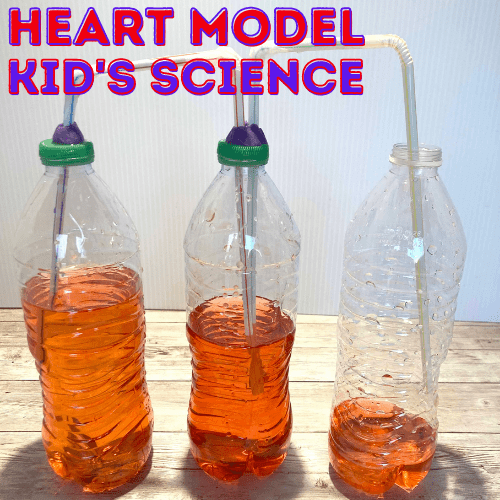
- Heart Model – Create a working model to show how our heart pumps blood through the body.
- Heart Rate Experiment – Measure how your pulse changes before and after exercise.
- X-Ray STEAM Art Project – Make realistic skeleton art and learn about bones and the skeletal system.
- Banana DNA Extraction Experiment – Smash a banana, add soap and alcohol, and pull out real DNA strands. A fun way to show that DNA is in all living things—even you!
- Wingspan Measurement Activity – Measure your arms from fingertip to fingertip and compare them to your height. Explore symmetry, data collection, and body proportions.
- Giant Thumbprint Experiment: Explore unique thumbprints and learn about yours!





FAQ About Digestion and the Stomach in a Bag Experiment
What does the stomach do in digestion?
The stomach mixes food with digestive juices, including stomach acid and enzymes, to break it down into smaller pieces. This process turns food into a thick liquid called chyme, which then moves to the small intestine for nutrient absorption.
How does the stomach in a bag experiment show digestion?
The cracker represents food, the soda acts like stomach acid, and squishing the bag mimics how stomach muscles churn food. Together, these steps show how the stomach breaks food into smaller, softer pieces.
How long does it take food to digest in the stomach?
On average, food stays in the stomach for 2–4 hours. Digestion time depends on what you eat — carbohydrates move through faster, while proteins and fats take longer.
Why do we use soda in the stomach in a bag experiment?
Soda contains acids, such as carbonic acid and phosphoric acid, which make it a good stand-in for stomach acid. It helps break down the cracker just like real acid does inside your stomach.
What is chyme?
Chyme is the semi-liquid mixture of food, stomach acid, and digestive juices created in the stomach. It’s the form food takes before moving into the small intestine to continue the digestion process.