
What is a shadow? This fun shadow activity is an excellent way for kids of all ages to learn about shadows, light, and the movement of the Sun! Try this simple science invesitgation today and see how a shadow changes throughout the day.

What is a Shadow?
Have you ever noticed how your own shadow follows you on a sunny day? Or how the size of the shadows changes throughout the day? Shadows are a dark shape that forms when a light source, like the Sunlight, is blocked by an opaque object.
💡Explore more light experiments for kids here.
Shadow Science Activity
In this fun shadow tracing science experiment, we’ll explore the formation of shadows and how they change at different times of the day. Easy to add to an Earth Science lesson plan.
- Concepts Explored: Light and Shadows
- Grade Level: Kindergarten – 3rd Grade
Supplies Needed:
- Chalk
- Flashlight
- A small opaque object (toy or cup)
- A sunny day for outdoor observations
- Observation worksheet (printable instructions in the STEM Club)
Shadow Activity Instructions
STEP 1: Set Up Your Object
Take your actual object outside and place it on a flat surface where the source of light (the Sun) can shine on it.
STEP 2: Trace the Shadow
Use chalk to outline the different shadow shapes your object makes. Write down the time.
STEP 3: Observe at Different Times of the Day
Return to your object at sunrise, midday, and sunset to see how the shadow changes. Each time, trace the new shadow shape. Below we recorded 12pm, 1pm, 3pm, and 5pm but make sure to get out in the morning as well!
STEP 4: Compare and Record
Look at your tracings. How did the different directions and different sizes of the shadows change?

What is a Shadow? Science Information
Why do shadows change size and direction?
- The Sun is a light source that appears to move across the sky because of the Earth’s rotation.
- The sun is low in the sky in the morning (sunrise) and evening (sunset), creating larger shadows.
- At noon, shadows are the shortest when the Sun is directly overhead.
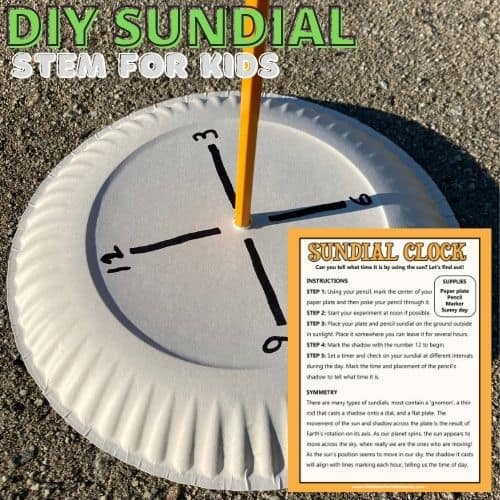
- This pattern repeats daily and is the basis for sundials, one of the oldest ways to tell time!
How does light interact with different materials? Try it!
- Opaque materials (wood, metal, cardboard) completely block light and create shadows.
- Transparent objects (glass, water) allow light to pass, so they don’t form strong shadows.
- Translucent objects (wax paper, frosted glass) let some light bounce, making lighter, blurry shadows.

Shadow Facts for Kids
- The longest shadows happen early and late in the day.
- Cloudy days reduce shadows because the clouds scatter the light.
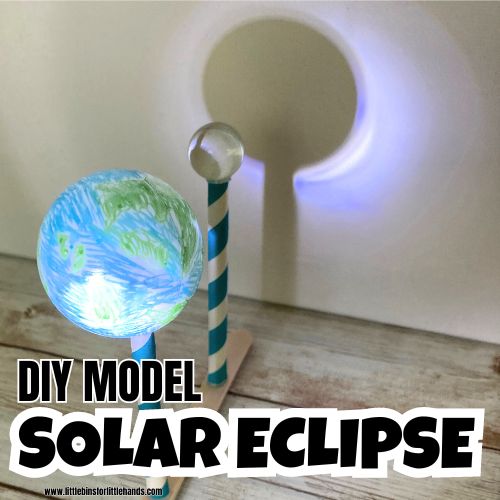
- The Moon casts shadows on Earth during a solar eclipse! This creates two shadow regions: Umbra (total shadow, dark center) and Penumbra (partial shadow, lighter edges)
Extension Activities
Related Shadow Activities
- DIY Sundial Science – Use shadows to tell time!
- Fun Flashlight Experiments – Explore how light moves and bounces!
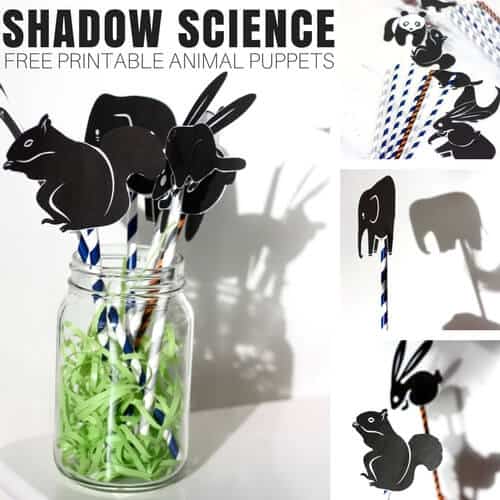
- Animal Shadow Puppets – Create and play with fun animal shadow designs!
- Preschool Shadow Investigation – A hands-on activity for young learners to explore light and shadows!
- DIY Flashlight – Learn how to make a flashlight with simple circuits!
- Moon Phases Activity – Learn how the Moon’s shadows create different phases!