
Setting up a DIY weather station for kids can be a fun and educational experience! Plus, it can be adjusted to suit younger and older kids with appropriate modifications. Here’s how to set up a weather station, make weather instruments, and explore more weather activities!

Materials Needed For A DIY Weather Station
A homemade weather station is a fun way for kids to explore and understand the different elements of weather. By setting up simple instruments like a thermometer, rain gauge, wind vane, and more, students can observe how temperature, wind, rain, and air pressure change each day.
Building and using these tools helps kids become junior meteorologists, learning to predict the weather and make connections to the world around them. Plus, it’s a hands-on way to bring science to life!
Recommended Grade Level: 3rd-5th Grade
Building a weather station aligns with NGSS 3-ESS2-1 and 3-ESS2-2 as students collect and analyze weather data (temperature, precipitation, wind) to identify patterns over time. It engages science and engineering practices like data collection, measurement, and interpretation. Crosscutting concepts such as patterns and cause and effect help students understand weather systems and their environmental impact.
Materials Needed:
These items can be homemade, store-bought, or a combination of both! While you may not get perfectly accurate readings with these DIY versions, they’re fantastic for a weather unit with elementary grades.
- Thermometer (Make a DIY Thermometer here)
- Rain gauge
- Wind vane
- Anemometer
- DIY Barometer
- Hygrometer (Amazon Affiliate Link)
- Printable guide, weather journal, and chart (see below)
- Access to weather forecasts or online weather resources for comparison (try NOAA.gov)
How To Set Up A Weather Station
Introduction to Instruments (All Ages): Introduce each weather instrument and explain its purpose. Discuss how meteorologists use these instruments to measure different aspects of weather.
Setting Up (All Ages): Choose a suitable location outdoors that is accessible and safe for students to visit regularly. Install the thermometer, barometer (if available), rain gauge, wind vane, and anemometer in a visible and stable location.
Recording Data (All Ages): Create a weather journal or chart where students record daily observations, including temperature, precipitation, wind direction, and wind speed.
Data Analysis (Older Kids): Teach older students how to analyze trends in weather data over time. Discuss concepts such as averages, highs, lows, and patterns in weather.
Weather Predictions (Older Kids): Encourage older students to predict future weather based on observed patterns and compare these with actual weather forecasts.
Extension Activities (Older Kids): Research and discuss weather phenomena such as fronts, storms, and climate patterns specific to your region. Conduct experiments related to weather phenomena, such as creating miniature tornadoes or studying cloud formation.
About the Weather Instruments
Thermometer (Make a DIY Thermometer here)
A thermometer measures the temperature of the air. Kids can make a simple DIY thermometer to observe how temperature changes throughout the day and how heat expands liquids.
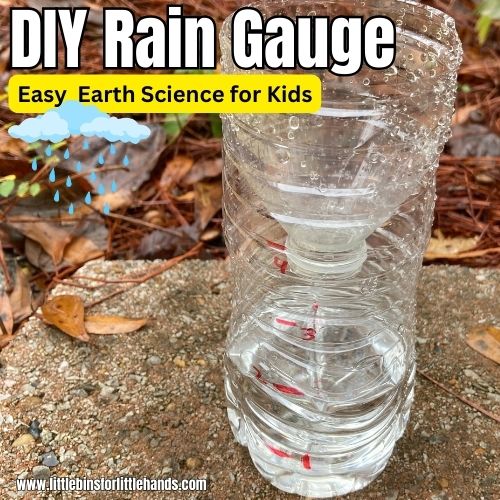
DIY Rain Gauge
A rain gauge measures the amount of rainfall in a specific area. It’s easy to make one using a clear container to see how much rain falls during a storm, helping kids understand weather patterns and precipitation.
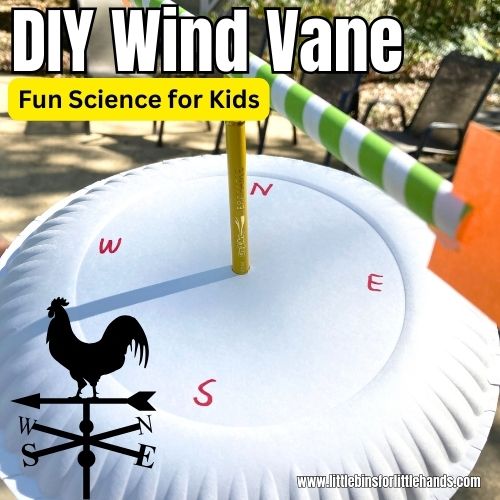
DIY Wind Vane
A wind vane, also called a weather vane, shows the direction the wind is blowing. Using simple materials, kids can learn how to identify wind direction and its role in changing weather. (Can be simple with directional markers)
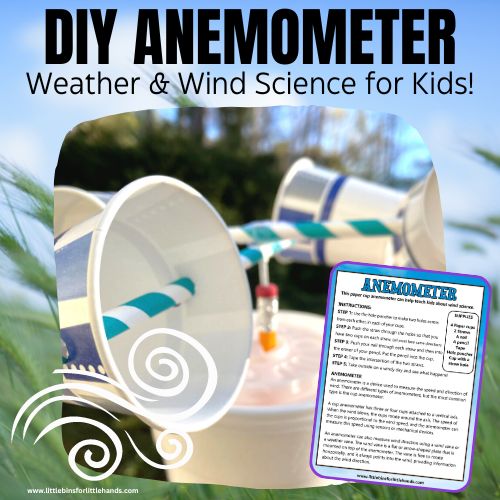
DIY Anemometer
An anemometer measures the strength of the wind, precisely its speed. By tracking how fast the wind moves, an anemometer helps determine wind speed, which is a critical factor in understanding weather conditions. A homemade version lets kids observe how the wind moves and how fast it blows on windy days.
DIY Barometer
A barometer measures atmospheric pressure, which helps predict weather changes. Kids can watch air pressure rise or fall with a DIY barometer, learning how it correlates with fair or stormy weather. Track air pressure and look for low pressure and high pressure days!
Pine Cone Hygrometer (measures humidity)
A hygrometer tracks the amount of moisture in the air, known as humidity. Kids can learn how high or low humidity impacts weather and how it affects things like rain, heat, and air quality.
Pine cones respond to changes in moisture in the air. When it’s dry, their scales open to release seeds. When it’s humid or rainy, the scales close to protect the seeds. This natural reaction makes them a simple hygrometer and observing a pine cone’s behavior can give insight into daily weather changes.


Grab the free Homemade Weather Station guide [here].

Printable Science Projects For Kids
If you’re looking to grab all of our printable science projects in one convenient place plus exclusive worksheets and bonuses like a STEAM Project pack, our Science Project Pack is what you need! Over 300+ Pages!
- Bonus Quick Grab Packs for Biology, Earth Science, Chemistry, and Physics
- 90+ classic science activities with journal pages, supply lists, set up and process, and science information. NEW! Activity-specific observation pages!
- Best science practices posters and our original science method process folders for extra alternatives!
- Be a Collector activities pack introduces kids to the world of making collections through the eyes of a scientist. What will they collect first?
- Know the Words Science vocabulary pack includes flashcards, crosswords, and word searches that illuminate keywords in the experiments!
- My science journal writing prompts explore what it means to be a scientist!
- Bonus STEAM Project Pack: Art meets science with doable projects!
- Bonus Quick Grab Packs for Biology, Earth Science, Chemistry, and Physics