
Science is not only about memorizing facts or following experiment steps. Students also need opportunities to question ideas, examine evidence, notice mistakes, and explain how they reached a conclusion.
Science detective activities make those skills approachable. Kids investigate surprising claims, identify misconceptions, compare evidence, and revise their thinking when new information changes what they know.
These activities are especially useful for grades 3–5 science warm-ups, centers, partner discussions, early finishers, and science-and-reading lessons.
What Is a Science Detective?
A science detective looks closely at a question, claim, or investigation before deciding what is accurate.
Students practice:
- Identifying misconceptions
- Evaluating scientific claims
- Using evidence to support ideas
- Revising their thinking
- Explaining scientific reasoning
The goal is not simply to find the correct answer. Students learn to explain why the evidence supports that answer.
Science detective lessons can take several forms:
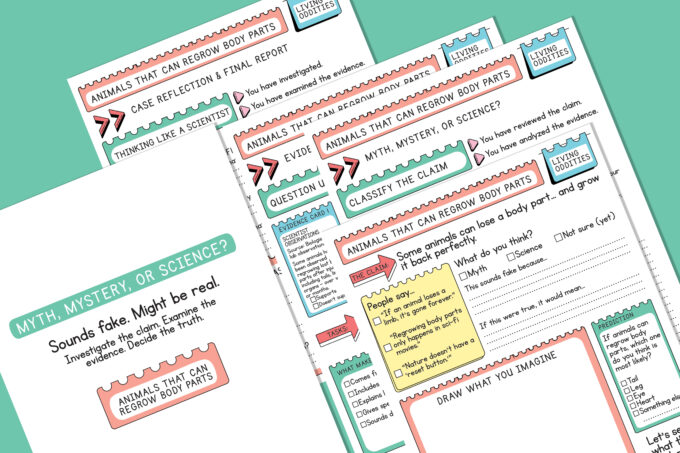
- Mystery Files (this page) ask students to investigate surprising science claims and decide what the evidence really shows.
- Find the Flaw activities challenge students to identify mistakes in experiments, conclusions, and scientific explanations.
- Fast Facts Micro Lessons introduce high-interest science topics through short reading cards, discussion, and quick creative-thinking challenges.
Start With Careful Observation
Science detective work begins with noticing details. Students should understand the difference between an observation and an inference.
- Observation: The rock has many tiny holes.
- Inference: The holes may contain trapped air.
The observation describes what can be seen. The inference is a possible explanation that still needs evidence.
👉 Find more simple ideas in our complete Observation Activities for Kids collection. Plus grab a free inference printable pack.
Investigate Surprising Science Claims
A scientific claim is a statement that can be examined using observations, experiments, research, or other evidence.
💡 Some claims sound reasonable but are not completely accurate. Others sound impossible but contain some truth.
For example:
Rocks always sink in water.
Most familiar rocks do sink, so the statement may sound correct. However, pumice contains trapped air spaces and can sometimes float.
The original statement is too broad. A more accurate claim would be:
Most rocks sink, but some rocks with trapped air can float.
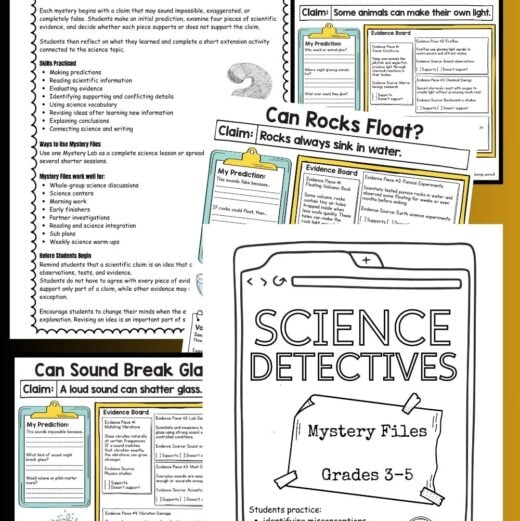
A Science Mystery File guides students through this type of investigation. Students read the claim, make a prediction, examine several pieces of evidence, look for an exception or missing detail, and explain a final conclusion.
💡 Changing an answer after reviewing the evidence is not a mistake. Revising an idea is an important part of scientific thinking.
Try a Free Science Mystery File
The free Science Starter Pack includes a sample Mystery File that you can use to introduce this evidence-based approach.
👉 Grab the Free Science Starter Pack
Explore the Science Detectives: Mystery Files Pack
Ready to investigate more surprising science claims?
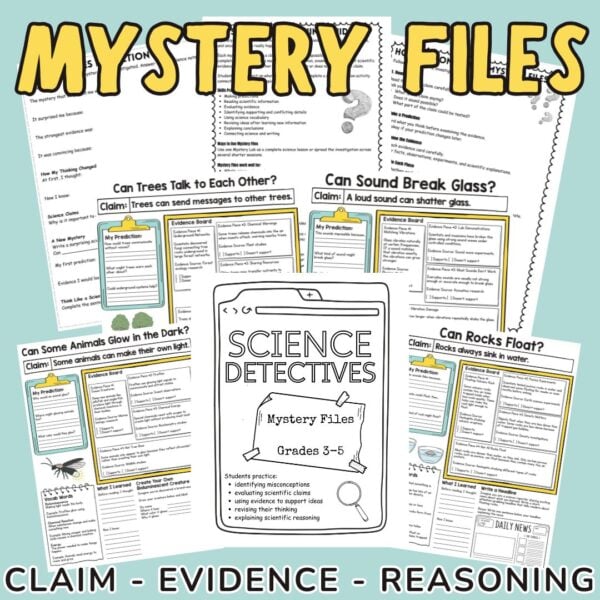
The complete Science Detectives: Mystery Files Pack includes seven evidence investigations for grades 3–5:
- Can rocks float?
- Can sound break glass?
- Can some animals make their own light?
- Can trees send messages to other trees?
- Can a frog freeze and come back to life?
- Can birds sense Earth’s magnetic field?
- Can lightning strike the same place twice?
Each Mystery File includes a surprising claim, prediction prompts, four pieces of evidence, key science vocabulary, before-and-after thinking, and a short extension activity.
The pack also includes teacher guidance, discussion prompts, a reusable investigation page, answer guides, reflection, and a create-your-own Mystery File activity. The activities are designed to help students evaluate evidence, identify conflicting details, revise ideas, and explain conclusions.
👉 Explore the Science Detectives: Mystery Files Pack
What Should Science Detectives Look For?
Students do not need a long checklist every time they evaluate a claim. Teach them to watch for a few common clues:
- Words such as always, never, all, or impossible
- Evidence that supports only part of a claim
- An important limit or exception
- A conclusion that does not match the evidence
- An inference presented as a proven fact
- A claim that needs more information
For example, the statement “Lightning never strikes the same place twice” uses the word never. Evidence from tall buildings and towers shows that the same structure may be struck repeatedly.
🔎 A better claim would be: Lightning can strike the same place more than once, especially tall or exposed structures.
Rewriting the claim helps students do more than spot an error. It asks them to build a more accurate scientific explanation.
Find Mistakes in Science Investigations
Science detectives can also examine an experiment or explanation that contains a flaw.
Students may notice that more than one variable was changed, there was no fair comparison, too few trials were completed, measurements were inconsistent, or the conclusion did not match the results.
Instead of only identifying the mistake, ask students to explain how the investigation could be improved.
👉 The Science Detectives: Find the Flaw activities provide ready-to-use practice with evaluating investigations, correcting scientific errors, and explaining better methods.
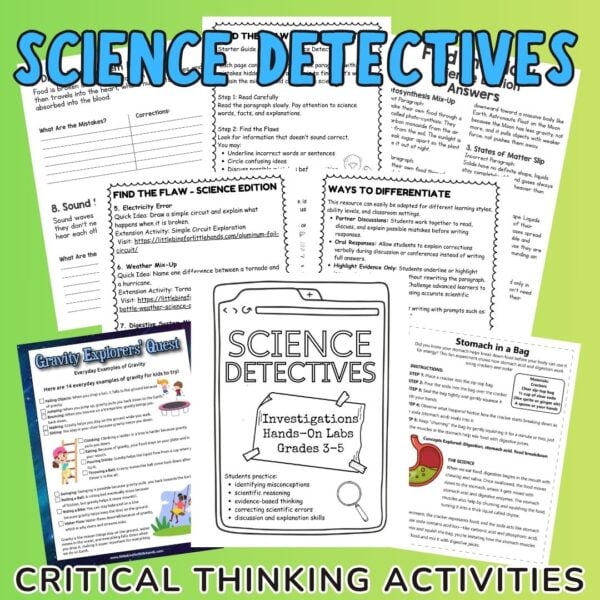
💡 Together, the three Science Detectives formats give students different ways to think scientifically: they can explore an intriguing topic with a Fast Facts Micro Lesson, evaluate a surprising claim with a Mystery File, or identify and correct a mistake with Find the Flaw.
Explore Science With Fast Facts Micro Lessons
Science detective thinking can also begin with a surprising fact or an unanswered question.
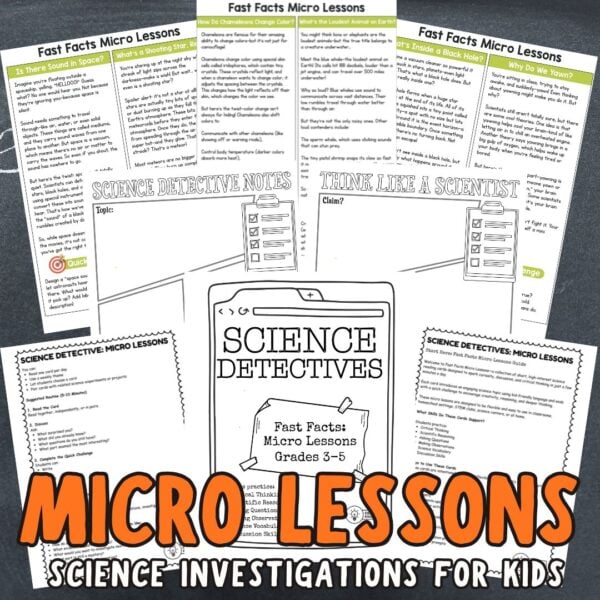
The Science Detectives: Fast Facts Micro Lessons are short, high-interest science reading cards designed to spark curiosity, discussion, and deeper thinking in just a few minutes.
Topics include questions such as:
- What is inside a black hole?
- Why do we yawn?
- Is there sound in space?
- What is a shooting star?
- Why do we get goosebumps?
- Do sharks sleep?
- How do chameleons change color?
- What is the loudest animal on Earth?
Each card introduces a science topic in kid-friendly language and ends with a quick challenge. Students might draw, write, explain, predict, design, or share a theory.
The cards help students practice critical thinking, scientific reasoning, asking questions, making observations, science vocabulary, and discussion skills.
Use them as science warm-ups, bell ringers, read-alouds, center activities, early-finisher work, or science notebook prompts. One simple routine is to read a card, discuss what surprised students, and complete the quick challenge.
💡 They can also connect naturally to related Mystery Files, Find the Flaw activities, experiments, or science topics—but each Micro Lesson works on its own.
Easy Ways to Use Science Detective Activities
Use a surprising claim as a quick science warm-up, or complete an entire Mystery File during a science lesson.
Students can work with a partner, discuss the evidence as a class, or record their conclusions in a science notebook. The activities also work well for centers, early finishers, weekly critical-thinking practice, and sub plans.
Try asking students to defend different conclusions before revealing the answer guide. The goal is not to encourage arguing for an incorrect answer, but to help students explain which evidence influenced their thinking.
Useful discussion questions include:
- What makes this claim sound believable?
- What evidence would help you decide?
- Does the evidence support the whole claim or only part?
- Is there an important exception?
- Which evidence seems strongest?
- Did your prediction change?
- How could the claim be rewritten?
- What new question do you have?
Frequently Asked Questions
What grades are these activities for? The Mystery Files are designed primarily for grades 3–5. Younger students can participate through teacher-led discussions, simple observations, and shorter claim-and-evidence activities.
Are Mystery Files hands-on experiments? Mystery Files are evidence investigations rather than traditional hands-on experiments. Students read a claim, examine scientific information, and explain what the evidence shows. Pair them with related hands-on science activities when you want students to investigate the concept further.
What is the difference between an observation and an inference? An observation describes something noticed directly through the senses or with a science tool. An inference is a possible explanation based on that observation. The inference may be reasonable, but additional evidence may still be needed.
Do students need to know the correct answer first? No. Students should make an initial prediction before reviewing all the evidence. The purpose is to help them compare their first ideas with new information and revise their thinking when needed.
Can students complete the activities independently? Many students in grades 3–5 can complete the activities independently. However, partner and whole-group discussions often lead to stronger explanations because students hear different interpretations of the same evidence.
How can I introduce science detective activities? Begin with one simple observation-and-inference example. Then present a surprising claim and model how to examine each piece of evidence. Once students understand the process, they can complete Mystery Files more independently and apply the same thinking to Find the Flaw activities and other science investigations.
Keep Exploring Science Skills
Continue building scientific thinking with:
- Scientific Method Activities
- Variables in Science
- Science Notebook Pages
- Science Experiments for Kids
Science detective activities help students see science as an active process of noticing, questioning, examining evidence, correcting mistakes, and improving explanations.
Printable Elementary Science!
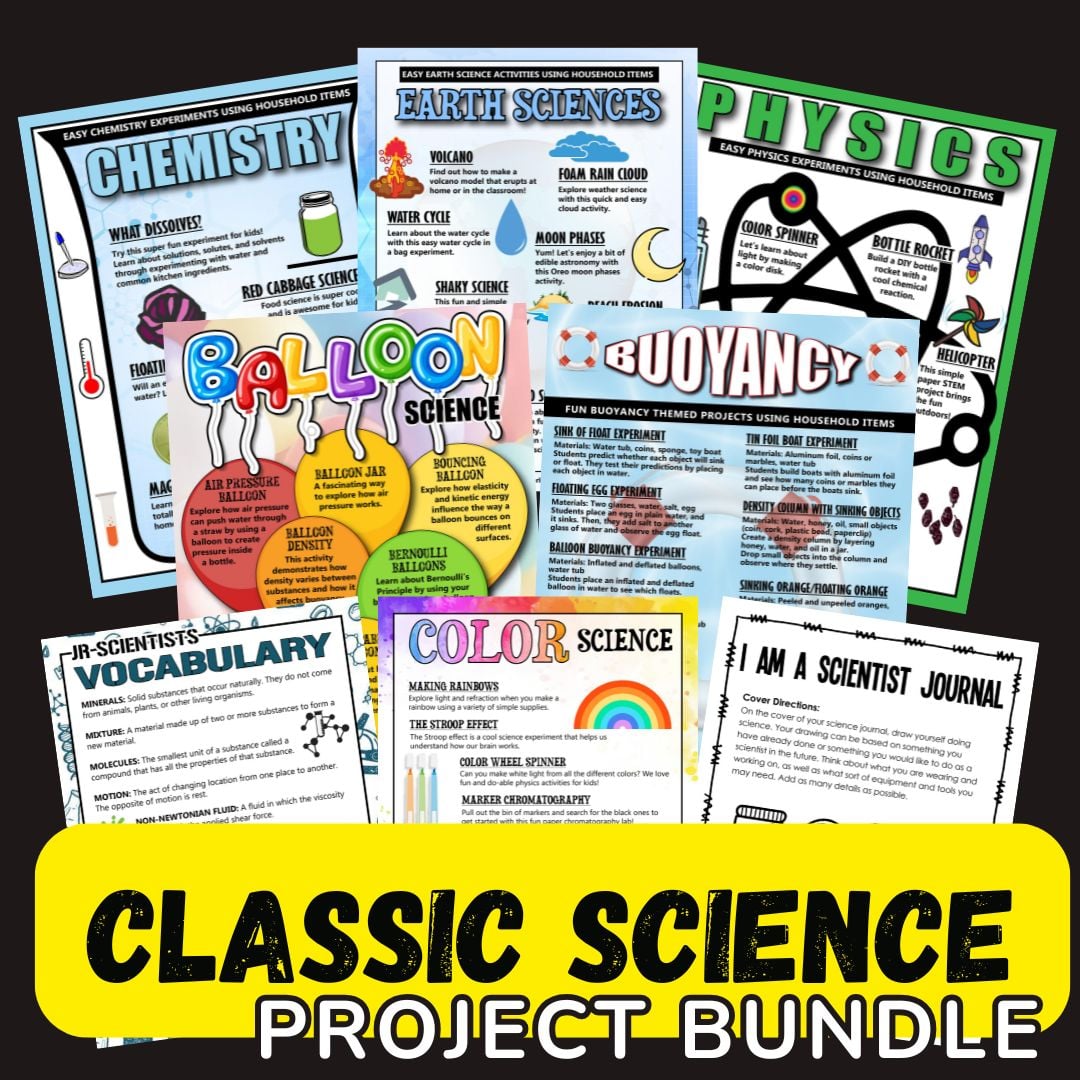
Want to do meaningful science — but not start a full unit yet? This starter lab provides quick, hands-on investigations across multiple science topics, allowing students to explore how science works before diving deeper into any one subject.
Perfect for regularly trying science without extensive planning. Grades: K–5.