
The first week of science does not need to begin with a complicated experiment or a full unit. Let me show you some great ways to launch your science classroom (or homeschool)!
We’ll use the first few lessons to introduce the routines and thinking skills students will use all year: observing carefully, asking questions, making predictions, recording results, and explaining what the evidence shows.
The activities below are simple, hands-on, and easy to prepare with common classroom supplies. Choose a few to practice science safety, lab routines, observation, questioning, and evidence-based thinking without overwhelming students—or yourself.
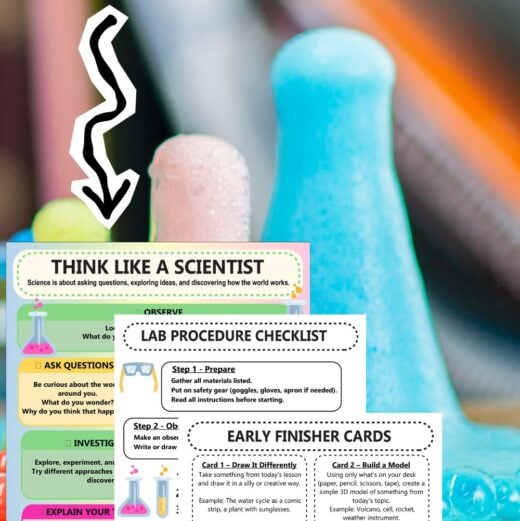
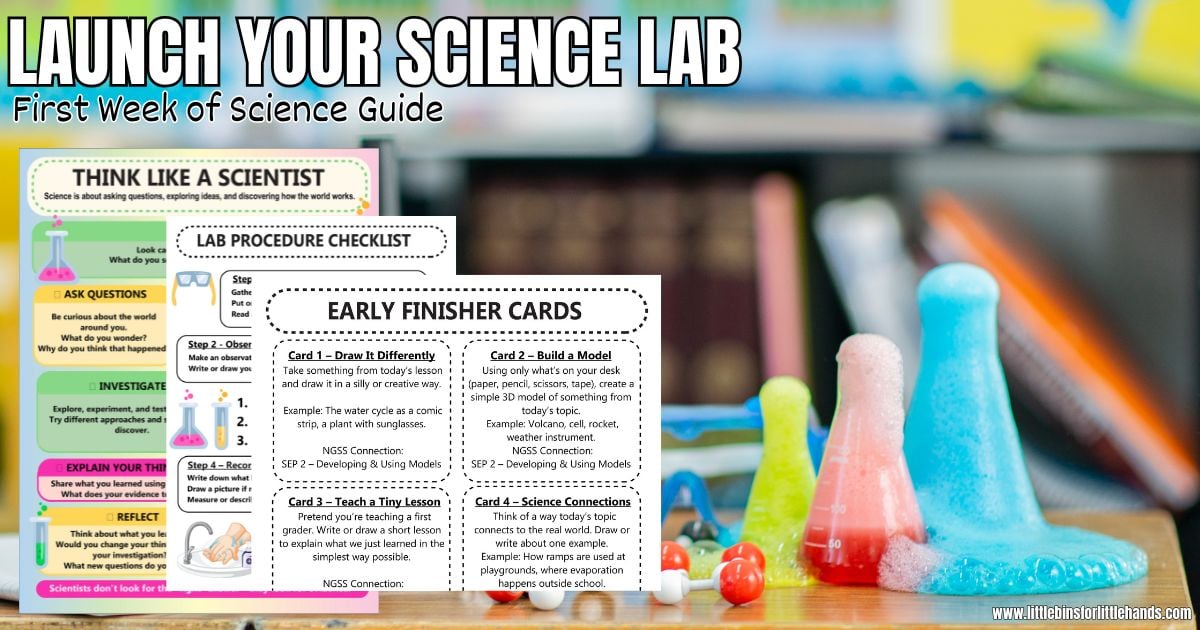
📥 Download the FREE Science Classroom Starter Kit below for science safety rules, observation activities, investigation pages, early finisher cards, and more.
New to Teaching Science?
Start the school year with confidence! Discover easy first week of science activities that introduce observation, scientific thinking, science safety, and classroom routines. Perfect for elementary classrooms, homeschool, and STEM clubs, plus grab a FREE Science Classroom Starter Kit.
Instead, focus on four essential science habits:
- Observe carefully.
- Ask questions.
- Gather evidence.
- Explain your thinking.
Use short investigations, science discussions, and observation activities to practice these habits without complicated materials or lengthy directions.
Science is something students do. The specific activity matters less than the thinking students practice as they observe, test, compare, and explain.
👉 Explore more ways to introduce these skills with our Scientific Method for Kids and Observation Activities resources.
What Kids Learn During the First Week of Science
During the first week, students begin practicing the science process skills they will use throughout the year.
They will learn how to:
- Make careful observations
- Ask questions that can be investigated
- Make predictions
- Gather and compare evidence
- Look for patterns
- Record observations and measurements
- Follow simple lab procedures
- Handle materials safely
- Discuss results with others
- Explain conclusions using evidence
These skills can be practiced through physical science, life science, earth science, and chemistry activities throughout the year.
Grade Level Tips
Grades K–2: Focus on noticing details, using the senses safely, making simple predictions, drawing observations, comparing objects, and following one-step or two-step investigation routines.
Grades 3–5: Add measuring, identifying variables, designing fair tests, organizing data, evaluating evidence, and supporting conclusions with observations or results.
💡 For younger students, oral discussion and labeled drawings may be more useful than lengthy written responses. Older students can begin using simple data tables, claims, evidence, and reasoning.
Think Like a Scientist
Introduce the habits students will use during every investigation:
- Notice details.
- Ask questions.
- Look for patterns.
- Make predictions.
- Test ideas.
- Gather evidence.
- Compare results.
- Revise explanations when new evidence appears.
👉 Display a Think Like a Scientist poster (included in science starter pack below) or add these prompts to students’ science notebooks for easy reference.
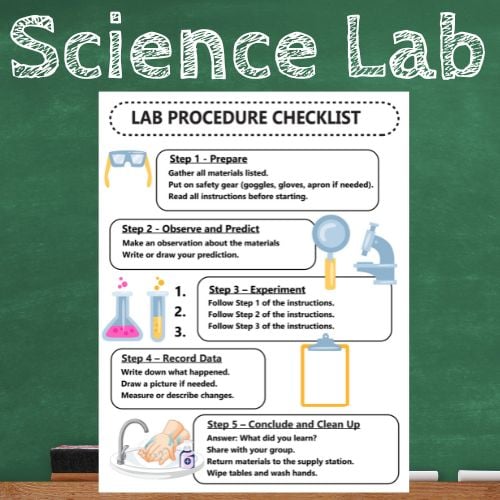
You can also practice these habits through short Science Detectives activities. Rather than immediately giving students an answer, ask them to examine clues, discuss the evidence, and explain their thinking.
👉 Explore Science Detectives: Fast Fact Micro Lessons.
Introduce Science Safety
Before students begin investigating, introduce a few clear safety expectations.
Discuss:
- Reading or listening to directions before beginning
- Wearing safety goggles when needed
- Handling materials and tools carefully
- Keeping materials away from the mouth
- Walking carefully while carrying supplies
- Respecting classroom equipment
- Reporting spills or broken materials
- Working safely with a partner or group
- Cleaning the workspace and washing hands
Display a Science Safety Rules poster where students can refer to it throughout the year.
💡 Teacher Tip: Avoid spending the entire science period discussing rules. Introduce the most important expectations, and then let students practice them during a short, controlled investigation.
👉 Continue reading with our Science Lab Safety Rules for Kids.

Teach a Simple Lab Routine
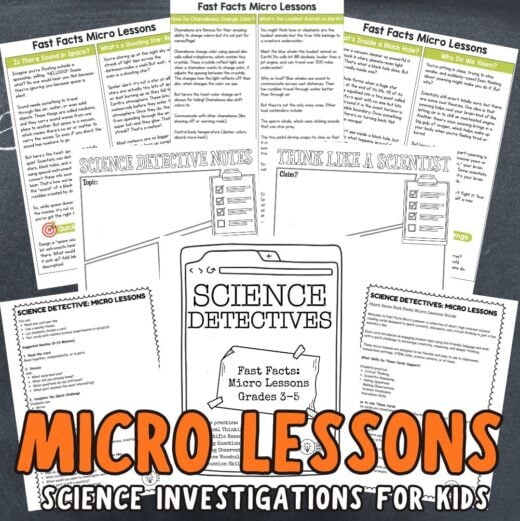
One of the most helpful things you can do during the first week is establish an investigation routine students will use all year.
Practice the same basic sequence:
- Observe and ask a question.
- Gather the materials.
- Make a prediction.
- Test the idea.
- Record observations or data.
- Discuss the results.
- Draw a conclusion.
- Clean the workspace.
Students become more independent when they know what should happen before, during, and after an investigation.
💡 The routine does not need to be complicated. Keep the focus on using materials safely, recording what happened, and completing each step carefully.
Become Observation Detectives
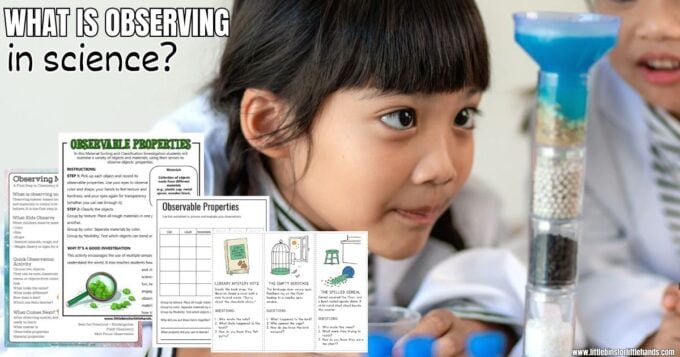
Observation is one of the first skills every young scientist learns.
Before students can ask questions, make predictions, or test ideas, they need to slow down and notice the world around them.
Encourage students to describe what they can actually see, hear, feel, or measure before deciding what something means. This helps them begin distinguishing between an observation and an inference.
Try one of these simple activities:
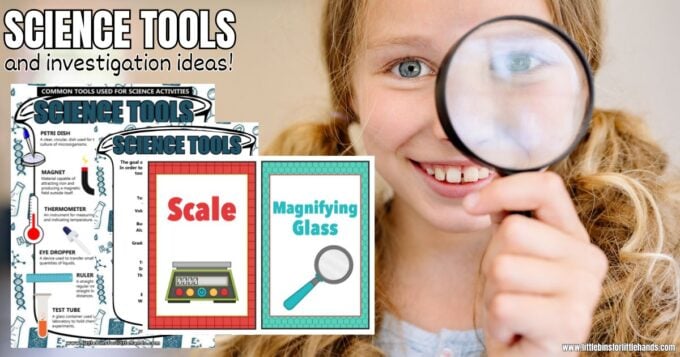
As students become more confident, introduce simple science tools such as magnifying glasses, rulers, thermometers, and droppers.
👉 Visit our Observation Activities for Kids for more ideas and free printable observation pages.
Practice Asking Scientific Questions
Students often need help moving from general curiosity to questions they can investigate.
Begin with a simple object or phenomenon, such as:
- A balloon
- A magnet
- A shadow
- A cup of water
- A paper clip
- A leaf
- A toy car
Ask students to observe it and generate questions.
They might ask:
- What happens if we change the material?
- Which object will move farther?
- Does the size of the object matter?
- What happens when the light moves?
- Which objects are attracted to a magnet?
- Will the result be the same every time?
Sort the questions into two groups:
- Questions we can test in the classroom
- Questions that require additional research
Students do not need to design a complete experiment yet. The goal is to help them notice which questions can be explored through observation, measurement, or testing.
👉 Continue with our Scientific Method for Kids guide to turn questions into simple investigations.
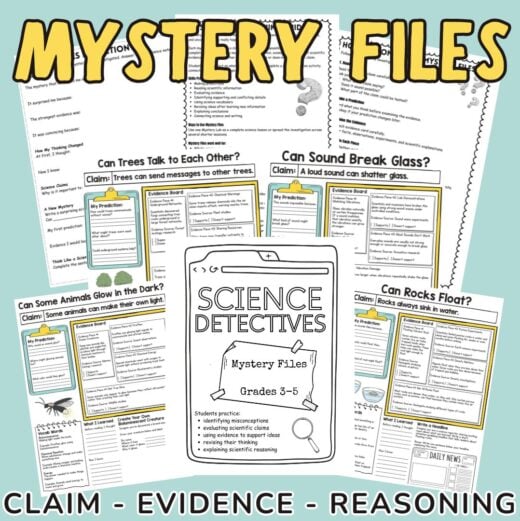
Investigate a Science Mystery
Scientists do not accept every surprising claim without examining the evidence.
They ask:
What evidence supports this idea?
That is the thinking students practice with Myth, Mystery, or Science? investigations and other evidence-based science activities.
Students might investigate questions such as:
- Can rocks float?
- Can sound break glass?
- Can frogs freeze during winter?
- Can birds sense Earth’s magnetic field?
- Can trees communicate?
- Can lightning strike the same place twice?
Instead of simply reading the answer, students examine information, identify evidence, decide whether a claim is supported, and explain their conclusion.
This provides an age-appropriate introduction to claims, evidence, and reasoning while connecting science to unusual real-world topics.
💡 Use these investigations as an entry point into topics such as density, sound, animal adaptations, weather, plants, and earth science.
👉 A complete Myth, Mystery, or Science? investigation is included in the free Science Classroom Starter Kit below. Read more about the mystery science files here.
Find and Fix Science Mistakes
Scientists examine information carefully instead of assuming every diagram, model, or explanation is correct.
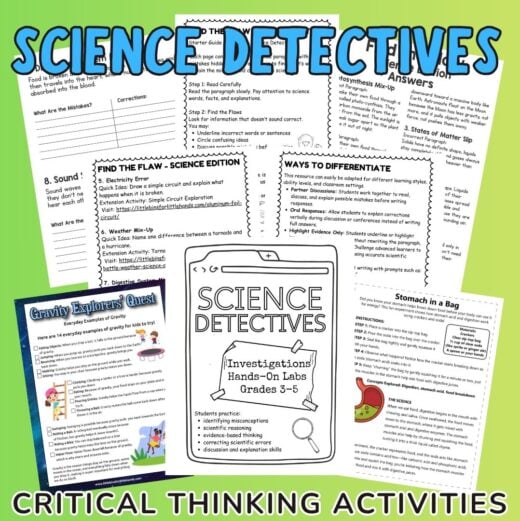
Find the Flaw activities challenge students to identify a scientific mistake and explain how it should be corrected.
The flaw might be:
- An incorrect label
- A missing step
- An item in the wrong category
- A process shown out of order
- A misleading scientific statement
Students might discover:
- A step in photosynthesis is incorrect.
- A stage of a life cycle is out of order.
- An animal is placed in the wrong habitat.
- A water-cycle process is labeled incorrectly.
- A plant or cell part has the wrong function.
- A scientific diagram contains a misleading detail.
Ask:
- What is the flaw?
- What makes you think it is incorrect?
- What should it show instead?
- How would you fix it?
Students can circle the mistake, redraw the incorrect section, or write a brief explanation.
💡 Use these quick activities as science warm-ups, partner discussions, early-finisher activities, or checks for understanding.
👉 Explore our Find the Flaw Science Activities.
Try a Simple Hands-On Science Investigation
Once students understand the basic routine, choose one or two short investigations that emphasize observation, prediction, and evidence.
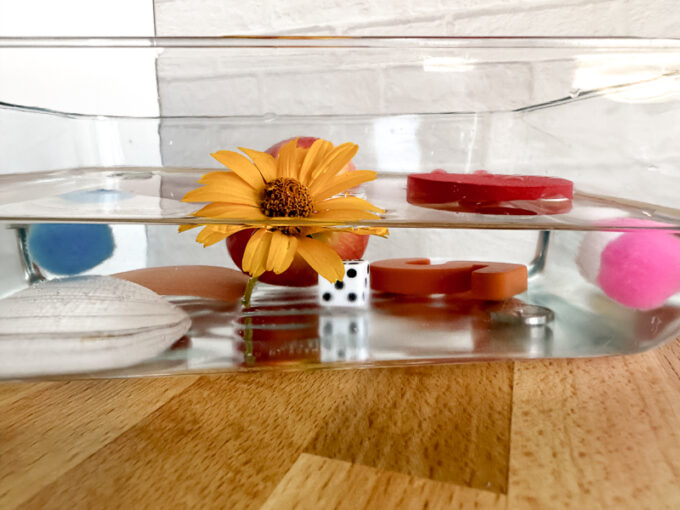
Sink or Float Investigation: Gather waterproof classroom objects made from different materials. Students predict whether each object will sink or float, test it, record the results, and look for patterns. Extend the activity by comparing objects made from wood, metal, plastic, rubber, or foam.
Balloon Static Electricity: Rub an inflated balloon against fabric or hair and hold it near paper pieces, tissue, a wall, or an empty aluminum can. Students observe attraction and movement while exploring static electric charge.
Magnet Investigation: Test a collection of classroom objects to determine which are attracted to a magnet. Encourage students to sort the objects, identify the materials, and look for patterns in the results.
Shadow Investigation: Use a flashlight and a small classroom object to investigate how shadow size and direction change when the light source moves. Students can trace or measure shadows and compare results.
Light and Materials Test: Shine a flashlight through transparent, translucent, and opaque materials. Students predict how much light will pass through each material and classify the results.
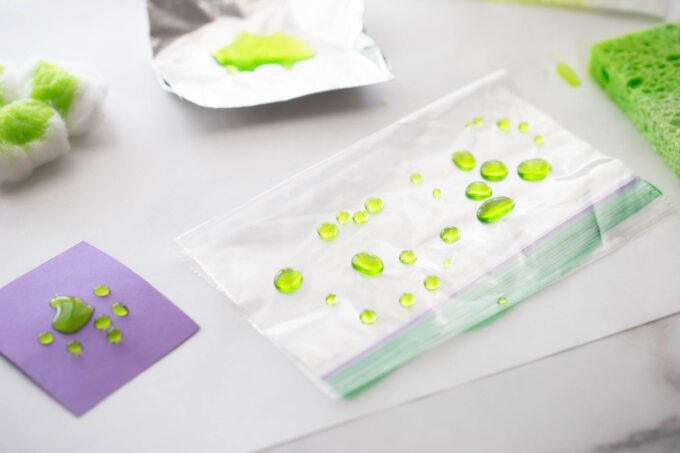
Water Drop Investigation: Use droppers to place water on wax paper, foil, plastic, paper, and fabric. Observe the shape of the drops and compare how water behaves on different surfaces.
Paper Towel Absorption Test: Compare small, equal-sized pieces of paper towel or other paper materials. Keep the amount of water and the size of each sample the same so students can begin practicing fair testing.
Sound and Vibration Investigation: Stretch rubber bands over an empty container or use a ruler placed over the edge of a desk. Students observe how vibrations create sound and investigate what happens when the length or tension changes.
Ramp and Motion Investigation: Roll the same ball or toy car down ramps set at different heights. Students measure how far it travels and identify the variable that changed. Keep the focus on motion, measurement, and evidence rather than building or redesigning the ramp.
Melting Ice Investigation: Place equal-sized ice cubes in different classroom locations or on different materials. Students predict which will melt first, observe changes over time, and discuss heat transfer.
The goal is not to complete the most impressive experiment. The goal is to help students practice making predictions, controlling variables, observing changes, recording results, and explaining what the evidence shows.
Start a Science Notebook
Science notebooks do not need to be complicated.
They give students one place to collect:
- Questions
- Drawings
- Observations
- Measurements
- Data
- Conclusions
Begin with simple prompts:
- I notice…
- I wonder…
- I predict…
- I observed…
- My evidence shows…
- Now I think…
Younger students can draw what they observe and add a few labels. Older students can use data tables, measurements, diagrams, and short written explanations.
A science notebook also allows students to see how their ideas change after they gather new evidence.
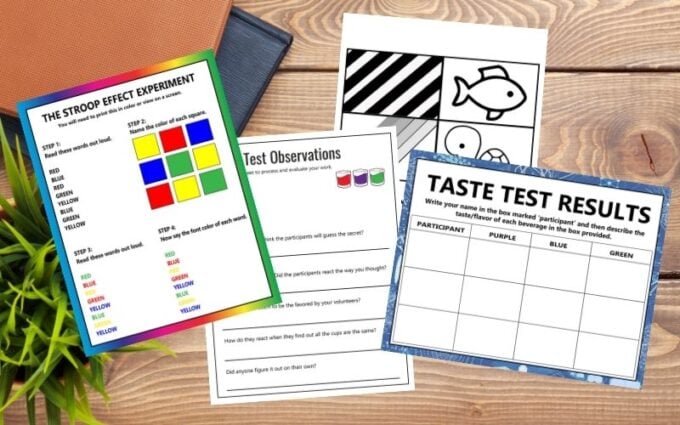
Use our Science Notebook Pages, Scientific Method Worksheets, and Observation Recording Sheets to get started.
👉 Find a variety of printable science worksheets here or check out our Lifetime Library!
Introduce Claims, Evidence, and Reasoning
Students do not need to write a lengthy lab report during the first week. However, they can begin learning how scientists use results to explain what happened.
Use this simple structure:
- Claim: What conclusion can you make?
- Evidence: What did you observe or measure?
- Reasoning: How does the evidence support your claim?
After a sink or float investigation, a student might write:
Claim: The plastic lid floats in water.
Evidence: It remained on the surface during all three tests.
Reasoning: The repeated observations support the conclusion that this plastic lid floats.
💡 Keep early explanations short. The goal is to show students that a science conclusion should be supported by something they observed, measured, or recorded.
Keep Early Finishers Thinking
When students finish early, provide short extensions that continue the same scientific thinking rather than unrelated busy work.
Students might:
- Draw and label the investigation.
- Write a new testable question.
- Compare their results with a partner.
- Look for a pattern in the class data.
- Explain the result to someone else.
- Draw a real-world connection.
- Predict what might happen if one variable changed.
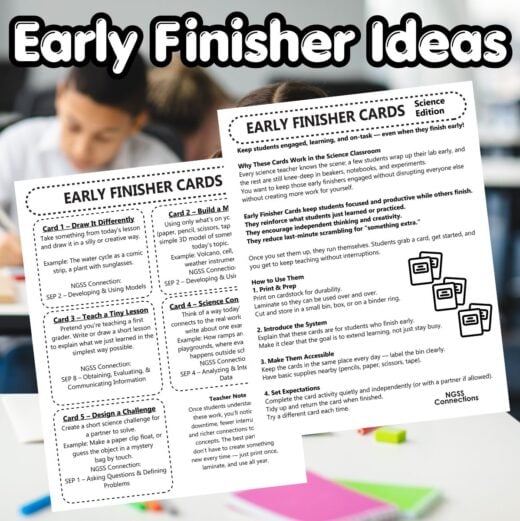
The Science Early Finisher Cards (included in the free starter kit) make these extensions easy to introduce and reuse throughout the year.
Students can select a card and work independently while others finish the main activity.
FREE Science Classroom Starter Kit
Use the FREE Science Classroom Starter Kit to establish routines and introduce scientific thinking during the first week.
Inside, you’ll receive:
✔ Science Safety Rules Poster
✔ Lab Procedure Checklist
✔ Science Challenge Cards
✔ Think Like a Scientist Poster
✔ Observation Recording Page
✔ Sample Mystery Science File
Use the kit in classrooms, homeschool settings, science centers, after-school programs, or STEM clubs.
👉 Download the FREE Science Classroom Starter Kit here.
Continue Building Scientific Thinking
Once students understand how to observe, investigate, evaluate evidence, and communicate ideas, they are ready to apply those skills to more focused science topics.
Continue with:
- Observation Activities: Practice noticing, comparing, measuring, and recording.
- Mystery Science Files: Examine unusual claims and evaluate evidence.
- Find the Flaw Activities: Identify and correct scientific mistakes.
- Science Experiments for Kids: Explore hands-on activities across physical science, life science, earth science, and chemistry.
- September Science 4 Week Plan: The perfect plan to get started with science this fall (or anytime of the year with non-seasonal science skills)
Looking for engineering instead? Visit our First Week of STEM Activities guide to introduce the engineering design process through building, testing, and improving designs.
Find Science Activities for Your Grade
Planning for a specific grade level? Explore science activities, investigations, and teaching ideas organized by grade.
- Kindergarten Science Activities
- Elementary Grades Science Activities
- Middle School Science Activities
Frequently Asked Questions
What should I teach during the first week of science? Focus on science safety, classroom routines, observation skills, asking questions, making predictions, recording results, and completing one or two simple investigations.
What is the best first science activity? Begin with an observation hunt or a short investigation with visible results. Sink or float, magnets, shadows, water drops, and static electricity are all good options because students can predict, observe, and discuss what happened.
Should I start the year with the scientific method? You can introduce the scientific method, but students do not need to memorize every step immediately. Begin with a simple routine that includes asking a question, predicting, testing, recording, and discussing results.
Should first-week science include engineering challenges? You can include engineering during the first week, but it serves a different purpose. Science investigations focus on observing phenomena and gathering evidence. Engineering challenges focus on designing and improving solutions.
What science skills should students practice first? Begin with observation, questioning, prediction, measurement, comparison, pattern recognition, and using evidence to explain a conclusion.
How long should first-week science investigations take? Most first-week investigations can be completed in 15 to 30 minutes. Keep the activity simple so there is enough time to introduce routines, discuss observations, and clean up.
How do I teach scientific thinking? Give students frequent opportunities to observe closely, ask questions, test ideas, compare evidence, and explain how their results support a conclusion.
How can younger students record science observations? Students in grades K–2 can draw what they observe, add labels, circle a prediction, complete a simple chart, or share their thinking orally.
How do I keep early finishers engaged? Ask students to write another question, identify a pattern, draw a labeled diagram, compare evidence, explain the result, or predict what would happen if one variable changed.
Final Thoughts
The first week of science is not about covering as much content as possible.
It is about establishing the habits and routines students need to investigate successfully throughout the year.
Start with clear safety expectations, one simple investigation, and plenty of opportunities to observe, question, record, and discuss.
Those foundational skills will support every science topic that follows.
Most importantly, have fun!