

Use sugar cubes to explore science concepts such as absorption, solubility, and the properties of different materials. This hands-on sugar cube experiment is easy to set up! Simple science experiments from everyday items!

How To Set Up A Sugar Cube Experiment
In this sugar cube experiment, junior scientists will test the absorption properties of different materials to discover which ones are most effective at preventing sugar cubes from dissolving in water.
💡ASK: How do different materials interact with water?
Recommended Grade Level: 2nd – 5th Grade
Supply List:
- Sugar cubes
- Clear plastic cups or small, shallow bowls
- Water
- Food coloring
- Timer or stopwatch
- Eyedropper, pipette, or small measuring spoon (for adding water)
- Test materials (e.g., paper towels, plastic cling film, aluminum foil, tissue paper, cotton fabric, sponge)
- Recording sheets or science journals
- Pencils and rulers (for measuring any changes)
Part 1: Explore a Stack of Sugar Cubes
Grade Level: Kindergarten to 1st Grade
💡 For younger kids, this step is suitable for playful science. For older kids, use it as a warm-up activity before proceeding to the next part of the experiment!
Before starting the main experiment, give your students time to explore how sugar cubes absorb and dissolve in water through a simple, colorful activity. Is it magic? Or is it science?
Step 1: Give each group of students a stack of 3-4 sugar cubes. Have them place the stack of cubes in a shallow dish or clear cup.

Step 2: Mix water with drops of food coloring, then allow students to carefully pour or use an eyedropper to add the colored water to the dish, just enough to touch the bottom of the sugar cube stack.
Step 3: Make observations. Encourage students to watch as the colored water travels through the sugar cubes. Ask them to notice how the cubes absorb the water rising and gradually dissolve.
- Additionally, kids can use pipettes to squeeze water drops on or beside the sugar cube tower to continue observing the color spread.
- Want to add color mixing? Provide red, yellow, and blue food coloring containers and encourage mixing of the colors using pipettes.
💡 Extension: Have students gently touch the cubes and describe how the texture changes as the cubes absorb more water.

Part 2: Test the Absorption Properties of Materials
Grade Level: 2nd to 5th Grade
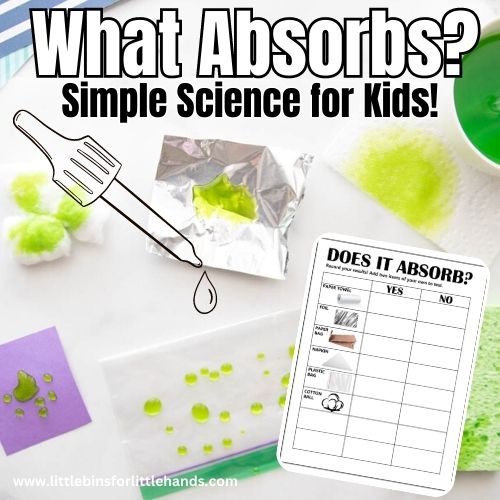
💡 Younger grade levels: Try our What Absorbs Experiment!
Preparation:
- Gather Materials: Set up one sugar cube per test material and arrange clear plastic cups for each test. Place one sugar cube in each cup.
- Choose Test Materials: Select materials that might absorb or repel water, such as paper towels, plastic wrap, aluminum foil, cotton fabric, and a sponge. Cut these materials into squares large enough to cover the sugar cube.
Step-by-Step Procedure:
Form a Hypothesis: Ask students to predict which materials will best prevent the sugar cube from dissolving. Have them write their predictions in their science journals or recording sheets.
Cover the Sugar Cube: Place each material over a sugar cube, ensuring it is completely covered.
Add Water: Use an eyedropper or small spoon to add a few drops of water on top of the material. Make sure the water doesn’t touch the sugar cube directly.
Observe: Watch how the water interacts with each material. Does the water soak in or run off? Time how long it takes for the sugar cube to show any signs of dissolving.
Record Results: Have students note their observations, such as how much water each material absorbed, whether the sugar cube stayed dry or began to dissolve, and any other changes.
Compare Results: After testing all the materials, compare the results as a class. Which materials were most effective at protecting the sugar cubes from dissolving? Why do you think this happened?

Science Concepts:
- Absorption: Absorption occurs when one material takes in or soaks up another substance. In this experiment, students learn how different materials either absorb or repel water.
- Solubility: Sugar cubes are soluble, meaning they dissolve in water unless something prevents the water from reaching them.
- Material Properties: Students explore how materials like sponges and cotton are highly absorbent, while others like plastic wrap and aluminum foil repel water, keeping the sugar cubes dry longer.
💡Explore our Material Properties activities here along with a free printable activity pack.
Extending the Experiment
Encourage kids to extend their learning by testing new variables and materials. See how to incorporate the scientific method.

Printable Science Projects For Kids
If you’re looking to grab all of our printable science projects in one convenient place plus exclusive worksheets and bonuses like a STEAM Project pack, our Science Project Pack is what you need! Over 300+ Pages!
- Bonus Quick Grab Packs for Biology, Earth Science, Chemistry, and Physics
- 90+ classic science activities with journal pages, supply lists, set up and process, and science information. NEW! Activity-specific observation pages!
- Best science practices posters and our original science method process folders for extra alternatives!
- Be a Collector activities pack introduces kids to the world of making collections through the eyes of a scientist. What will they collect first?
- Know the Words Science vocabulary pack includes flashcards, crosswords, and word searches that illuminate keywords in the experiments!
- My science journal writing prompts explore what it means to be a scientist!!
- Bonus STEAM Project Pack: Art meets science with doable projects!
- Bonus Quick Grab Packs for Biology, Earth Science, Chemistry, and Physics