
Ever wonder why a sponge soaks up water or why metal feels cold to the touch? The everyday materials around us behave uniquely because of the materials they’re made from. Let’s explore observable material properties activities with simple experiments and free worksheets.

Hands-on Science Investigations: Materials
These activities explore how materials can be absorbent, waterproof, strong, soluble, or flexible and how these properties affect their use in construction, design, and everyday objects.
💡 These activities help kids test physical properties of materials—see how these properties are defined in our Physical Properties of Matter for Kids guide.
Material Scavenger Hunt: Students search their home or classroom for objects that fit specific material properties, such as absorbency or hardness, and write down what they find next to each property. This adds a layer of practical exploration and connection with everyday objects.
Sugar Cube Absorption Experiment: This experiment tests the absorbency of sugar cubes when exposed to water and various materials, extending the study of absorbency from previous activities.
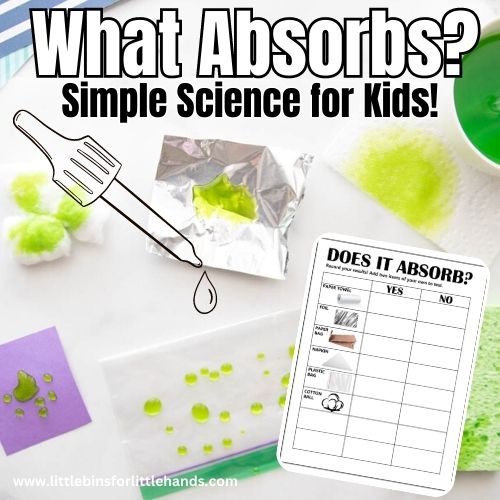
What Absorbs Experiment: Use items like fabric, plastic, and paper towels to test different materials to see which absorb the most water. Have students predict, experiment, and record which material holds the most water. This is an excellent follow-up to the absorbency worksheets.
Paper Towel Experiment: Similar to our absorption experiment above, except this time you will compare different brands of paper towel to find out which one is the most absorbent.
What Colors Absorb Heat Experiment: Kids explore how different materials absorb heat at different rates by placing them in sunlight or near a heat source. Materials like metal, plastic, and fabric will warm up at different rates. Students can observe which materials retain the most heat and relate this to everyday uses.
Melting Ice Cubes: Explore how ice melts faster on some surfaces than others. It all comes down to the properties of materials to absorb, reflect and transfer heat energy.
Insulation Experiment: Learn about the properties of materials to retain heat and act as insulators. Test various materials and determine which makes the best thermal insulator!


What are Observable Properties?
Observable properties are characteristics of a material or object that can be identified and measured using our senses without needing special tools. These properties help us describe and understand what an object is made of and how it behaves. Some common observable properties include:
- Color – What color is the material? For example, wood is usually brown, while metal might be shiny or silver.
- Texture – How does it feel when you touch it? A surface could be smooth like glass, rough like sandpaper, or soft like fabric.
- Shape – What shape does the material take? Is it round, square, or something else?
- Size – How big or small is the object or material?
- Flexibility – Can the material bend without breaking? For example, a rubber band is flexible, while a pencil is not.
- Hardness – How hard or soft is the material? A rock is hard, while a sponge is soft.
- Transparency – Can you see through the material? Glass is transparent, but wood is opaque.
- State of Matter – Is it a solid, liquid, or gas?
Printable Material Properties Activities Include:
Grade Level Recommendation: These activities are ideal for Kindergarten -3rd grade.
These free printables cover various ways to explore material properties and include hands-on activities for young scientists.
Properties of Materials Chart This worksheet introduces key properties of materials, such as absorbency, flexibility, water resistance, and strength. Students will explore how materials can be categorized based on these characteristics.
Simple Science Experiment. Testing Absorbency Kids test the absorbency of fabric, paper towels, and plastic materials. They predict which material will absorb the most water and record their findings.
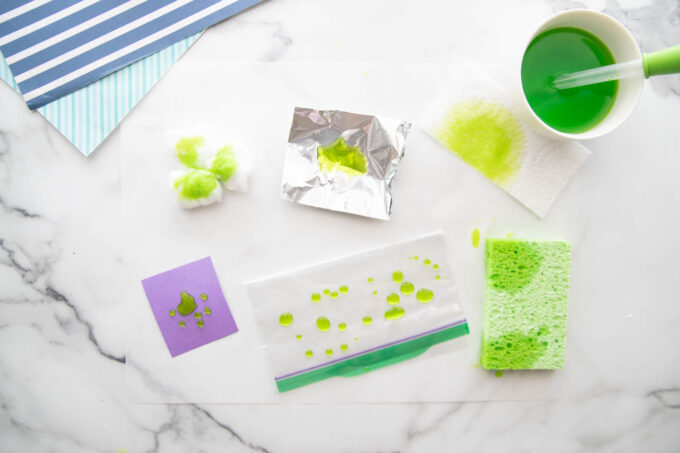
Sort the Materials Students sort pictures of different materials based on their properties (e.g., absorbent, waterproof, flexible, rigid).
Match the Property In this activity, students match objects with their correct material property, such as matching a sponge with “absorbent” or a steel beam with “strong.”
What Is It Made Of? Students identify what materials everyday objects are made of and explain why those materials were chosen.
Material Scavenger Hunt Students go on a scavenger hunt to find objects that match different material properties (e.g., absorbent, flexible, hard, smooth, heavy, etc.). They record their findings in a checklist.
Try It: Material Investigation (Paper Towel Test). Students compare different paper towel brands, measuring how much water each absorbs. They record their results and reflect on the effectiveness of each.
Material Properties Crossword: A fun crossword puzzle where students fill in the blanks using material property words such as absorbent, waterproof, and flexible.
Challenge: Design a Waterproof Shelter. Students are challenged to design and build a waterproof shelter for a small object using materials such as aluminum foil, plastic wrap, and paper towels. They test the shelter by spraying it with water and reflect on its success.
True or False: Material Properties This activity allows students to identify true or false statements about material properties, such as “Metal is flexible” or “Plastic is strong.”


Free Activity: Material Properties Pack
Use this free materials project pack to learn more about the properties of materials.

More Printable Activity Ideas
- Natural vs. Man-Made Materials Worksheet: Students sort materials into categories based on whether they are natural (like wood or cotton) or man-made (like plastic or nylon), complementing the scavenger hunt and material sorting activities.
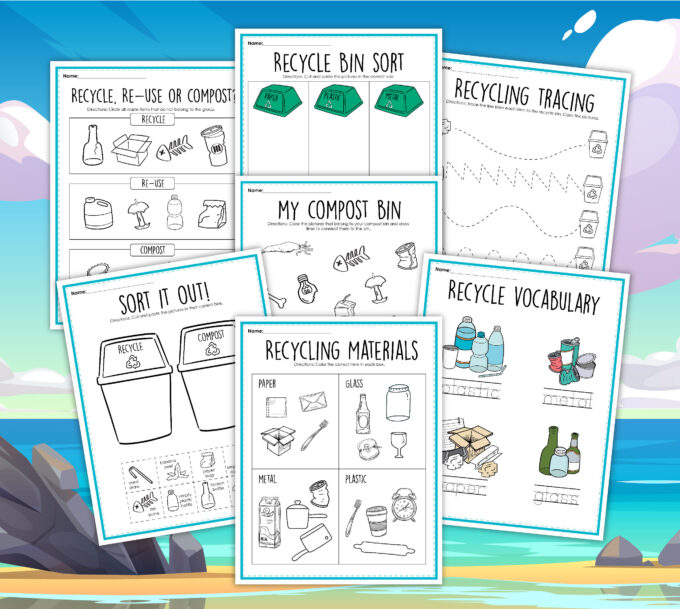
- Recyclables Activity Pack: What materials can be recycled and what can not? This is a simple but engaging pack for young scientists to explore recyclable materials.

Printable Science Projects For Kids
If you’re looking to grab all of our printable science projects in one convenient place plus exclusive worksheets and bonuses like a STEAM Project pack, our Science Project Pack is what you need! Over 300+ Pages!
- Bonus Quick Grab Packs for Biology, Earth Science, Chemistry, and Physics
- 90+ classic science activities with journal pages, supply lists, set up and process, and science information. NEW! Activity-specific observation pages!
- Best science practices posters and our original science method process folders for extra alternatives!
- Be a Collector activities pack introduces kids to the world of making collections through the eyes of a scientist. What will they collect first?
- Know the Words Science vocabulary pack includes flashcards, crosswords, and word searches that illuminate keywords in the experiments!
- My science journal writing prompts explore what it means to be a scientist!!
- Bonus STEAM Project Pack: Art meets science with doable projects!
- Bonus Quick Grab Packs for Biology, Earth Science, Chemistry, and Physics