

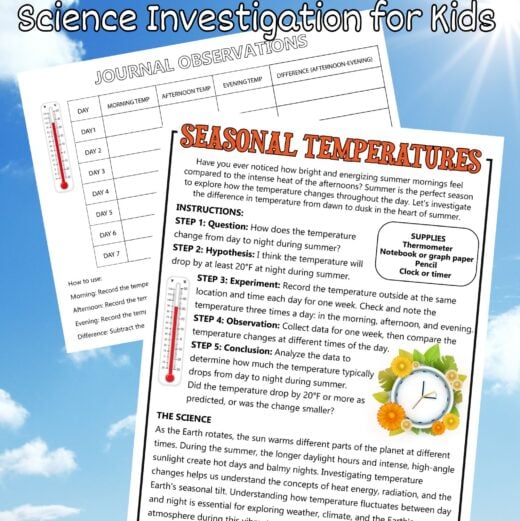
Have you ever noticed that summer afternoons often feel much hotter than early mornings? Temperatures change throughout the day as the sun warms Earth’s surface and the surrounding atmosphere.
In this simple weather investigation, kids collect temperature data throughout the day to discover how weather conditions change from morning to evening. It’s an easy way to practice observation skills, record real-world data, and learn about heat energy.
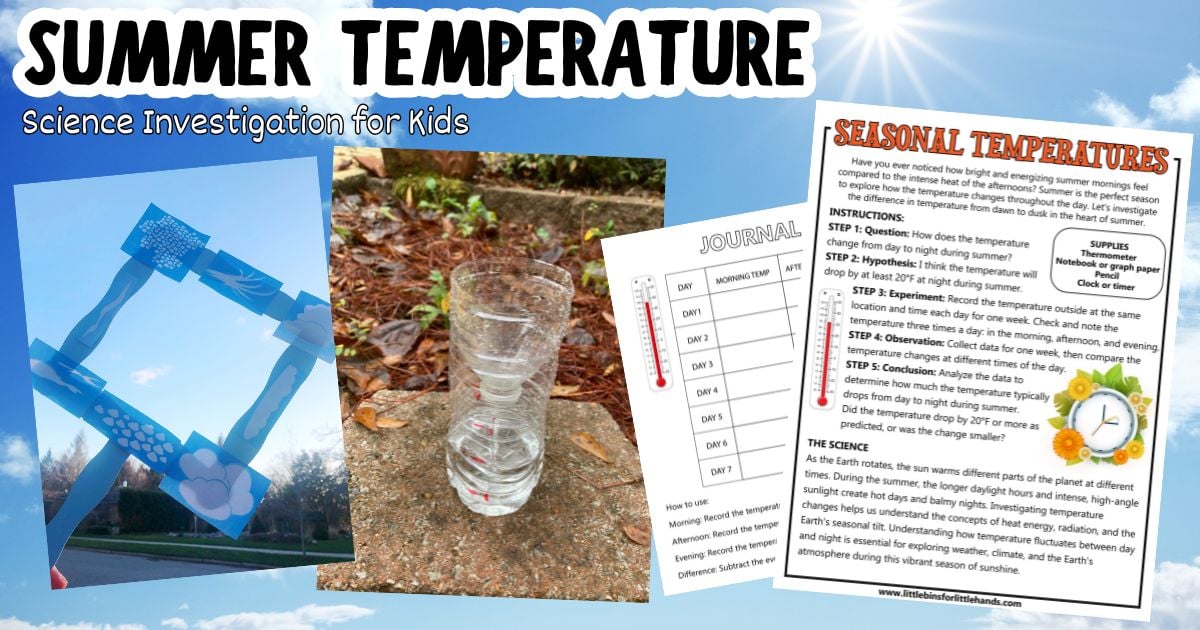
Summer Temperature Investigation
Tracking outdoor temperatures is a simple way to explore weather and heat energy. By recording temperatures throughout the day, kids can identify patterns and learn how sunlight affects Earth’s surface.
Science Concepts
Science: Earth Science, Weather Science
Age Group: Grades K–5
Key Concepts:
- Temperature
- Weather Patterns
- Heat Energy
- Data Collection
- Observation Skills
- Scientific Method
What Kids Will Learn
- Temperature changes throughout the day.
- The sun provides heat energy that warms Earth’s surface.
- Weather can be measured and recorded.
- Scientists use data to identify patterns.
- Observations help us understand weather conditions.
Supplies
- Outdoor thermometer
- Summer Temperature Investigation recording sheet
- Pencil
- Clock or timer
Instructions
Step 1: Ask a Question
How does the temperature change from morning to evening during summer?
Step 2: Make a Prediction
Before you begin, make a prediction.
Do you think the temperature will drop significantly after sunset? How much cooler do you think the evening will be compared to the afternoon?
Write down your prediction.
Step 3: Collect Temperature Data
Choose one outdoor location for your investigation.
Record the temperature at the same location three times each day:
- Morning
- Afternoon
- Evening
Try to check the temperature at approximately the same times each day.
Continue collecting data for one week.
Step 4: Observe
As you collect data, look for patterns.
Ask questions such as:
- Which time of day is warmest?
- Which time of day is coolest?
- Do temperatures change by the same amount every day?
- How do cloudy days compare to sunny days?
Record any observations on your investigation sheet.

Step 5: Draw Conclusions
After one week, review your data.
Compare the temperatures from morning, afternoon, and evening. Determine how much the temperature changed each day and decide whether your prediction was correct.
What patterns did you discover?
The Science Behind Temperature Changes
The sun is the primary source of heat energy for Earth.
As sunlight reaches the ground, roads, buildings, grass, and water absorb energy and warm up. Throughout the morning, this heat builds, causing temperatures to rise.
Even though the sun reaches its highest point around midday, temperatures often continue rising into the afternoon because Earth’s surface keeps absorbing and releasing heat.
After sunset, the ground gradually loses heat. Without direct sunlight, temperatures begin to cool throughout the evening and overnight hours.
Cloud cover, humidity, wind, and rainfall can all affect how quickly temperatures warm up or cool down.
👉 Want to explore the weather even further? Try building a rain gauge, making a weather station, or tracking clouds throughout the week.



Make It a Science Project
This activity is a great introduction to the scientific method. Kids can make a prediction, collect data, analyze results, and draw conclusions based on evidence. If you’d like additional investigation pages, grab our Scientific Method Worksheets.
Compare Sunny and Cloudy Days
Track temperatures on both sunny and cloudy days.
Which conditions create the greatest temperature changes?
Test Different Locations
Place thermometers in different locations, such as:
- Full sun
- Shade
- Grass
- Pavement
Which location becomes warmest during the day?
Graph Your Data
Create a line graph showing your temperature readings throughout the week.
Can you identify any trends or patterns?
Compare Seasons
Repeat the investigation during another season.
How do summer temperatures compare to fall, winter, or spring?
Summer Temperature Guiding Questions
Why is the afternoon usually warmer than the morning?
The ground absorbs heat from the sun throughout the day, causing temperatures to continue rising into the afternoon.
Why does the temperature cool after sunset?
Without direct sunlight, Earth’s surface loses heat and gradually cools.
Do temperatures change the same amount every day?
No. Wind, clouds, humidity, and other weather conditions can affect daily temperature changes.
How do scientists study weather patterns?
Scientists collect weather data over time and look for patterns and trends.
Why is it important to record observations?
Observations help scientists compare results, identify patterns, and draw conclusions based on evidence.
Grab Your Free Summer Temperature Investigation
Download the free Summer Temperature Investigation recording sheet and become a weather scientist. Kids will practice observation skills, collect data, and discover how temperatures change throughout the day.
More Weather Activities for Kids
Continue exploring weather science with these hands-on activities:
- DIY Rain Gauge
- Cloud in a Jar
- Weather Station Project
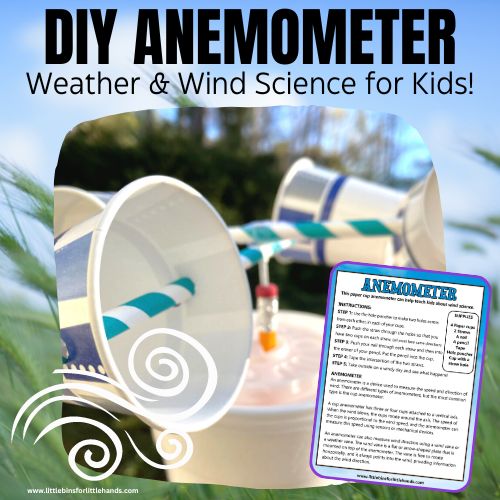
- Anemometer for Kids
- Pinecone Weather Station
- Cloud Identification Activities
👉 Explore more weather experiments for kids here
👉 Looking for more seasonal investigations? Explore our Summer Science Experiments and Outdoor Science Activities collections for even more ways to learn outside.

Make Summer STEM a Blast!
From slime and bubbles to nature walks and camp weeks—this Summer bundle is your one-stop summer STEM solution. Over 11 hands-on activity packs to make this your most fun and educational summer ever!