

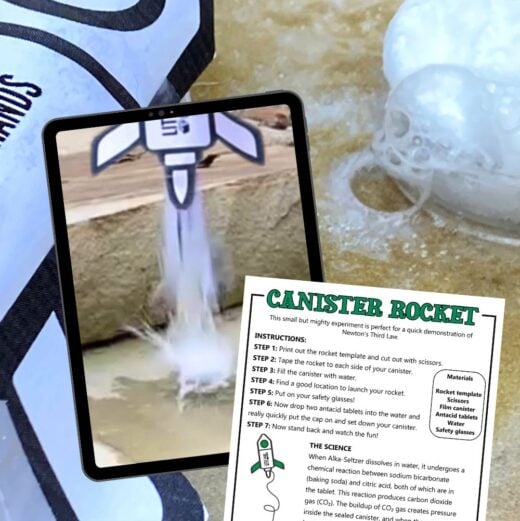
Blast off into science fun with these Alka-Seltzer rockets! This simple and exciting experiment perfectly demonstrates how chemistry and physics can launch a rocket high into the sky. Watch your kid’s eyes light up as they explore Newton’s Laws of Motion.

Alka Seltzer Rocket Science Experiment
Alka-Seltzer rockets or film canister rockets are a fantastic hands-on way to introduce kids to chemical reactions, energy, and Newton’s Three Laws of Motion. When the Alka-Seltzer tablets react with water inside a canister, they produce carbon dioxide gas.
As this gas builds up inside the canister, the pressure increases until the cap is forced off, sending the rocket flying! This experiment is a fun and educational way to learn about how forces and energy work in the real world.
Grade Level Recommendation: 2nd—to 6th grade. See extension activities below for the scientific method.
- 2nd to 4th grade: The focus is on observing the launch and learning about essential chemical reactions and forces.
- 5th and 6th grade: the experiment can be expanded to include a detailed analysis of energy transformation, Newton’s Three Laws of Motion, and design variations of the experiment.
Alka Seltzer Rocket Instructions:
🛑 Safety First!
Before starting this alka seltzer rocket experiment, it’s important to take some safety precautions:
- Adult Assistance: This activity requires adult supervision and assistance, especially when handling the rocket canister.
- Wear Safety Glasses: Always wear safety glasses to protect your eyes from the canister’s sudden launch.
- Stand Clear: Once the lid is on the canister, quickly set it down and stand back to watch the launch from a safe distance.
- Aim Away: Never aim the rocket toward people, animals, or breakable objects. Make sure your launch area is clear of living things and obstacles.
- Handle with Care: Be cautious when handling the canister after the launch; it may have some remaining pressure inside.
Supplies:
- Rocket template (included below)
- Scissors
- Film canister
- Alka-Seltzer tablets (antacid tablets,generic brands )
- Water
- Safety glasses
- Tape
How to Assemble Your Canister Rocket:
Print out the Rocket Template and cut it out using scissors.
Tape the Rocket to each side of your film canister.
Fill the Canister with Water.

Pick a Launch Location outdoors or in an open space.
Put on Your Safety Glasses! Safety first.
Add Two Alka-Seltzer Tablets into the water and quickly snap the lid onto the canister.

Step Back and Watch your Alka-Seltzer rocket launch into the air!


Rocket Science
When the Alka-Seltzer tablets drop into the water, a chemical reaction occurs. The reaction between sodium bicarbonate (baking soda) and citric acid in the tablets produces bubbles of carbon dioxide gas (CO₂). This gas builds up pressure inside the sealed canister. When the pressure becomes too high, it forces the lid off, launching the rocket into the air.
Energy Concepts:
- Potential Energy: The water and tablets inside the canister represent stored energy. This energy is held in the form of chemical potential energy.
- Kinetic Energy: Once the gas builds up enough pressure to pop the lid off, the stored potential energy converts into kinetic energy, which propels the canister upward. The height and speed of the rocket depend on how much energy was stored (more gas buildup = more pressure = higher launch).
Newton’s Laws of Motion:
First Law of Motion (Inertia): An object at rest stays at rest, and an object in motion stays in motion unless acted upon by an external force. Before the reaction, the canister sits still. It won’t move until the pressure from the gas inside creates enough force to push the lid off, causing the rocket to launch.
Second Law of Motion (Force = Mass x Acceleration): The acceleration of the Alka-Seltzer rocket depends on the force generated by the gas pressure inside the canister and the mass of the canister. A lighter canister or a more powerful reaction (more gas) will result in a faster and higher launch.
Third Law of Motion (Action and Reaction): For every action, there is an equal and opposite reaction. As the gas pushes down on the lid (action), the lid pushes back on the canister, propelling it upward or in the opposite direction (reaction). This is the key principle that makes the Alka-Seltzer rocket fly!
Free Printable Alka Seltzer Rocket Instructions

Extension Activities using Scientific Method
Here are a few ways older kids can apply the scientific method and use variables to understand better the science involved in this experiment.
- Vary the Water Amount: Try different levels of water in the canister to see how it affects the height and speed of the launch. How does the amount of water change the potential energy stored in the canister?
- Vary the Temperature of Water: Try hot water and cold water! Does the temperature of the water affect the outcome?
- Tablet Amount: Experiment with using more or fewer Alka-Seltzer tablets. How does this change the pressure buildup and the launch? Relate this to Newton’s Second Law – does more force (from more gas) result in faster acceleration?
- Change the Canister: Use different sizes or shapes of canisters to explore how mass affects the rocket’s motion, demonstrating Newton’s Second Law.
- Discuss Potential and Kinetic Energy: Use these Alka-Seltzer rockets to explain how energy is stored (potential energy) and then released (kinetic energy) during the rocket launch.
Scientific Method Example:
Ask a Question: How does the amount of water in the canister affect the height of the rocket’s launch?
Do Background Research: Learn how chemical reactions create gas, which builds up pressure inside the canister.
Form a Hypothesis: If I add more water to the canister, then the rocket will launch higher because the chemical reaction will have more water to react with, increasing gas production.
Conduct an Experiment: Set up multiple canisters with varying amounts of water (e.g., 1/4 full, 1/2 full, 3/4 full). Add the same number of Alka-Seltzer tablets to each canister. Launch the rockets and observe the results.
💡Learn more about the scientific method [here].
More Fun With Chemistry and Physics
Helpful Science Resources
Here are a few resources to help you introduce science more effectively to your kids or students and feel confident presenting materials. You’ll find helpful free printables throughout.
- Join us in the Club
- Best Science Practices (as it relates to the scientific method)
- Science Vocabulary
- All About Scientists
- Free Science Worksheets
- DIY Science Kits
- Science Tools for Kids
- Scientific Method for Kids
- Citizen Science Guide
- Printable Science Project Pack


3 Comments
Comments are closed.