
3-2-1 blast off! What can you do with a balloon and a straw? Build a balloon rocket, of course! Kids will love this awesome physics experiment that is more like play than science. A fun introduction to Newton’s Laws of Motion. We love hands-on and easy physics activities for kids!
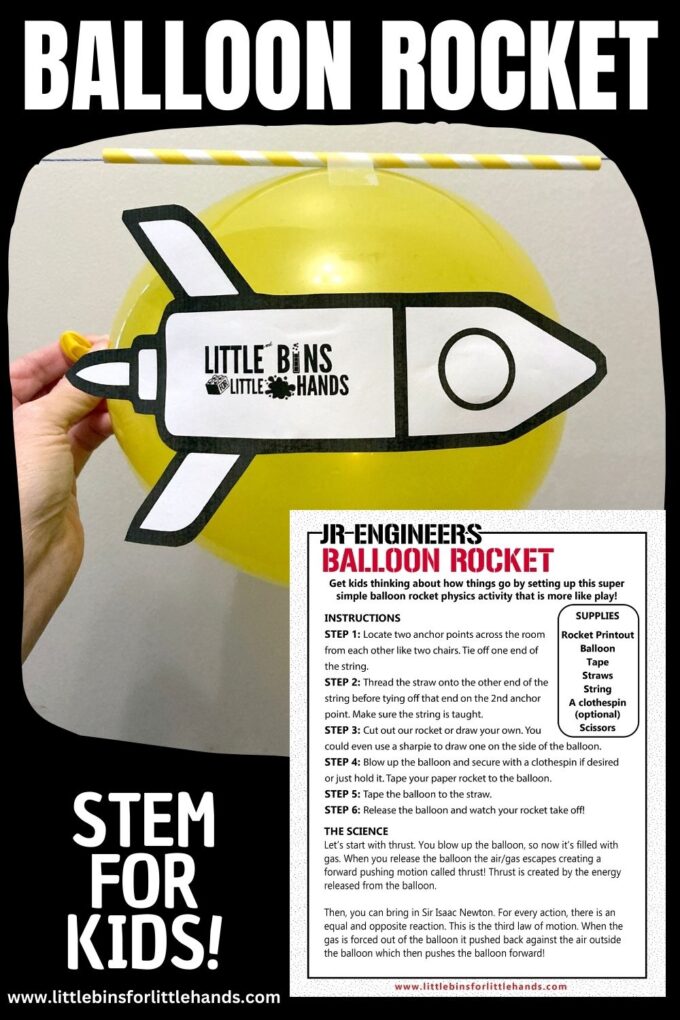
Make A Balloon Rocket For STEM
This simple balloon rocket activity lets your kids think about forces in motion. STEM for kids doesn’t need to be complicated or expensive. Some of the best STEM activities are also the cheapest! Keep it fun and playful, and not make it too difficult that it takes forever to complete.
This easy balloon rocket STEM activity can teach kids how the force of air moving in one direction can propel a balloon in the opposite direction, much like a real rocket! You can easily add in Newton’s Third Law as part of the science lesson!
MUST TRY: Have you ever made a bottle rocket for the outdoors?
Take up the challenge to make a balloon rocket with our step-by-step instructions below. Find out what makes the balloon move along the string and see how far or fast you can get your own balloon rocket to travel.
Also try these fun balloon rocket variations…
PRINTABLE BALLOON ROCKET PROJECT!
Turn It Into A Balloon Rocket Experiment
Turn it into a balloon rocket experiment by exploring what happens when the balloon is blown up to different sizes. Does the balloon travel further as it has more air in it? Learn more about the scientific method for kids!
If you want to set up an experiment that includes several trials with the same balloon, make sure to use a soft tape measure to measure the circumference of the first balloon. To recreate accurate trials, you need to change the independent variable and measure the dependent variable.
You can also get kids started by writing down their hypotheses before diving into the experiment. What do they think will happen when the blown-up balloon is released?
After performing the experiment, kids can draw conclusions as to what happened and how it matched their initial hypotheses. You can always change a hypothesis upon testing your theory!
You could also investigate…
- Does the different type of string affect how the rocket travels?
- Does the length or type of straw affect how the rocket travels?
How to Make a Balloon Rocket
Supplies:
- Rocket Printout
- Balloon
- Tape
- Drinking Straws (paper or plastic, which one works better?)
- String (yarn or twine, which one works better?)
- A clothespin (optional)
- Scissors
Instructions:
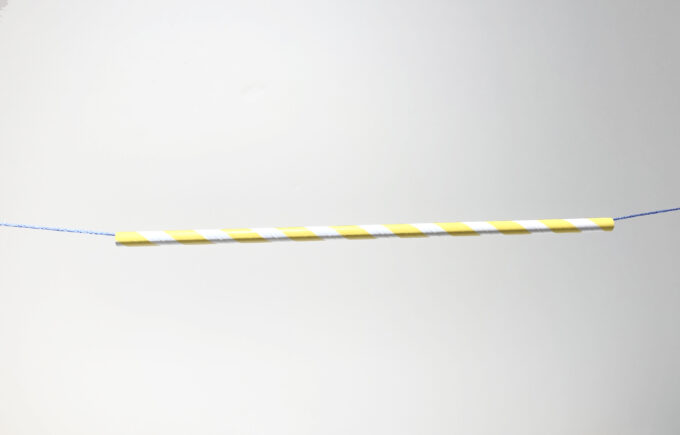
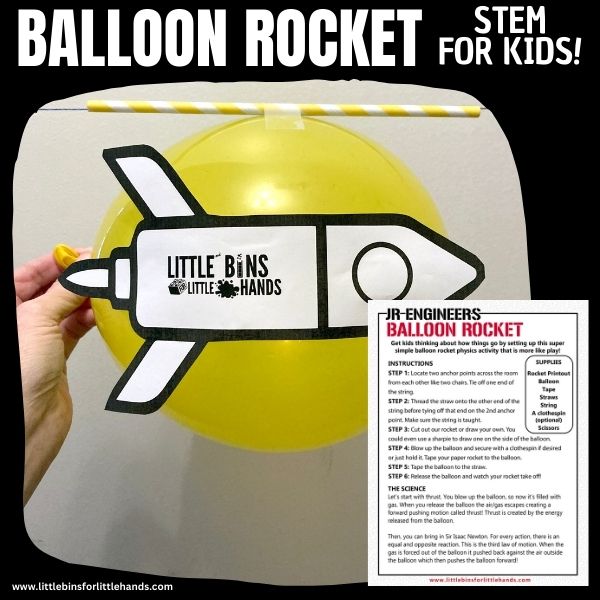
STEP 1: Locate two anchor points across the room from each other like two chairs. Tie off one end of the string.
STEP 2: Thread the straw onto the other end of the string before tying off that end on the 2nd anchor point. Make sure the string is taught.
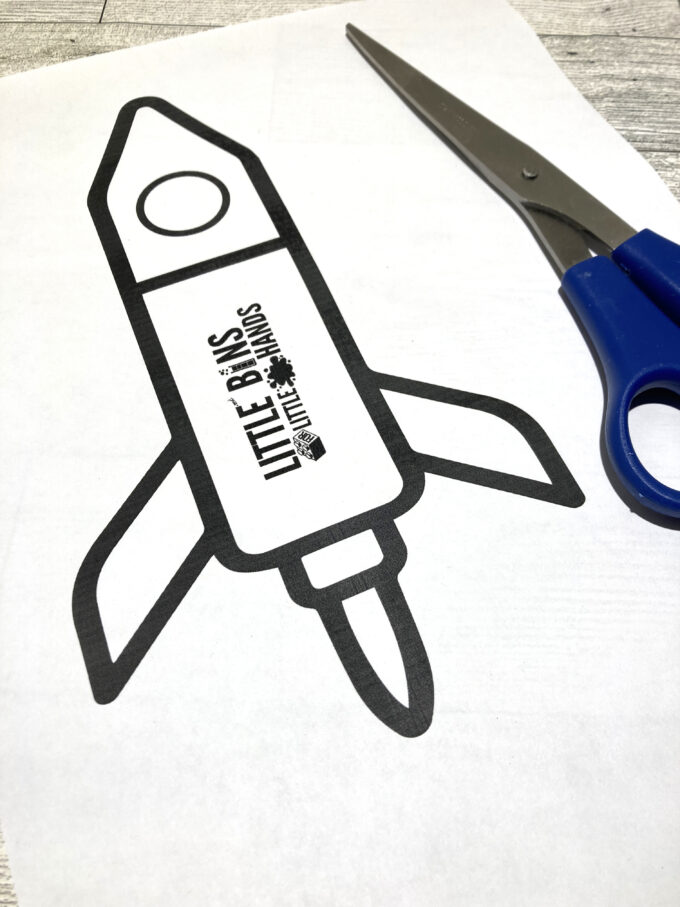
STEP 3: Cut out our rocket or draw your own. You could even use a sharpie to draw one on the side of the balloon.
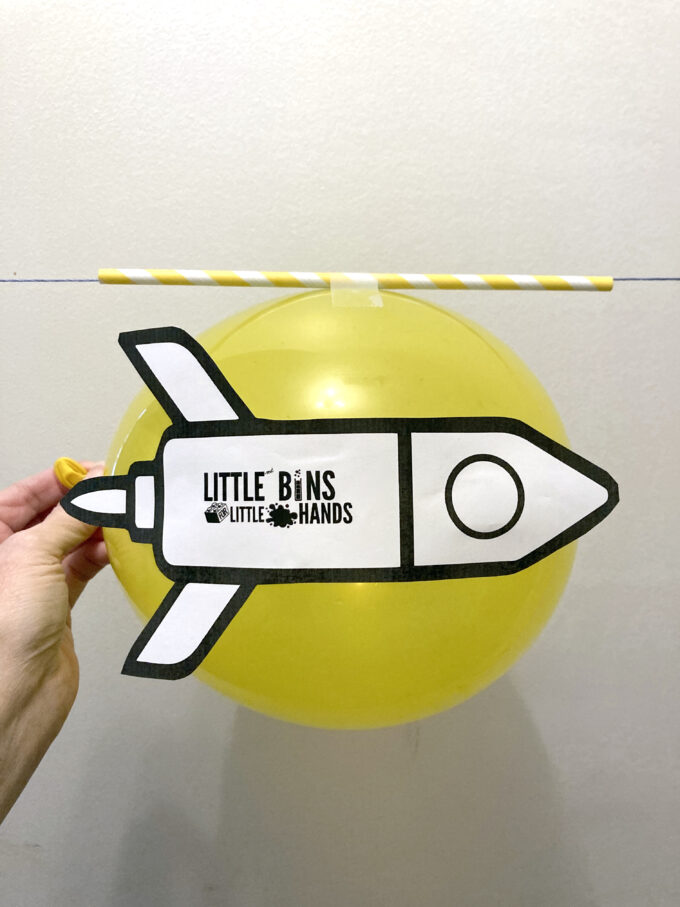
STEP 4: Blow up the balloon and secure the end with a clothespin if desired or hold it. Tape your paper rocket to the balloon.
STEP 5: Tape the balloon to the straw.
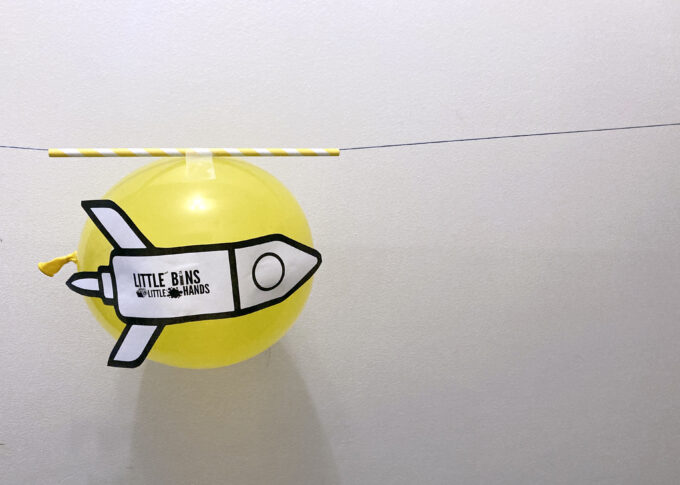
STEP 6: Release the balloon and watch your rocket take off! This is one you will want to repeat again and again!
How Does A Balloon Rocket Work?
Let’s start with thrust. First, you blow up the balloon, filling it with gas. When you release the balloon the air or gas escapes creating a forward motion called thrust! Thrust is a pushing force created by the energy released from the balloon.
Also learn how the force of lift works with this paper helicopter activity!
NEWTON’S THIRD LAW
Then, you can bring in Sir Isaac Newton and his third law. For every action, there is an equal and opposite reaction. This is the third law of motion. When the gas is forced out of the balloon, it is pushed back against the air outside the balloon, propelling it forward on the string!
Newton’s first law states that an object at rest stays at rest until an outside force acts upon it. An object in motion will stay in motion in a straight line until an unbalanced force acts upon it (think of a toy car going down a ramp).
His second law states that force times mass equals acceleration. All three laws of motion can be observed with a balloon rocket!
More Fun Ways To Explore Newton’s Laws
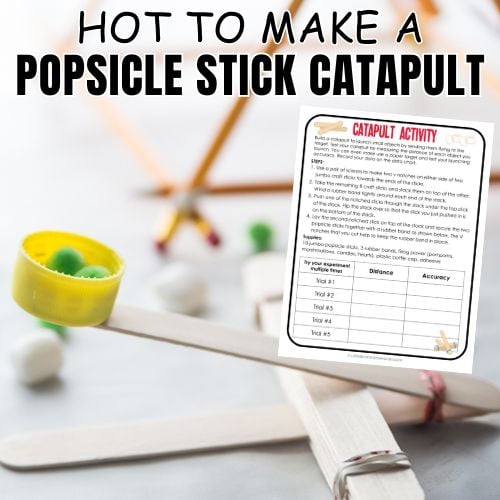
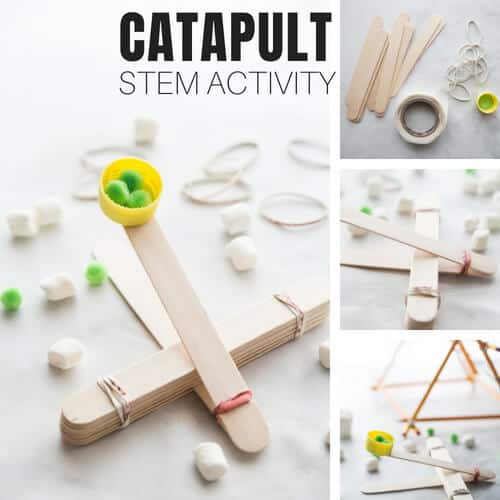
- Make a catapult
- Make a pom pom shooter
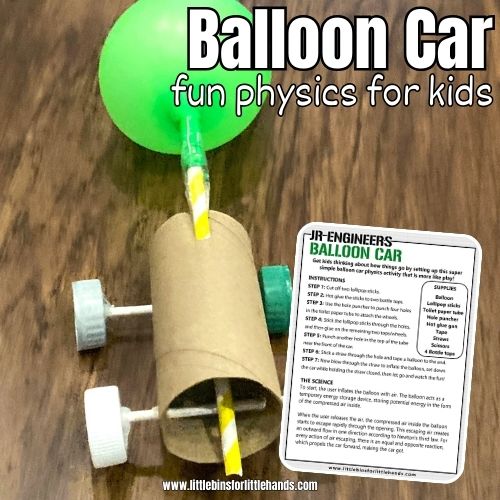
- Make a balloon powered car
- Set up a domino chain reaction
- Create a popsicle stick chain reaction


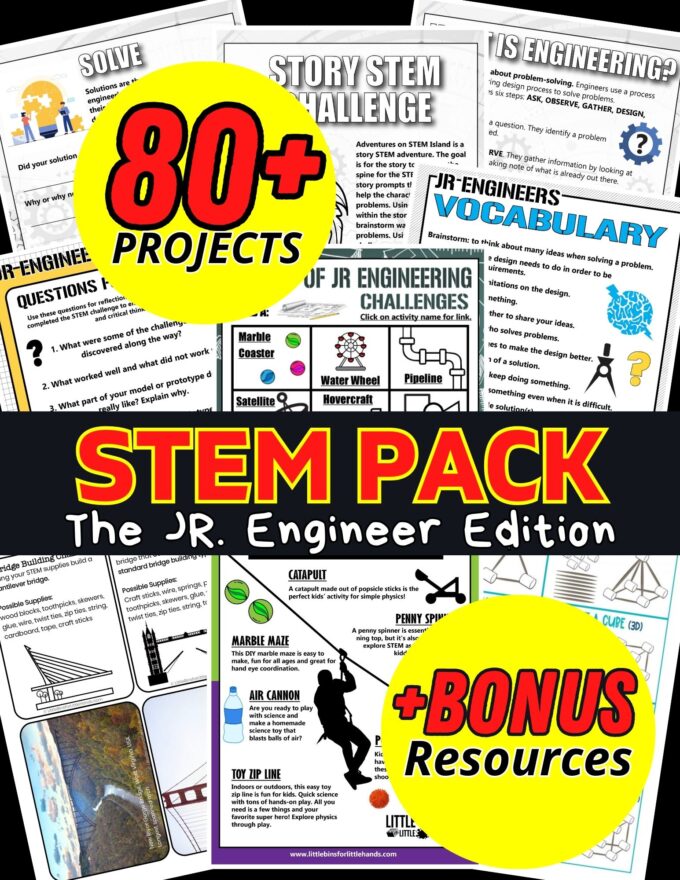
Printable STEM Pack for Kids
80+ Doable Engineering Projects in one convenient pack!
- Full instructions with sample images
- Activity-specific instruction sheets
- Data Collection Sheets
- Questions for Reflection
- Architecture Building Cards: Try the tallest tower challenge
- Bridge Building Cards: Explore different types of bridges to build your own.
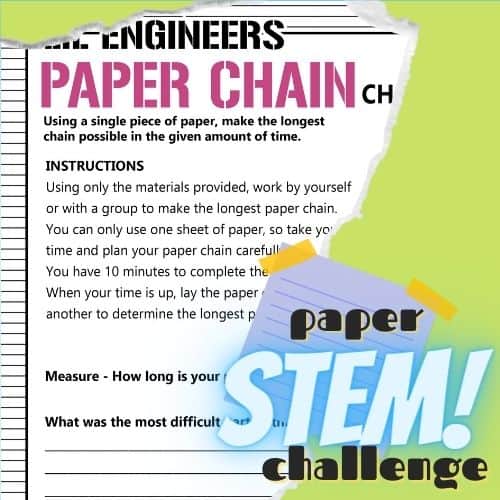
- Paper Chain STEM Challenge: Who can make the longest chain? Great icebreaker or quick challenge!
- 3 Little Pigs Architectural Pack: Design a house that won’t blow away!
- Great marshmallow challenge: A classic challenge kids love!
- Real-world STEM challenge lesson but don’t know where to start? Our easy-to-follow template shows the steps!
- What’s the difference between a scientist and an engineer?
- Crossword and word search with engineering vocabulary.
- Engineering vocabulary cards
- Design a one-of-a-kind invention and write about it with this 5-page activity!