

The marshmallow tower challenge is a fun, hands-on STEM activity that’s easy to set up with just marshmallows and toothpicks. Kids love building marshmallow toothpick towers while learning about structure and design. It’s low-prep, budget-friendly, and perfect for classrooms or home!
Marshmallow Toothpick Tower Challenge
Grade Level: Kindergarten through 5th grade (easily adaptable for older students too)
Science Concepts Explored:
- Engineering and design
- Structural stability
- Properties of materials
- Balance and symmetry
- Measurement and comparison
NGSS Simplified (3 Guiding Questions):
- What are we trying to figure out?
How can we build the tallest or strongest tower using marshmallows and toothpicks? - What do we need to investigate?
How different designs affect the strength, height, or stability of the tower. - How will we record and share what we learn?
Draw or measure the final structure, record how tall or stable it is, and reflect on what worked or didn’t work in the design.
Marshmallow and Toothpick Towers
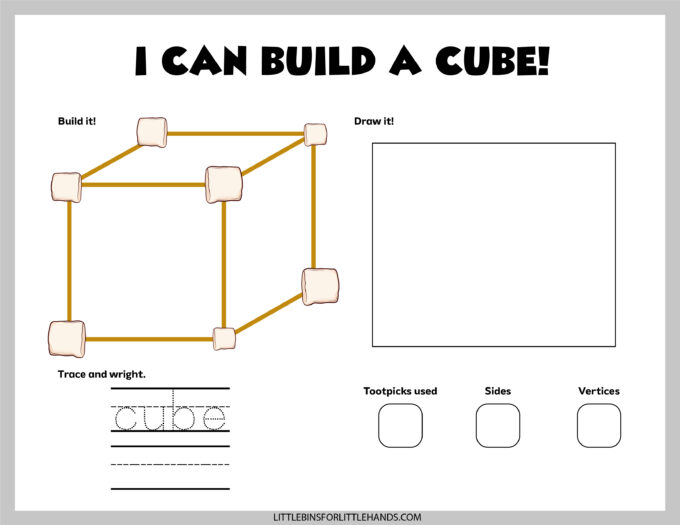
STEM Challenge #1: 2D & 3D Shapes
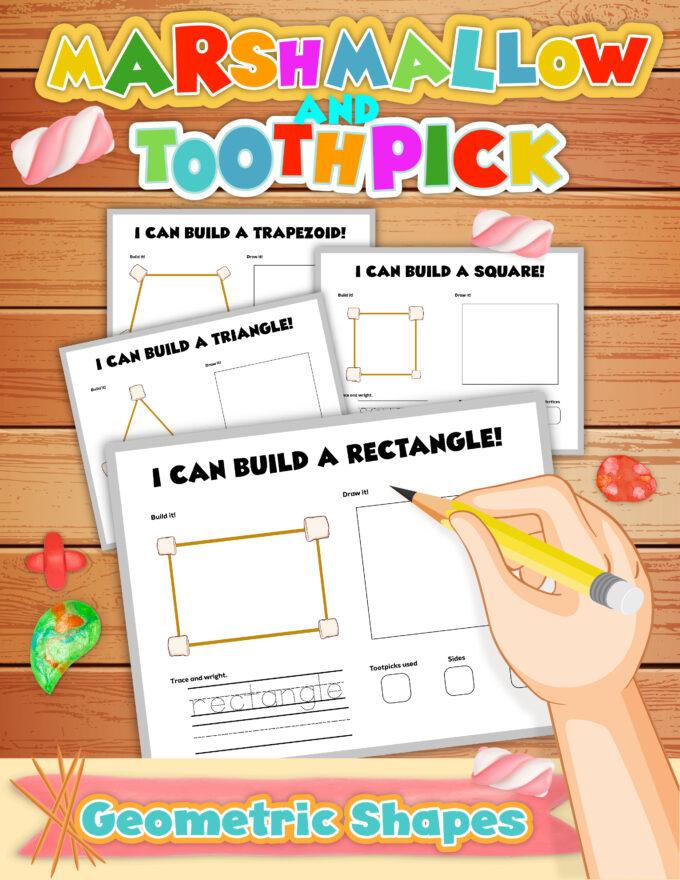
Start here! Kids can build the 2D and 3D shapes printed on the cards below! This is an excellent way for them to familiarize themselves with the various shapes. Additionally, it offers an opportunity to develop fundamental skills in building and problem-solving. This might be just the right level for your junior engineers!
STEM Challenge #2: 100 Marshmallows
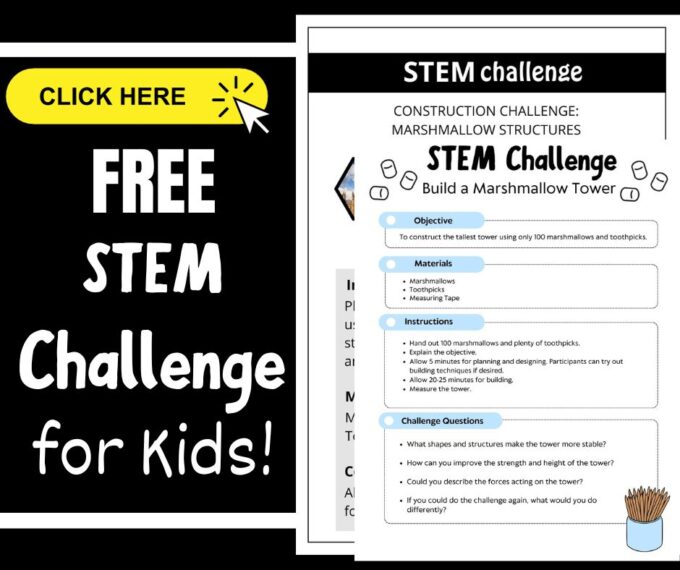
Next, try the 100 marshmallow tower challenge! Kids must build with 100 marshmallows in a set amount of time! Generally, 15-25 mins is a reasonable STEM challenge time frame. This is also a fun team-building activity! Use the free instant download below.
STEM Challenge #3: Famous Structures
Structure challenge! Research an interesting building or structure to replicate with marshmallows and toothpicks. It’s a fantastic opportunity to combine engineering, math, history, technology, and architecture for a STEAM project. Use the free printable above.
What are 2-Dimensional Shapes?
Two-dimensional (2D) shapes are geometric figures that exist in two dimensions, namely length and width. These shapes are flat and can be represented on a plane surface. Common examples of 2D shapes include:
- Square: A square is a four-sided polygon with equal sides and four right angles.
- Circle: A circle is a perfectly round shape with all points on its boundary equidistant from its center.
- Triangle: A triangle is a three-sided polygon, and the sum of its internal angles is always 180 degrees.
- Rectangle: A rectangle is a four-sided polygon with opposite sides of equal length and all angles at right angles.
- Pentagon: A pentagon is a five-sided polygon.
- Hexagon: A hexagon is a six-sided polygon.
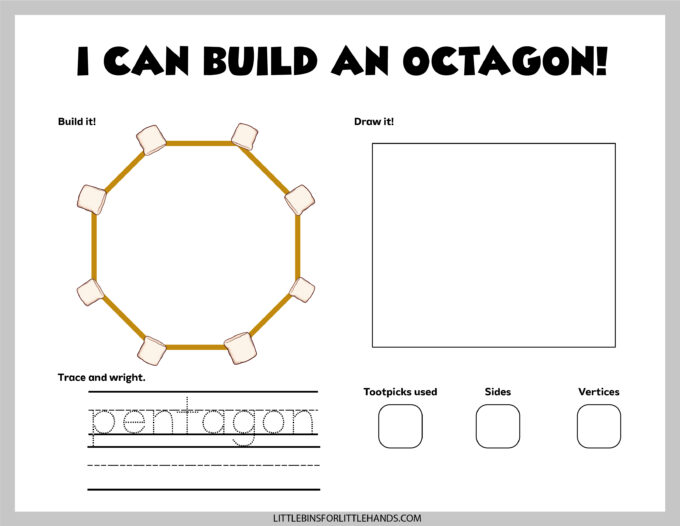
- Octagon: An octagon is an eight-sided polygon.
These shapes are fundamental in geometry and serve as building blocks for more complex geometric structures.
What are 3-Dimensional Shapes?
Three-dimensional (3D) shapes are geometric figures in three dimensions: length, width, and height (or depth). Unlike 2D shapes, 3D shapes have volume and occupy space. Common examples of 3D shapes include:
These 3D shapes are essential in geometry and commonly represent objects in the physical world. Understanding their properties is crucial in various fields, including mathematics, physics, and engineering.
For more 3D Shape building cards, grab this free printable.
- Cube: A cube is a three-dimensional shape with six equal square faces, and all angles are right angles.
- Sphere: A sphere is a perfectly round three-dimensional object, similar to a ball, with all points on its surface equidistant from its center.
- Cylinder: A cylinder has two parallel circular bases connected by a curved surface. It can be visualized as a can or a tube.
- Cone: A cone has a circular base connected to a single vertex (apex) by a curved surface. It resembles an ice cream cone.
- Rectangular Prism: A rectangular prism is a three-dimensional shape with six faces, each being a rectangle. It is similar to a box or a rectangular block.
- Pyramid: A pyramid has a polygonal base (such as a square, triangle, etc.) connected to a single apex by triangular faces.
- Cuboid: Similar to a rectangular prism, a cuboid is a three-dimensional shape with six rectangular faces.
Bonus STEM Activities With Marshmallows
Want more things to do with marshmallows?
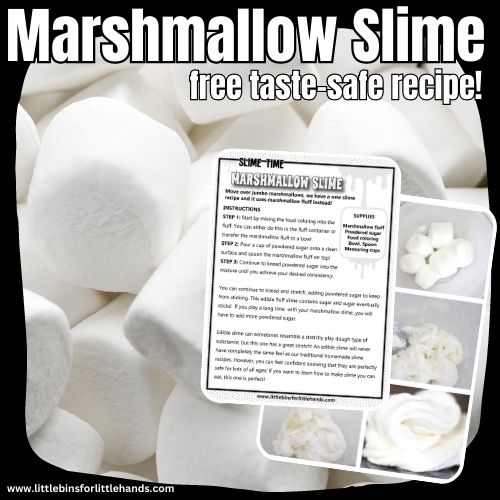
- Make marshmallow edible slime
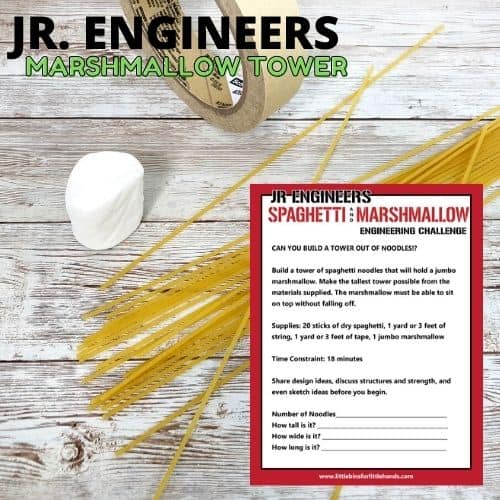
- Build a marshmallow spaghetti tower
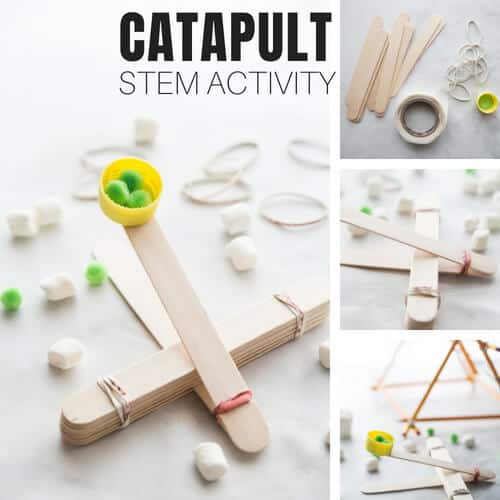
- Take the marshmallow catapult challenge
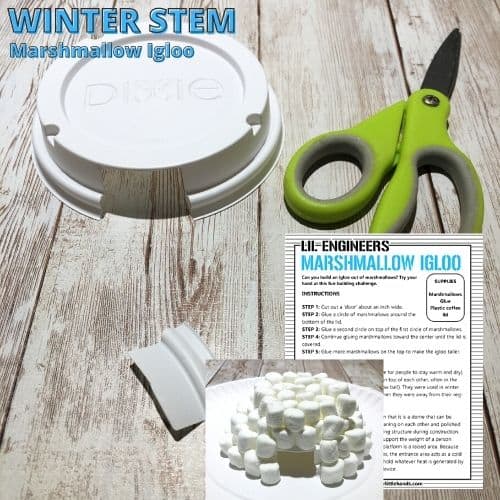
- Build a marshmallow igloo
More Fun STEM Challenges To Try
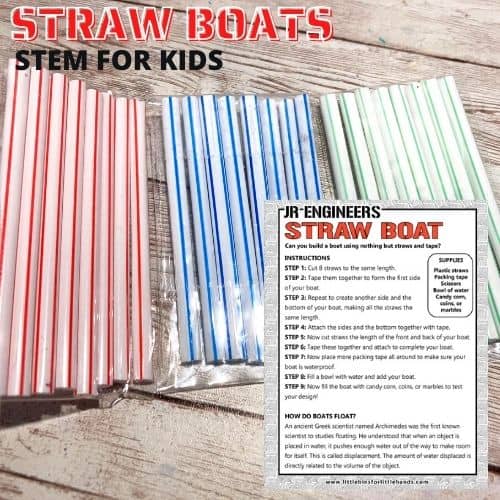
Straw Boats Challenge – Design a boat made from straws and tape and see how many items it can hold before it sinks.
Strong Spaghetti – Get out the pasta and test our your spaghetti bridge designs. Which one will hold the most weight?
Paper Bridges – Similar to our strong spaghettti challenge. Design a paper bridge with folded paper. Which one will hold the most coins?
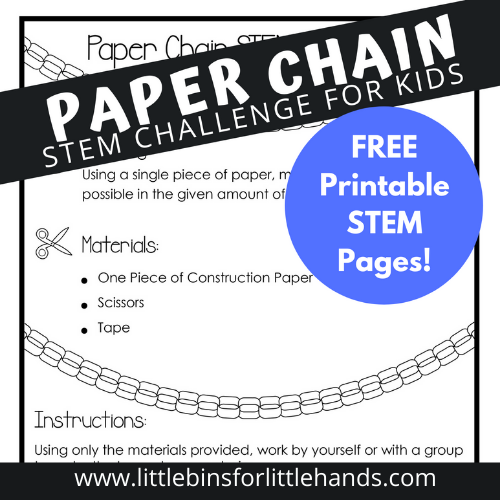
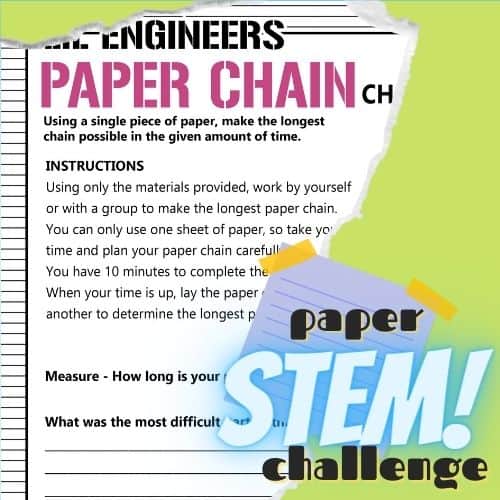
Paper Chain STEM Challenge – One of the simplest STEM challenges ever!
Paper Tower Challenge: Build the tallest free-standing tower possible using a limited amount of paper.
Strong Paper – Experiment with folding paper in different ways to test its strength, and learn about what shapes make the strongest structures.
Spaghetti Marshmallow Tower – Build the tallest spaghetti tower that can hold the weight of a jumbo marshmallow.
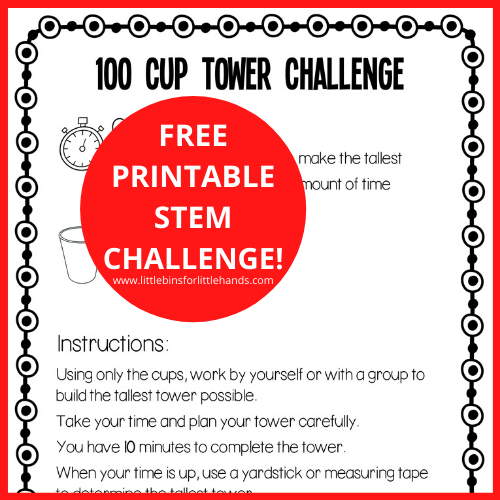
Cup Tower Challenge – Make the tallest tower you can with 100 paper cups.
Paper Clip Challenge – Grab a bunch of paper clips and make a chain. Are paper clips strong enough to hold weight?
Printable STEM Pack for Kids
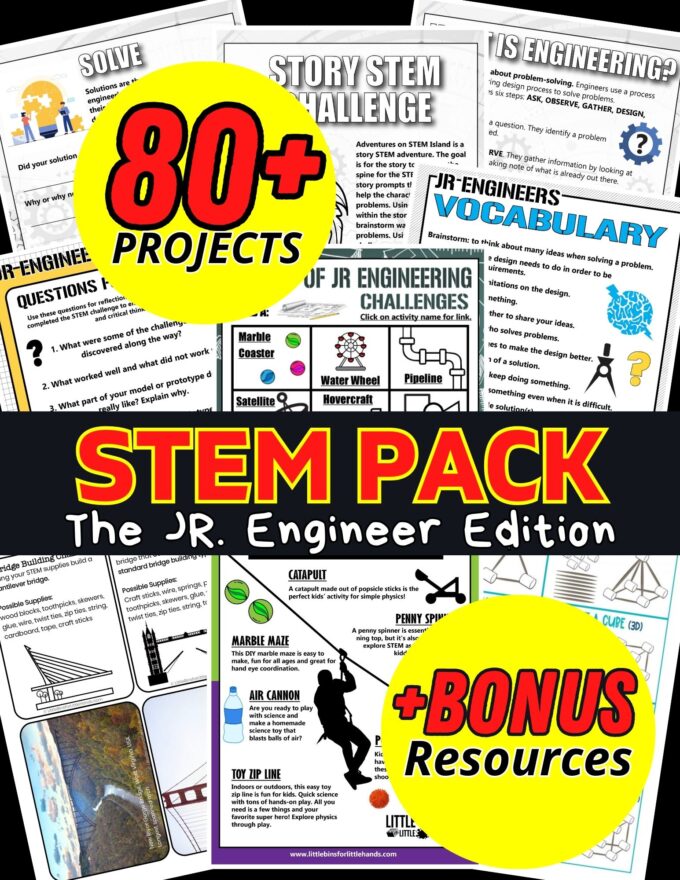
80+ Doable Engineering Projects in one convenient pack!
- Full instructions with sample images
- Activity-specific instruction sheets
- Data Collection Sheets
- Questions for Reflection
- Architecture Building Cards: Try the tallest tower challenge
- Bridge Building Cards: Explore different types of bridges to build your own.
- Paper Chain STEM Challenge: Who can make the longest chain? Great icebreaker or quick challenge!
- 3 Little Pigs Architectural Pack: Design a house that won’t blow away!
- Great marshmallow challenge: A classic challenge kids love!
- Real-world STEM challenge lesson but don’t know where to start? Our easy-to-follow template shows the steps!
- What’s the difference between a scientist and an engineer?
- Crossword and word search with engineering vocabulary.
- Engineering vocabulary cards
- Design a one-of-a-kind invention and write about it with this 5-page activity!


I thought about doing this activity when Caden tried to stick a toothpick into a ball of foil! But I think he would rather eat the marshmallows than play with them. It’s one of his favorite treats! LOL
Cute! That little ice cube tray is so cool and is perfect for the marshmallows! Looks fun!
I love how flexible and versatile this activity is – lots of possibilities!
this is awesome! adding marshmallows to my shopping list 😀 although, i wonder if there will be any by the time we get home.. hehe
Love the fine motor work going on here! So cute! 🙂
Great classic fine motor activity! We did this while reading Mike Mulligan & His Steam Shovel and made some 3D shapes, too!
That sounds fun!
Thanks Claire! There are so many fun ways to work on fine motor skills!
Yea, there’s a bit of restraint involved but great for hot chocolate later. Get some rice krispies and you can make it a baking activity too!
Thanks George. I have embraced flexibility in my life. Just roll with it!
Thanks Laura!
I loved the activity using the tweezers with the ice cube tray. Marshmallows are an essential element of a good activity 😉
I love the idea! There are so many variations you can do with toothpicks, marshmallows, tweezers, and ice cube trays. 🙂
I would like to know where I might be able to purchase the tweezers you are showing. I watch my grandson 3 days each week and love doing activities with him. He is 16 months old and those tweezers would be great for his little hands.
This reminds me of my days teaching geometry and having the kids make solids with gum drops and toothpicks. So fun! Thank you for sharing at Sharing Saturday!