
Looking for a simple yet highly engaging STEM challenge for your classroom or homeschool? Try the Paper Tower STEM Challenge! This activity is a fantastic way to introduce students to structural stability, civil engineering, and the engineering design process. Plus, all you need is paper, tape, and a ruler!

Tower STEM Challenge
In this challenge, kids will compete to build the tallest free-standing paper tower possible using limited materials. It encourages critical thinking, creativity, and teamwork while reinforcing key engineering concepts.
💡Find more structural engineering activities here.
Objective:
Build the tallest free-standing structure possible using only a stack of paper and tape.
Time Limit:
Give students 20-30 minutes to design, build, and test their towers.
- STEM Focus: Civil Engineering, Physics (stability and center of gravity), Engineering Design Process
- Grade Level: Perfect for upper elementary through middle school (grades 3-8).
- Concepts Explored: Structural stability, balance, base design, load distribution, iterative testing, and improvement.
Materials Needed:
- 10 sheets of paper
- 12 inches of tape
- Ruler or measuring tape (for testing height)
- Scissors (optional)
Set Up the Paper Tower STEM Challenge
- Set the Goal: Explain to students that the goal is to build the tallest free-standing structure using just paper and tape. The tower must stand on its own without external support.
- Design: Students brainstorm and sketch possible tower designs before starting construction.
- Build: Students fold, roll, or cut the paper to create their structures. Tape is only used to connect paper pieces together—not to stick the structure to the table or floor.
- Test: Once built, measure the height of the towers. The tower must stand independently for at least 10 seconds!
- Redesign: Students can improve their design after testing.

The Engineering Design Process
This challenge is a great way to introduce students to the Engineering Design Process (EDP), which mirrors how real engineers solve problems!
💡 Learn more about the engineering design process here (free printable).
Here are the basic steps of the EDP that your students will follow naturally during this activity:
- Ask: What is the problem? What are the rules? What is the goal?
- Imagine: Brainstorm different ideas and sketch possible designs.
- Plan: Choose a design and create a plan before building.
- Create: Use the materials to build the tower according to the plan.
- Test: Measure the tower’s height and check if it can stand on its own for at least 10 seconds.
- Improve: Based on testing, how can you make the tower taller or more stable? Make adjustments and test again!
This process encourages trial and error, creative problem-solving, and critical thinking—important skills in STEM fields and everyday life.
Paper Tower STEM Challenge Concepts
The Paper Tower STEM Challenge is hands-on and simple, yet packed with real-world learning! Here’s how it helps students explore important STEM ideas in a way that’s easy to understand:
Engineering Design Process: Students naturally follow the steps of the engineering design process—ask, imagine, plan, create, test, and improve. They brainstorm ideas, build their designs, test their towers, and then make changes to improve them. It’s the perfect way to practice problem-solving in a fun and creative way!
Structural Stability: Students quickly discover that some paper towers fall over easily while others stand tall. As they experiment with folding, rolling, or stacking paper, they learn how different shapes and bases make a structure more or less stable.
Civil Engineering: Civil engineers design buildings, bridges, and towers. In this challenge, students act like engineers—solving problems, creating structures, and thinking about height, balance, and strength just like real engineers do!
More Facts for Kids
- The Eiffel Tower’s broad base helps it stay stable despite being extremely tall.
- Many tall buildings use triangular bracing or truss structures to reduce swaying in the wind.
- Engineers often use lightweight but strong materials, like steel and concrete, to balance height and stability.
Discussion Questions:
💡Find a printable list of questions for reflections here.
- What design features made your tower stable or unstable?
- How did the shape of your base affect the height of your tower?
- What would you add or change if you had more materials to make your tower taller or stronger?
- What real-world structures (e.g., skyscrapers, radio towers) use similar engineering techniques?
Extension Activities:
- Try building a tower using only index cards!
- Create a paper bridge challenge using similar rules but focusing on how much weight the bridge can hold.
- Introduce wind (fan) to test how well the tower holds up to external forces.
STEM Activities for Kids
🔎 Discover more ways to play with Paper STEM Projects here.
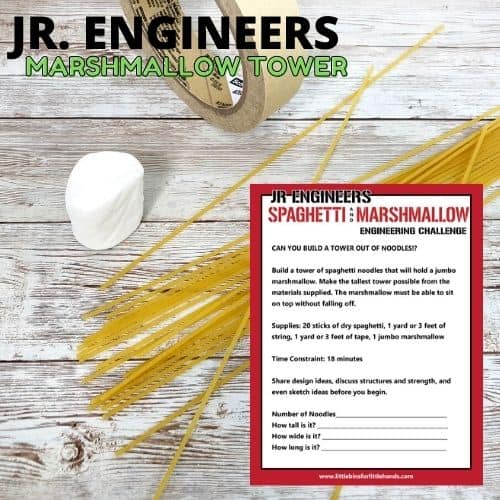
- Marshmallow and Spaghetti Tower Challenge
- Paper Chain STEM Challenge
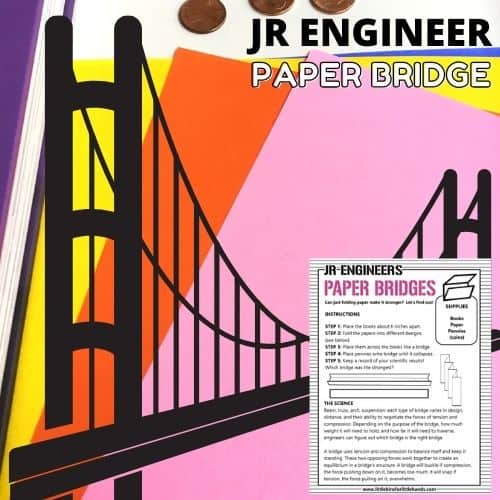
- Paper Bridge STEM Challenge
- Walk Through Paper Challenge
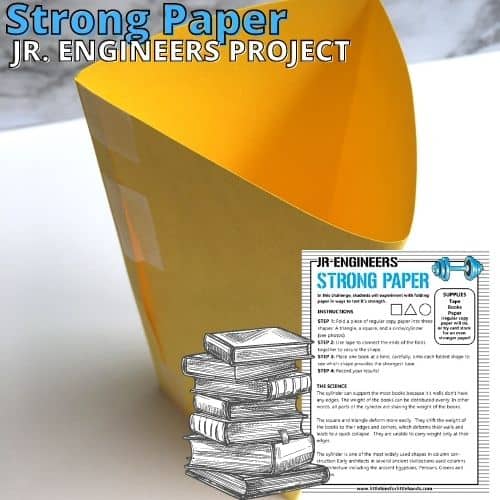
- Strong Paper Shapes
- Paper Grabber STEM Challenge


STEM Resources To Get You Started
Here are a few resources that will help you introduce STEM more effectively to your kiddos or students and feel confident when presenting materials. You’ll find helpful free printables throughout.
- Engineering Design Process Explained
- What Is An Engineer?
- Engineering Words
- Real World STEM
- Questions for Reflection (get them talking about it!)
- BEST STEM Books for Kids
- 14 Engineering Books for Kids
- Jr. Engineer Challenge Calendar (Free)
- Must Have STEM Supplies List
- Join us in the Club
- 80+ Doable Engineering Projects in one convenient pack!