
The Arctic is one of the coldest places on Earth, but it is full of life. In this Arctic animals guide for kids, children learn about Arctic habitats, tundra environments, food chains, and the special adaptations animals need to survive freezing temperatures.

This lesson introduces ecosystems by helping kids understand how plants, animals, ice, and ocean water all work together in one connected environment.
Where Is the Arctic?
The Arctic is the region around the North Pole. It includes parts of Alaska, Canada, Greenland, and northern Europe and Asia.
Unlike Antarctica, which is land covered by ice, the Arctic is mostly frozen ocean surrounded by land. This difference changes how animals live and move.
👉 Compare this with Antarctic animals: Penguin Activities for Kids
The Arctic Is a Biome
The Arctic is one of Earth’s major biomes — large regions with specific climates, plants, and animals. Biomes help scientists group environments so we can understand why certain animals live in certain places.
👉 Learn about biomes for kids
The Arctic Habitat
The Arctic contains several environments that work together.
Tundra
The tundra is land with permanently frozen ground called permafrost.
Because roots cannot grow deep, only small plants such as moss and grasses survive.
Sea Ice
Sea ice floats on the ocean and provides a primary habitat for animals to travel and hunt.
Polar bears depend on this ice to find food.
👉 See how polar bears survive here: Polar Bear Adaptations for Kids

Arctic Ocean
Under the ice live plankton — tiny organisms that feed fish, seals, and whales.
Arctic Food Chain for Kids
An ecosystem works like a chain where each living thing depends on another.
Sun → algae → fish → seals → polar bears
If one level changes, every level changes.
👉 Learn more about food chains for kids
Arctic Animal Adaptations
Animals survive the cold using special features called adaptations.
Common Arctic adaptations:
- blubber insulation
- thick fur
- camouflage coloring
- migration or hibernation
- compact body shapes
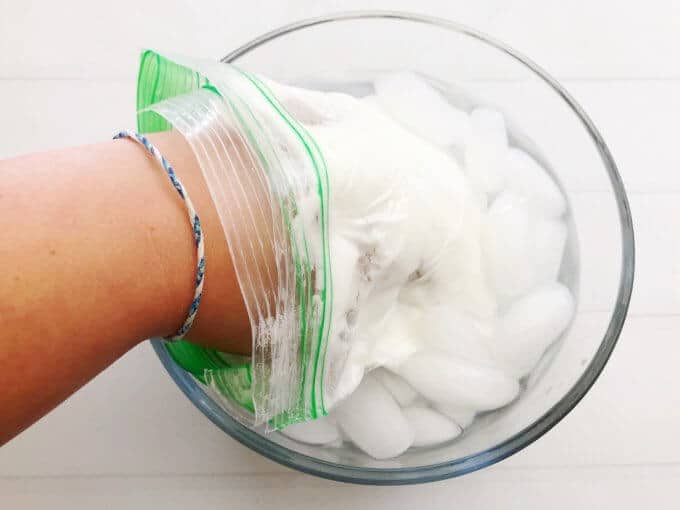
👉 Explore animal adaptations for kids or try a blubber insualtion experiment
Hands-On Activity — Build a Food Web
Give each child an organism card (sun, fish, seal, bear).
Connect them with a string to show energy flow.
Remove the “ice.”
Ask which animals lose food.
Kids quickly see how ecosystems connect.
👉 Build a Winter Food Chain here.

Arctic vs Antarctic
Many kids think penguins and polar bears live together. They do not.
Arctic (North Pole) → polar bears
Antarctica (South Pole) → penguins
Understanding this helps kids learn geography and habitats.
Free Arctic Activity
Help kids sort Arctic vs Antarctic characteristics and animals. Download the free Arctic activity here.
Why the Arctic Matters
The Arctic environment controls global weather and supports many species. When ice conditions change, animals must adapt or move to survive.
Learning about the Arctic teaches kids how environments affect living things.
Continue Learning
See a predator adapted for freezing water:
👉 Polar Bear Adaptations for Kids
Visit the opposite pole:
👉 Penguin Activities for Kids
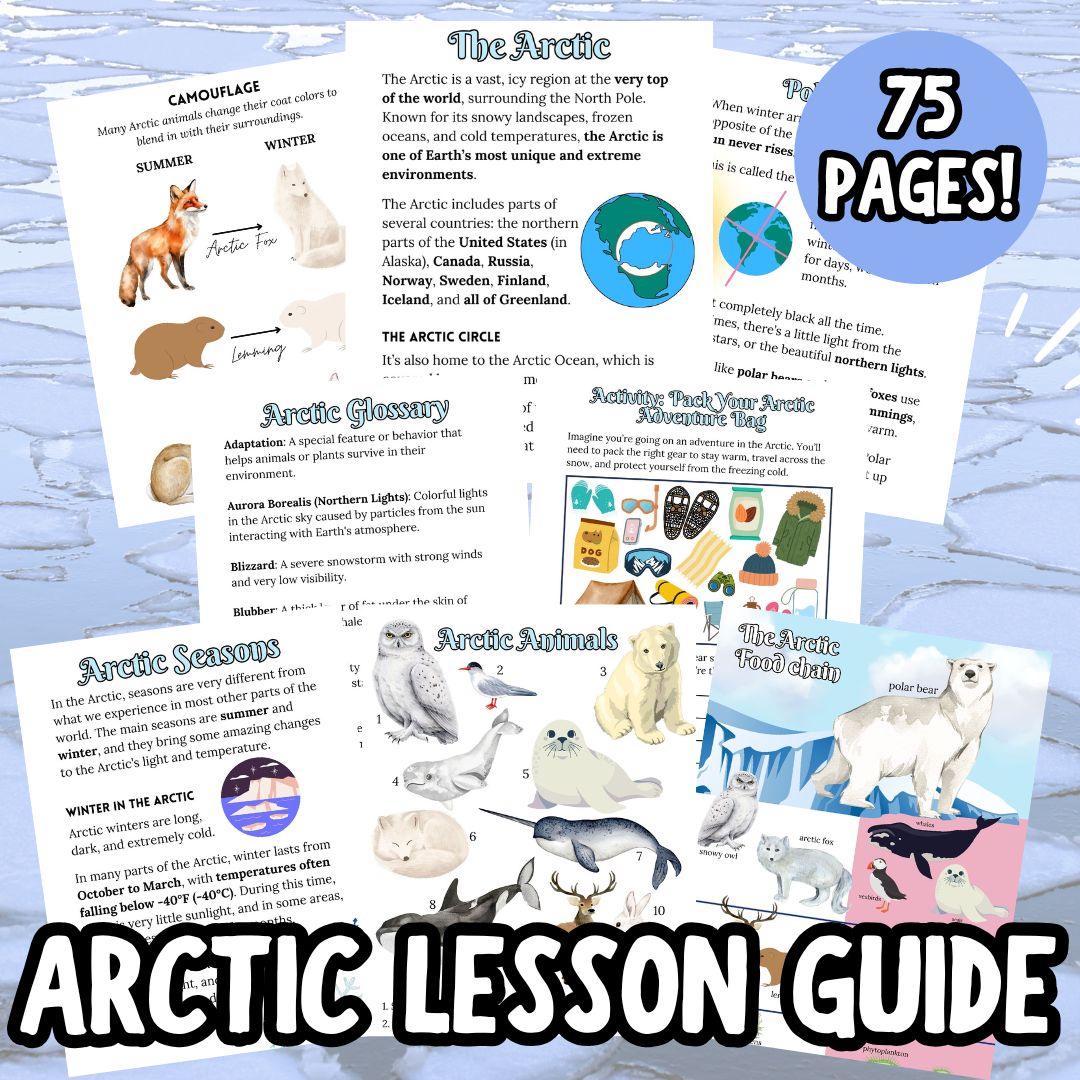
Want the Full Arctic Study?
The printable Arctic unit expands this lesson with animal profiles, sorting activities, and ecosystem learning pages.