
Looking for a hands-on STEM activity that teaches real mechanical engineering concepts?
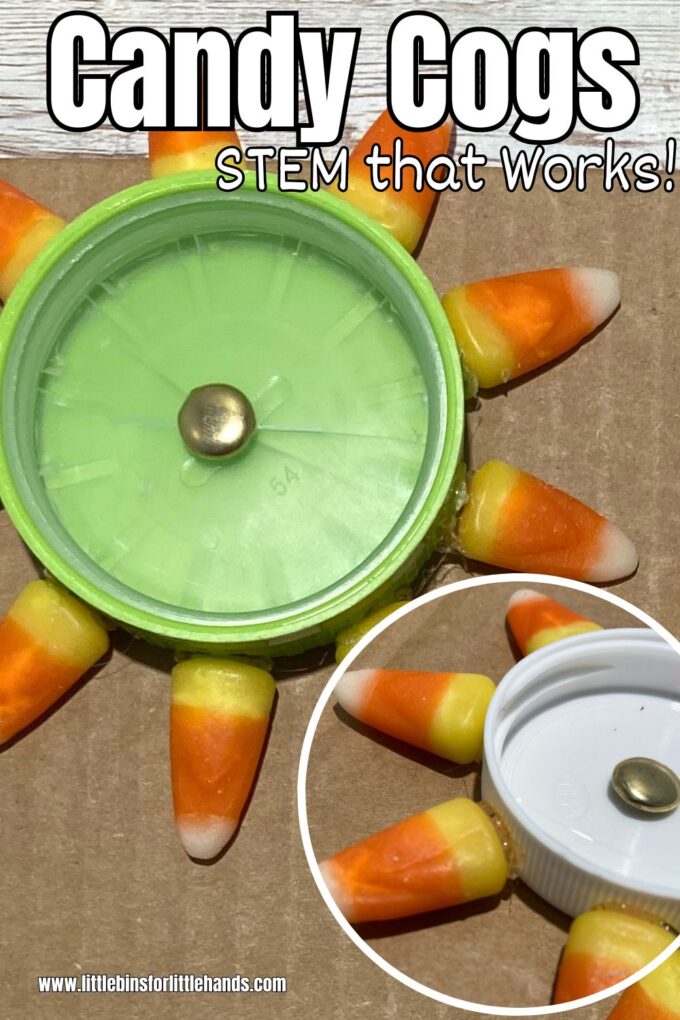
Build a working gear system using candy corn and recycled jar lids. This simple gear STEM activity helps kids explore how gears transfer motion, change speed, and reverse direction. By building and testing their own model, students can see how a gear system works in real-world machines.
Candy Corn Gears STEM Activity
This activity works well for simple machines units, engineering lessons, or hands-on science centers.
- Field of Science: Engineering, Physical Science
- Grade Level: Grades 2–5
- Concepts Explored: Simple machines • Gear systems • Transfer of motion • Gear ratio • Mechanical advantage • Direction of rotation
Supplies Needed
- Round plastic lids (various sizes)
- Hammer and nail
- Candy corn pieces
- Glue
- Brads
- Cardboard
- Marker
How To Make Candy Corn Gears
STEP 1. Draw a dot in the center of each lid.

STEP 2. Carefully pierce a hole through each dot using a hammer and nail.
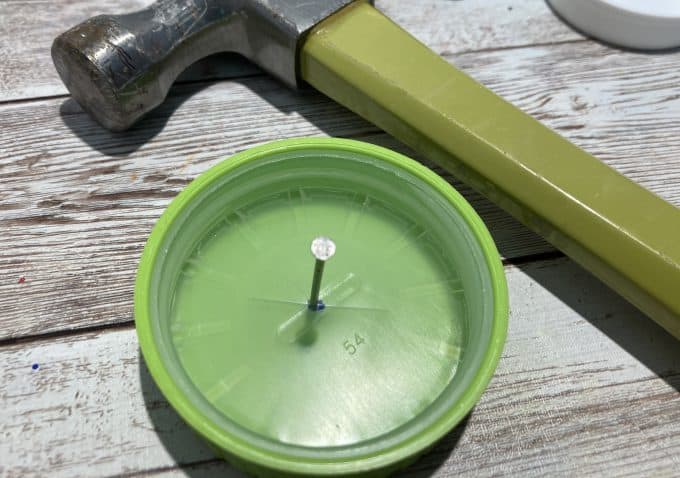
STEP 3. Push a brad through each hole and secure it loosely so the lid can spin.

STEP 4. Glue candy corn pieces evenly spaced around the edge of each lid to form the “teeth.”
STEP 5. Attach your gears to a cardboard base using the brads. Make sure the teeth of one gear fit between those of another.
Challenge Questions
- What happens when you turn one gear?
- Which gear spins faster?
- Does the direction change?
- What happens if one gear is much larger than the other?
- Can you connect three or more gears together?
Encourage students to observe before explaining.

What Is a Gear?
A gear is a circular simple machine with teeth (called cogs) that interlock with another gear to transfer motion and force.
When one gear turns, the connected gear rotates in the opposite direction. Add a third gear and the direction reverses again.
This interlocking system allows machines to control motion efficiently.
What Is a Gear System?
A gear system is two or more gears working together to change:
- Speed
- Force (torque)
- Direction of motion
Smaller gears rotate faster because they have fewer teeth. Larger gears rotate more slowly but can increase torque. This relationship is called gear ratio.
This simple candy model demonstrates how real machines like bicycles, clocks, cars, and factory equipment transfer motion.
This classroom model is designed for STEM learning, not industrial manufacturing.
Why This Is Mechanical Engineering
Mechanical engineering focuses on how moving parts work together to transfer motion and force.
This candy corn gears STEM activity demonstrates:
- Rotational motion
- Energy transfer
- Mechanical advantage
- Motion control
Building a hands-on model helps students visualize how gear systems operate in real-world machines. This activity fits perfectly into a simple machines unit or a larger engineering design lesson.
Vocabulary
Gear – A toothed wheel that transfers motion.
Cog – The tooth on a gear.
Rotation – Turning around a center point.
Gear Ratio – The relationship between connected gears that affects speed and torque.
Torque – The force that causes rotation.
Make It a Science Fair Project
Turn this candy corn gears STEM activity into a full investigation by testing one variable at a time.
Possible experiment questions:
- How does gear size affect rotation speed?
- How does the number of teeth change performance?
- How many gears can be connected before motion slows?
- Does spacing between teeth impact movement?
Have students:
- Form a testable question
- Keep one variable constant
- Measure rotations
- Record data
- Redesign and improve
This transforms a seasonal activity into a true mechanical engineering experiment.
Extension Ideas
- Compare cardboard gears to candy corn gears.
- Measure how many rotations occur in 10 seconds.
- Add a hand crank to create a full working mechanism.
- Try different sizes of recycled lids.
Explore More Simple Machines & Engineering Projects
If your kids enjoyed building candy corn gears, try more hands-on mechanical engineering activities that explore how simple machines transfer force and motion.
- Pulley System STEM Challenge – Investigate mechanical advantage and lifting force.
- Hand Crank Winch – Explore rotational motion and torque.
- Paper Grabber (Lever System) – Build a working lever and test force.
- Archimedes’ Screw – Discover how this ancient simple machine moves water upward.
- Paper Tower Challenge – Test structural stability and design improvements.
👉 Looking for a full collection of hands-on builds? Visit our Engineering Projects Hub to explore simple machines, forces, motion, and mechanical design activities for grades K–5.