

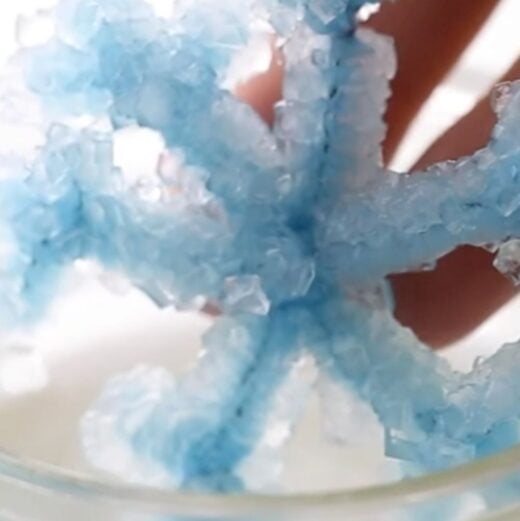
Growing crystal snowflakes is a fun, hands-on science activity that combines creativity with real chemistry. As kids make these sparkling crystal snowflake ornaments, they observe how crystals form, explore crystal growth over time, and learn how supersaturated solutions work.
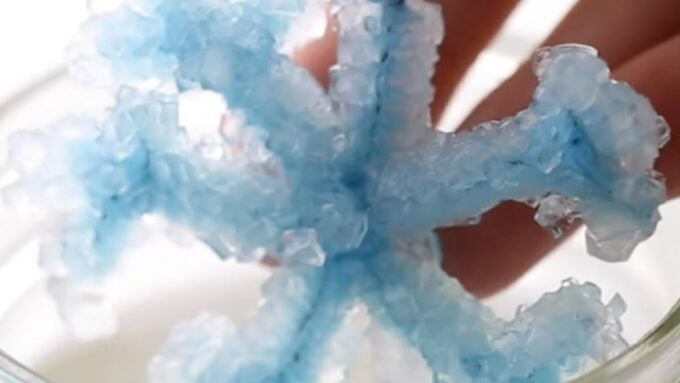
Before starting, it helps to understand what crystals are and why they grow in repeating patterns. If crystal science is new to your students, our What Are Crystals? guide provides a simple explanation of crystal structure and formation.
This crystal snowflake experiment uses simple materials like borax, pipe cleaners, and hot water, making it an easy and engaging winter science activity for home or the classroom.
💡 We love winter science activities for kids because they pair seasonal creativity with real scientific concepts.
How to Make Crystal Snowflakes
Since this experiment uses very hot water, adult supervision is required. My son observed while I measured, stirred, and poured the solution. Older children may be able to help more independently.
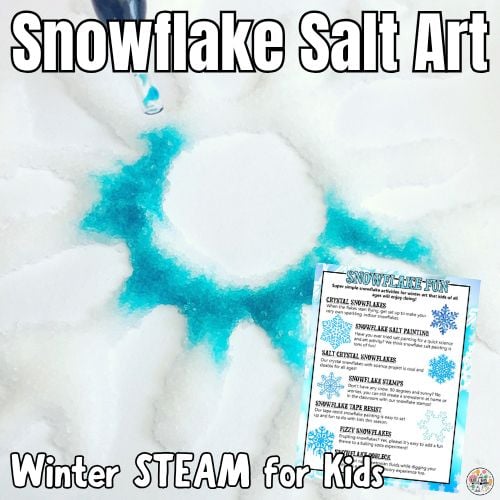
If you’d like a hands-on crystal option without boiling water, try our salt crystal snowflakes instead.
Supplies
- Borax (found in the laundry detergent aisle)
- Water
- Glass jars or vases
- Craft sticks or pencils
- String or ribbon
- Pipe cleaners
Step 1: Make a Pipe Cleaner Snowflake
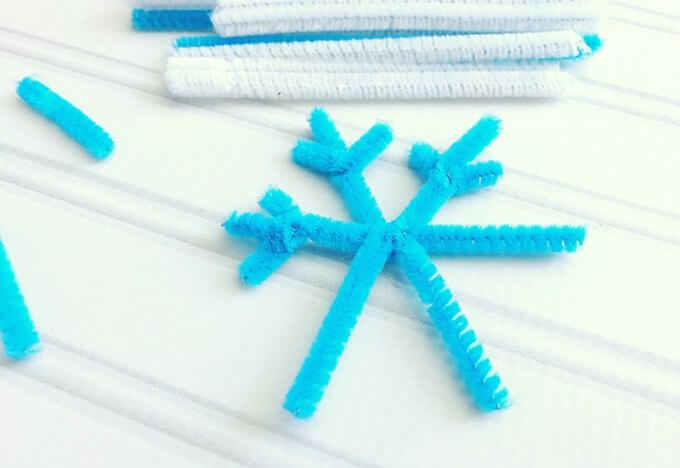
Cut one pipe cleaner into thirds. Stack the pieces, twist them in the center, and spread the six arms to form a snowflake.
Cut six small 1½-inch pieces of pipe cleaner and twist one onto each arm to add more detail to the snowflake.
Step 2: Add the String
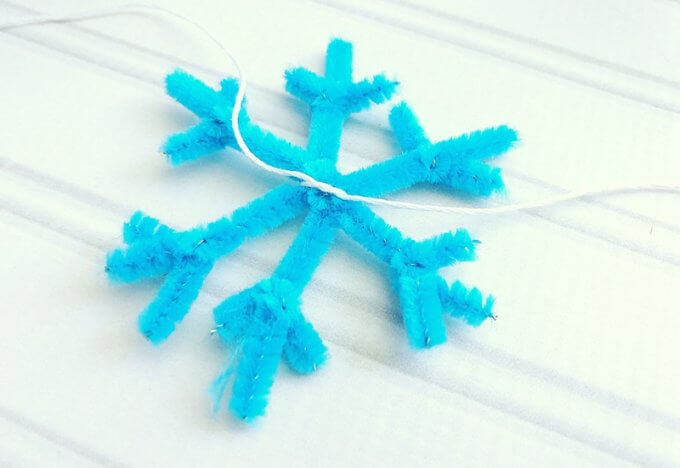
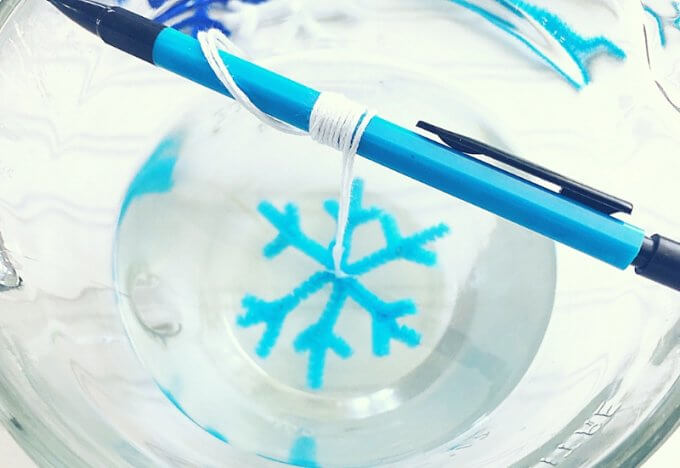
Tie a long piece of string to the center of the snowflake and wrap the other end around a pencil or craft stick.
For icicles, wrap the pipe cleaner around a marker to create a spiral shape. Any design works well — we’ve even made crystal gingerbread men by wrapping pipe cleaners around cookie cutters.
🔎 Want to learn more about snowflakes? Check out these snowflake facts.
Crystal Snowflake Tips
- Check jar size first. Make sure your snowflake fits easily inside the jar before lowering it in.
- Adjust string length. The snowflake should hang freely without touching the sides or bottom of the jar.
Step 3: Make the Borax Solution
Dissolve 3 tablespoons of borax powder for every 1 cup of boiling water. This creates a supersaturated solution, which is essential for crystal growth.
🛑 Adult assistance is required for this step.
When water is heated, its molecules move farther apart, allowing more borax to dissolve than would be possible at room temperature. As the solution cools, the excess borax particles begin to come out of solution and attach to available surfaces.
🔎 This crystal growth is a physical change, meaning no new substance forms — the borax particles simply rearrange into a crystal structure.
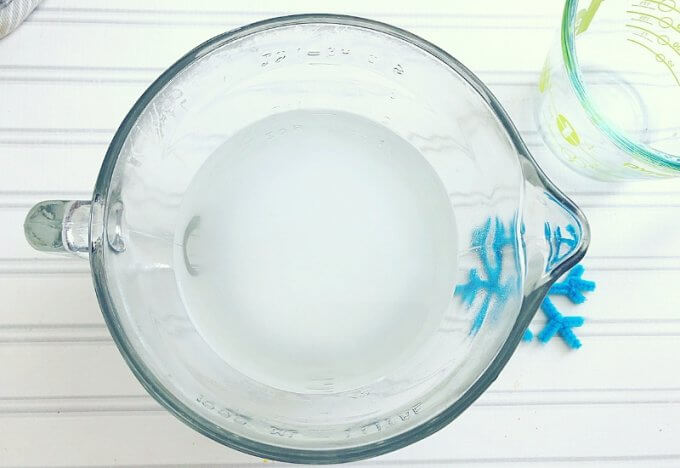
Step 4: Grow Your Crystal Snowflakes
Carefully lower the snowflake into the jar so it is fully submerged but not touching the sides or bottom.
Place the jar in a quiet, undisturbed area. Do not stir, move, or tug on the string. Crystal growth works best when the solution remains completely still.
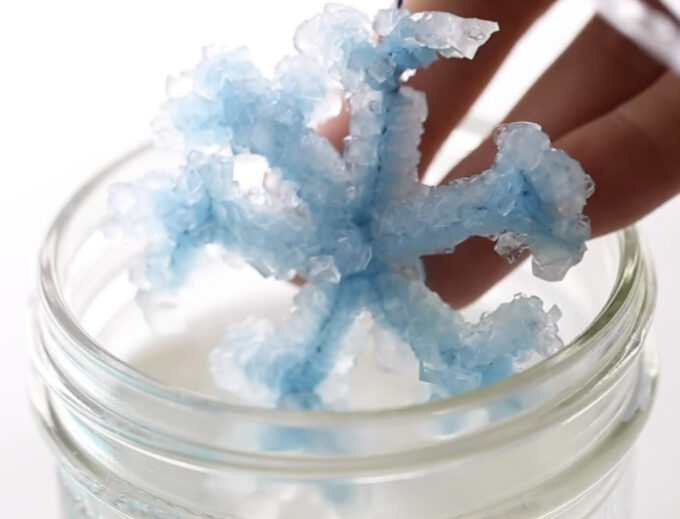
Within a few hours, you’ll start to see crystals forming. Leave the jar undisturbed for 24 hours to allow the crystals to fully grow.
Step 5: Dry the Crystal Ornaments
The next day, gently lift the crystal snowflake out of the solution and place it on paper towels to dry for about an hour.
Once dry, hang your crystal snowflake ornaments on a tree, in a window as a sun catcher, or use them as winter decorations.
Tips for Growing Crystals in the Classroom
This activity works well in classrooms with a few adjustments. When we made crystal hearts in a 2nd-grade classroom, we used very hot (not boiling) water and plastic party cups.
Plastic containers cool faster than glass, which can cause crystals to form more quickly but less evenly. While this may lead to smaller or less perfect crystals, students can still clearly observe the crystal growth process.
🔎 Remind students not to touch or move the cups once the experiment begins. Crystals need time and stillness to form properly.
The Science of Growing Borax Crystals
This experiment begins with a supersaturated solution, meaning the liquid holds more dissolved material than it normally can at room temperature.
As the solution cools, the excess borax particles leave the solution and attach to the pipe cleaner. Over time, these particles arrange themselves into repeating patterns, forming visible crystals.
Slow cooling produces larger, more defined crystals, while faster cooling can trap impurities and create smaller crystal structures.
🔎 This crystal snowflake activity is one example of crystal growth. Explore more hands-on crystal experiments for kids to compare different materials, shapes, and growth conditions.
Field: Physical Science — Matter & Its Interactions
Grades: 2–5
Concepts Explored:
Matter can change form without becoming a new substance; crystals form through physical changes; temperature affects how materials dissolve and crystallize; patterns in nature can be observed and explained.
Snowflake Science Extension Activities
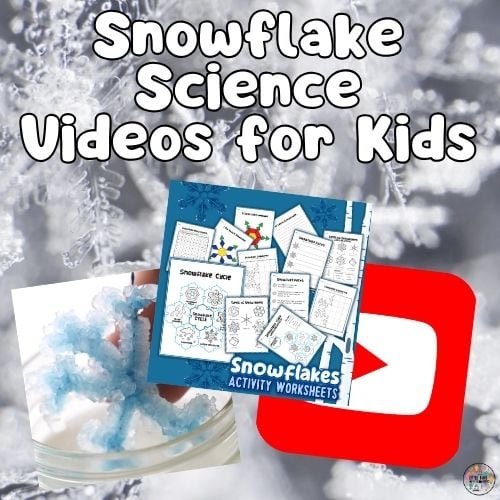
Reinforce crystal and snowflake concepts with hands-on worksheets that help students observe patterns, symmetry, and crystal shapes found in real snowflakes.
Our Snowflake Activity Worksheets include:
- The snowflake cycle (how snowflakes form)
- Types of snowflakes (plates, dendrites, columns, and more)
- Snowflake symmetry activities
- Snowflake facts pages
- Writing and observation prompts
These activities pair perfectly with crystal snowflake experiments and are ideal for classroom science centers, winter units, or homeschool lessons.
🔎 Grab the Snowflake Activity Worksheets here.

More Crystal Projects to Try
More Snowflake Activities to Try
Looking for structured snowflake science activities? Our Snowflake Activity Worksheets help kids explore snowflake formation, crystal shapes, and symmetry.
- Snowflake Oobleck
- Snowflake Slime
- Salt Painting Snowflakes
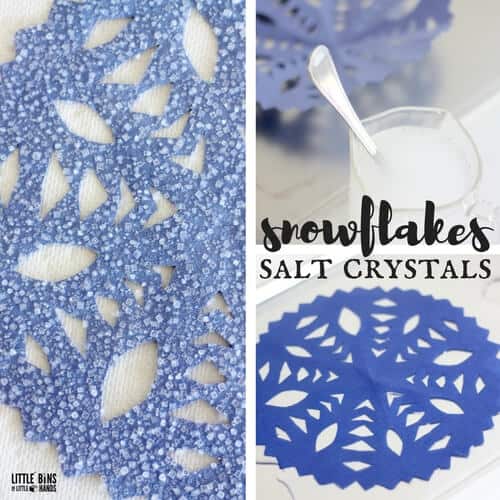
- Snowflake Salt Crystals
- 3D Paper Snowflakes
- Pollock Snowflakes
- Snowflake Science Videos
Extend Your Winter Learning
If your kids enjoyed this winter activity, explore our Winter STEM Pack—a collection of hands-on winter science and STEM activities with printable instructions, recording pages, and extension ideas. It’s perfect for homeschool, classroom centers, or seasonal learning.

I just saw this on Pinterest — and pinned it. This is such a great idea — and so beautiful! I absolutely love the icicles. I’m going to make some with my grandchildren.
I invite you to share this idea at my Party in Your PJs link party on my Grandma Ideas site http://grandmaideas.com. I think that my readers will like this idea as much as I do. Feel free to share a couple more links, too.
My party runs through Sunday night at Midnight. I hope to see you there!
Warmest regards,
Nina
Thank you! Plus it really is just so easy to make!
This is really a great idea & to think I found it by chance ! My little students will love making these during their
Holiday . Thank you !
Thank you! have fun!
It’s so perfect for kids of all ages to enjoy. Glad you found us!
Love these! Can I suggest one change though? Borax can be dangerous for little ones by ingestion (or pregnant women!) so you can use alum instead!! You can get it off Amazon, it’s used in pickling so it’s not as toxic.
I wish more bloggers knew and wrote about the potential hazards of borax!!
can you do this in plastic cups? does it have to be in glass????
You can do it in plastic cups. We did with a group of kids that way. The mixture does cool down faster resulting in less stable crystals though.
Im in charge of our art projects in my pre k class. This is a really cool idea and was wondering if it would be possible to premake the solution the day before, then have the kids make their pipe cleaner snowflakes and insert it the next day. I have no place to boil water in class and cant have 4 year olds around boiling water. I love this idea and want to make it work if possible.
Hello! I love this idea!. Thank you for the great tutorial! I have a quick question for you. What would you say is the learning outcome for this activity? In order for me to do it with my class, my director will want me to tell her specifically what the children will learn. I am thinking fine motor skills while shaping the snowflakes, but I know there is more here! I am drawing a blank. Any suggestions? Thank you again!
Hi, Did you read through the science portion of the experiment? This is a fun Chemistry experiment for STEM and yes they can “design” their own snowflakes. They will also learn abut mixtures, saturated solutions, how crystals form…. You can compare it to our salt crystal activity and set the two up separately and contrast/compare them…
I tried this yesterday with my 5 year old as we are studying crystals in minerals in science. I’m a bit confused about the 1:1 ratio. We did everything exactly as you said using 8 cups of boiling water and 8 TBSP Borax. We left it totally alone and this morning there are no crystals at all. Did you mean 1 cup water to 1 CUP Borax for the 1:1 ratio? We’d like to try again. Just disappointed trying to figure out what went wrong. Do you need to let the water and borax boil together for awhile? Thanks for your help!
Many apologies, this was written incorrectly. You need 3tbsp per 1 cup of water!
Unfortunately, this would not work well for growing crystals. I would suggest for this age group that you try our salt crystal variation. With either recipe, you could use a coffee urn filled with very hot water though. We did this with my son’s 2nd-grade class. You will not get as wonderful results but you will see some crystals grow. The salt crystal ingredients are more friendly if you have kids who will put their fingers in their mouths during the process.
What can I use as a substitute for borax. I see someone posted alum. How can I do this?
I have seen alum used but it is expensive in bulk. You can also use salt. We have salt crystal snowflakes too.