
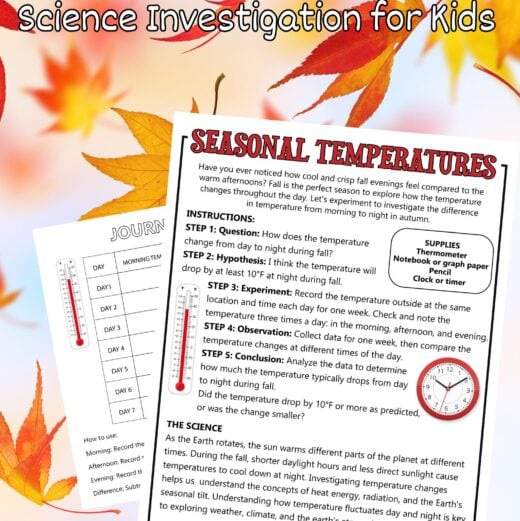
Fall temperatures can change quite a bit from morning to afternoon and again by evening. Instead of checking the temperature once, turn those changes into a simple science investigation kids can follow over several days.
In this fall temperature experiment, students use a thermometer to collect real weather data, compare temperatures at different times of day, and look for patterns. Start with one week, or keep the investigation going for a full month to see even bigger changes as fall progresses.
Field: Earth Science
Grades: 2–5
Concepts: Temperature, weather observation, measurement, data collection, patterns, seasonal change
Fall Temperature Investigation
The main question for this investigation is: How does the temperature change throughout the day during fall?
Students measure the outdoor temperature in the same location during the morning, afternoon, and evening. They record their measurements and compare the results over time.
Supplies
- Outdoor thermometer
- Fall Temperature Observation Sheet
- Pencil
- Clock or timer
- Science notebook, optional

How to Set Up the Temperature Experiment
1. Choose your question.
Start with: How does the temperature change from morning to evening during fall?
Older students can turn this into a more specific question, such as: How much does the temperature usually change between afternoon and evening?
2. Make a prediction.
Ask students what they think will happen.
For example: I think the afternoon temperature will usually be warmer than the morning and evening temperatures.
3. Choose one observation location.
Take each temperature measurement in the same place. Avoid switching between sunny and shady locations, as this can affect the results.
4. Record the temperature three times each day.
Check the temperature in the:
- Morning
- Afternoon
- Evening
Try to measure at approximately the same times each day.
5. Continue for at least one week.
Record each measurement on the temperature tracker.
6. Compare the results.
Look across the week and see what patterns appear.
💡 The original investigation also provides an opportunity for older students to identify variables, including time of day as the independent variable and temperature as the dependent variable.
What Can Kids Notice About Temperature?
After several days of observations, ask students to look beyond individual numbers.
- Which time of day was usually warmest?
- Which was coolest?
- Was the warmest day also warm in the morning?
- Did temperatures change by about the same amount every day?
- Were there any days that did not follow the usual pattern?
This turns a basic temperature activity into a real weather observation investigation.
Keep the Investigation Going for a Month
One week gives students a useful snapshot of fall weather, but a full month of temperature observations can reveal much more.
Continue taking measurements several times each week and add them to a science notebook or weather journal.
Over a month, students may begin to notice:
- Cooler morning temperatures
- Changes in afternoon highs
- Larger or smaller differences between daytime and evening temperatures
- Unusually warm or cool days
- Overall changes as fall progresses
💡 A longer investigation also gives kids more data to graph, compare, and discuss.
Start a Fall Science Journal
This temperature investigation is an easy introduction to a longer-term science project.
Instead of completing an experiment in one sitting, kids revisit the same question, take repeated measurements, and build a collection of observations over time.
Add the temperature tracker to a science journal or notebook along with:
- Weather notes
- Cloud observations
- Drawings
- Questions
- Wind observations
- Changes in plants or leaves
- Predictions for the next day
👉 Explore our Observation Activities for Kids for more ways to help students slow down, notice details, and record useful science observations.
Why Does Temperature Change During the Day?
The Sun warms Earth’s surface during the day.
Temperatures are often cooler in the morning after the ground has lost heat overnight. As sunlight warms Earth’s surface, temperatures generally rise. Later in the day and evening, temperatures begin to drop again as less solar energy reaches the surface.
Fall also brings seasonal changes in sunlight, which contribute to cooler temperatures as the season progresses.
💡 This makes temperature a useful way for kids to investigate both daily weather changes and longer seasonal patterns.
Weather vs. Climate
This investigation records weather.
- Weather describes conditions we experience over short periods of time, including temperature, wind, clouds, and precipitation.
- Climate describes typical weather patterns measured over much longer periods.
One week or even one month of temperature data cannot tell students that the climate is changing, but it can introduce the idea that scientists collect weather observations over long periods to identify larger patterns.
Add More Fall Weather Observations
Temperature is only one part of the weather.
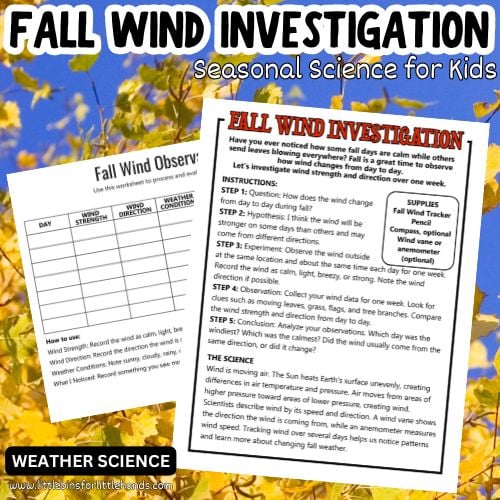
Pair this activity with our Fall Wind Investigation and have students track wind strength, wind direction, and temperature during the same week.
You can also add:
- Cloud observations
- Rainfall
- Wind direction
- Wind speed
- Sunrise and sunset observations
👉 Visit our Fall Weather Science Activities for more ways to investigate changing fall weather.
Extend the Temperature Investigation
- Graph the temperatures. Create a simple line graph showing morning, afternoon, and evening measurements.
- Compare two weeks. Does the second week look different from the first?
- Track for a month. Look for larger changes as fall progresses.
- Compare locations. Measure in the sun and shade or in two different outdoor locations.
- Compare seasons. Repeat the same temperature investigation in winter, spring, or summer.
- Add weather tools. Make a Wind Vane, Rain Gauge, or Anemometer and begin collecting several types of weather data.
👉 Older kids will enjoy setting up a homemade weather station!

Guiding Questions
- When was the warmest temperature recorded?
- When was the coolest?
- How much did the temperature change during one day?
- Did every day follow the same pattern?
- What weather conditions did you notice on unusually warm or cool days?
- What patterns appear after one week?
- Do you notice different patterns after one month?
Free Fall Temperature Investigation
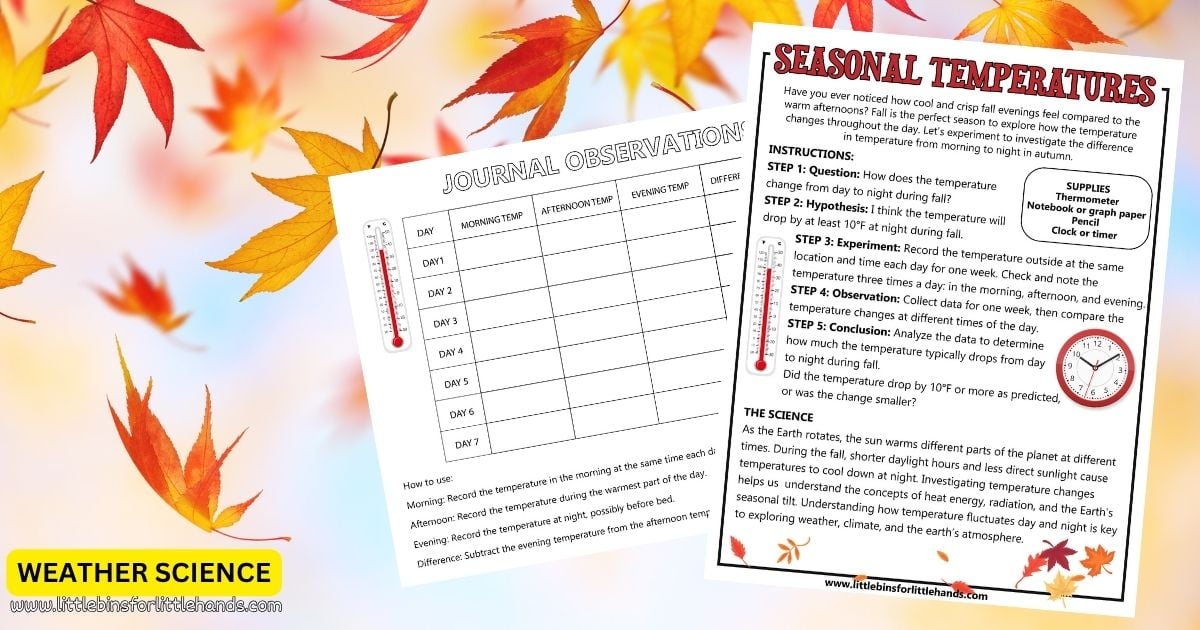
Grab the free Fall Temperature Investigation printable to record morning, afternoon, and evening temperatures and compare how they change.
GET THE FREE TEMPERATURE INVESTIGATION →
Use it for one week or keep it in a science notebook and continue tracking temperatures throughout the month.
FAQ
What is a temperature investigation? A temperature investigation has students measure and record temperatures over time, compare the results, and look for patterns or changes.
What grade is this temperature experiment for? This activity works especially well for grades 2–5. Younger students can focus on measuring and comparing, while older students can graph data and work with variables.
How long should you track temperature? One week is enough for a simple investigation. Tracking for a full month gives students more data and makes longer-term weather patterns easier to notice.
When should students measure temperature? Morning, afternoon, and evening measurements make it easy to compare how temperature changes during the day. Try to measure at similar times and in the same location.
Is this a weather or climate activity? It is primarily a weather investigation. Long-term weather records can eventually be used to study climate, but a week or month of observations represents local weather data.
Want the Full Fall Investigation Lab?
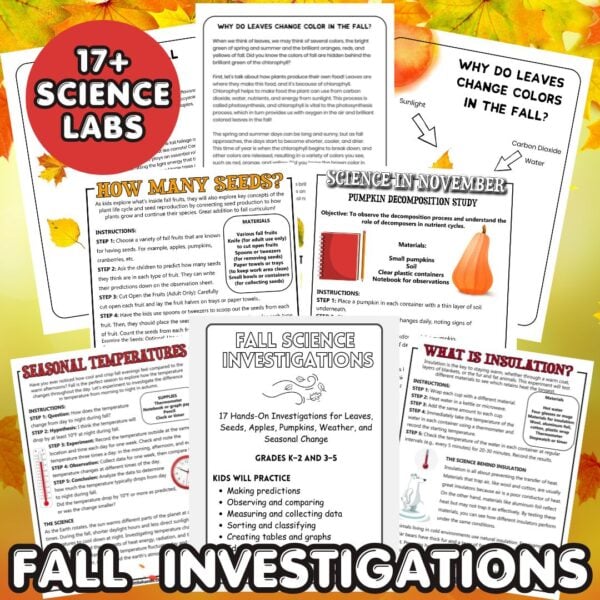
If you want more than the free wind investigation, the Fall Investigation Lab brings together seasonal science activities you can use across several weeks.
It’s designed for simple, observation-based fall science with printable recording pages and investigations that help kids collect data, compare changes, and look for patterns.
GET THE FALL INVESTIGATION LAB →
It’s also included in the All-Access Pass.
More Fall Science
Visit our Fall Science Activities hub for hands-on seasonal experiments and investigations.
Explore our Fall Weather Science Activities for more ideas involving temperature, wind, clouds, weather tools, and changing conditions.
Our Fall Life Science Activities also explore leaves, seeds, trees, migration, hibernation, animal behavior, and how living things respond to seasonal changes.
Try next:
- Fall Wind Investigation
- Pine Cone Weather Experiment
- DIY Anemometer
- DIY Wind Vane
- Rain Gauge
- Cloud Viewer